Difference between revisions of "Chamaerop humilis var. argentea"
Geoff Stein - Author & Editor
| Line 6: | Line 6: | ||
''Chamaerops humilis var. cerifera'' | ''Chamaerops humilis var. cerifera'' | ||
| − | + | <center> | |
{| colspan="2" style="background: #FCFCFC; border: 1px solid black; vertical-align: top;" | | {| colspan="2" style="background: #FCFCFC; border: 1px solid black; vertical-align: top;" | | ||
| style="width: 50%; background: #f8e8df; border: 1px solid black; vertical-align: top;" | | | style="width: 50%; background: #f8e8df; border: 1px solid black; vertical-align: top;" | | ||
| Line 39: | Line 39: | ||
*'''Availability''': moderately common (often sold at garden outlet stores) though large plants costly | *'''Availability''': moderately common (often sold at garden outlet stores) though large plants costly | ||
|} | |} | ||
| + | {{#Widget:AdResBan}} | ||
<gallery> | <gallery> | ||
File:Chamaerops argentea aka cerifera trimmed cloudey day.JPG|San Fernando valley, California | File:Chamaerops argentea aka cerifera trimmed cloudey day.JPG|San Fernando valley, California | ||
Latest revision as of 18:36, 31 July 2015
Common Name: Blue Mediterranean Fan Palm
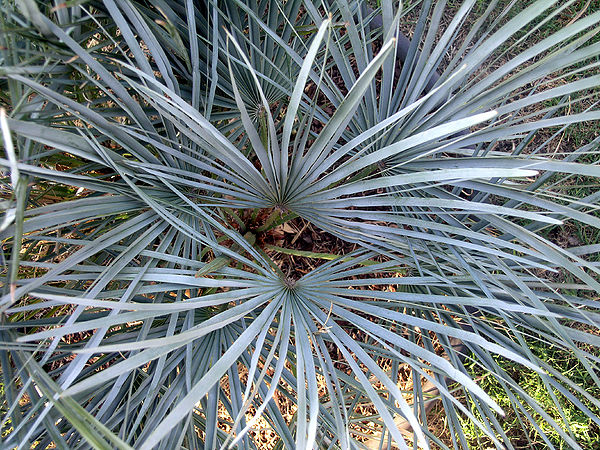
Chamaerops humilis var. argentea is listed here separately as it is such a beautiful and somewhat unique form of this plant and rapidly becoming one of the more popular palms in California. Though many gray, waxy and somewhat glaucous forms of Chamaerops humilis exist in cultivation all over California, this form seems so strikingly blue and they grow a lot slow and ultimately are smaller, that it is getting a separate entry here. However, if grown under extreme conditions of drought, heat and high winds, a lot of the blue coloration gets wiped from the leaves and the resulting plants look disappointingly ordinary- these now greener plants still grow agonizingly slow unlike their naturally green counterparts, though. Note that seeds from this variety often grow into ordinarily green plants. True var. argenteas are strikingly blue from small seedling stages.
Chamaerops humilis var. cerifera
|
Appearance and Biology
|
Horticultural Characteristics
|

San Fernando valley, California
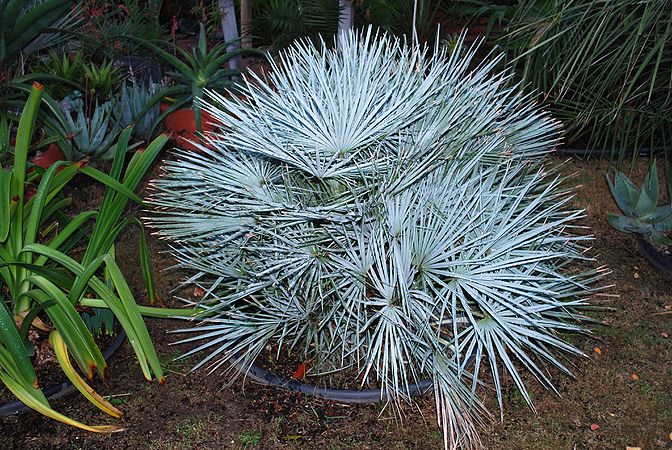
flash shot illuminating reflective coloration

Orange county, California

Palm Desert, California
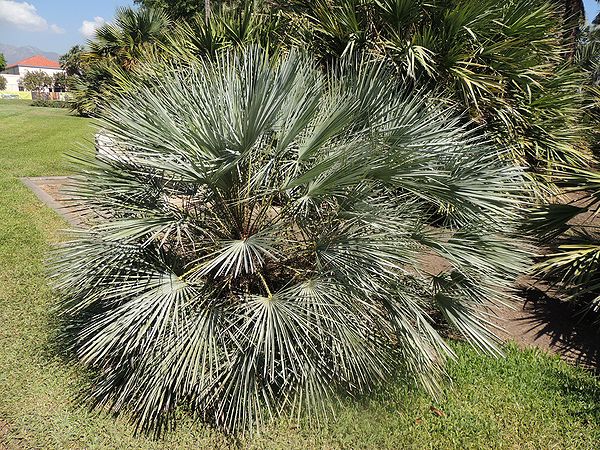
Huntington Gardens, near Pasadena, California

Los Angeles arboretum near Pasadena, California
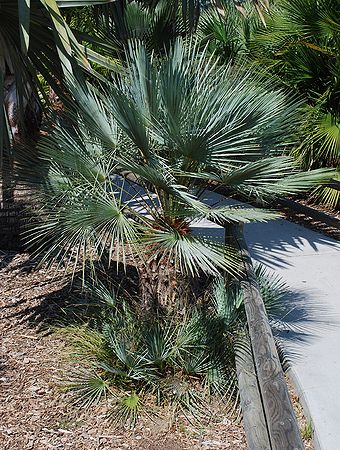
Orange county, California
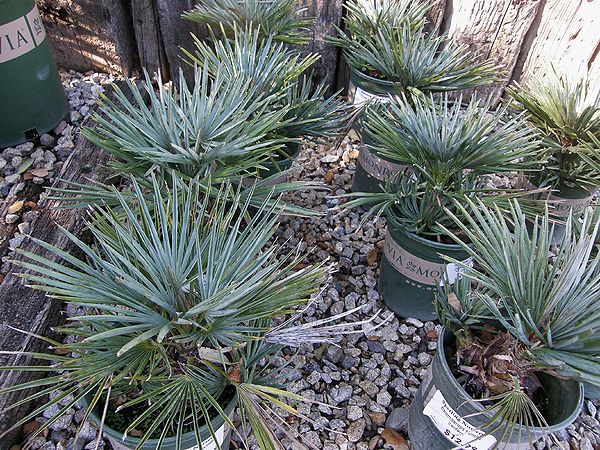
nursery plants, California


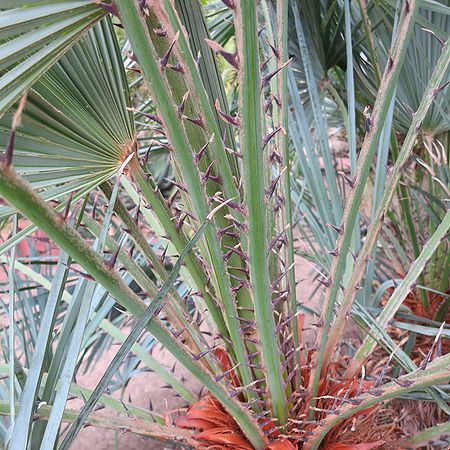
note petiolar teeth angle and color- not like 'normal' Chamaerops humilis


