Difference between revisions of "Bentinckia condapanna"
Geoff Stein - Author & Editor
| Line 4: | Line 4: | ||
</center> | </center> | ||
'''''Bentinckia condapanna''''' is one of the most recent, wonderful surprises for Californians in terms of successful growing of a palm that was assumed to be way too tropical. And amazingly, this is the better looking of the two known species of this palm, the other having long since been proved to be far too tropical in its needs to survive in a Mediterranean climate. This strikingly colorful but highly endangered palm from India has become very popular among palm enthusiasts in the tropics so it is not surprising that California palm growers have been trying this one, too. It is still a marginal palm, but one that seems to be doing well in numerous palm gardens in zone 10b, and amazingly seems to be a relatively fast palm (for a 'slow' palm), with some California specimens already starting to form early trunks. The bright orange to yellowy petioles, dense white patina on the leaf bases and crownshaft, the reddish orange new leaf spikes, closely prominently spaced rings on the green trunk and the attractively arching pinnate leaves are making this one of the most colorful and exciting palms for California. | '''''Bentinckia condapanna''''' is one of the most recent, wonderful surprises for Californians in terms of successful growing of a palm that was assumed to be way too tropical. And amazingly, this is the better looking of the two known species of this palm, the other having long since been proved to be far too tropical in its needs to survive in a Mediterranean climate. This strikingly colorful but highly endangered palm from India has become very popular among palm enthusiasts in the tropics so it is not surprising that California palm growers have been trying this one, too. It is still a marginal palm, but one that seems to be doing well in numerous palm gardens in zone 10b, and amazingly seems to be a relatively fast palm (for a 'slow' palm), with some California specimens already starting to form early trunks. The bright orange to yellowy petioles, dense white patina on the leaf bases and crownshaft, the reddish orange new leaf spikes, closely prominently spaced rings on the green trunk and the attractively arching pinnate leaves are making this one of the most colorful and exciting palms for California. | ||
| − | + | <center> | |
{| colspan="2" style="background: #FCFCFC; border: 1px solid black; vertical-align: top;" | | {| colspan="2" style="background: #FCFCFC; border: 1px solid black; vertical-align: top;" | | ||
| style="width: 50%; background: #f8e8df; border: 1px solid black; vertical-align: top;" | | | style="width: 50%; background: #f8e8df; border: 1px solid black; vertical-align: top;" | | ||
Revision as of 20:35, 26 July 2015
Common Name: none
Bentinckia condapanna is one of the most recent, wonderful surprises for Californians in terms of successful growing of a palm that was assumed to be way too tropical. And amazingly, this is the better looking of the two known species of this palm, the other having long since been proved to be far too tropical in its needs to survive in a Mediterranean climate. This strikingly colorful but highly endangered palm from India has become very popular among palm enthusiasts in the tropics so it is not surprising that California palm growers have been trying this one, too. It is still a marginal palm, but one that seems to be doing well in numerous palm gardens in zone 10b, and amazingly seems to be a relatively fast palm (for a 'slow' palm), with some California specimens already starting to form early trunks. The bright orange to yellowy petioles, dense white patina on the leaf bases and crownshaft, the reddish orange new leaf spikes, closely prominently spaced rings on the green trunk and the attractively arching pinnate leaves are making this one of the most colorful and exciting palms for California.
|
Appearance and Biology
|
Horticultural Characteristics
|

Escondido, California in the garden of Gary Levine

Escondido, a different angle

closer shot of Gary's palm

juvenile palm with entire leaves in San Diego county, California, Bradford garden

Hawaii

Hawaii

Hawaii

Floribunda Palms, Hawaii

Lundkvist estate, Hawaii

Hawaii in some shade

Floribunda Palms and Exotics, Hawaii

Floribunda Palms sale plants

potted plants ready for sale, Floribunda Palms, Hawaii

crownshaft on palm in Hawaii, Floribunda Palms

leaf bases on Hawaiian palm

petiolar shot

Hawaii
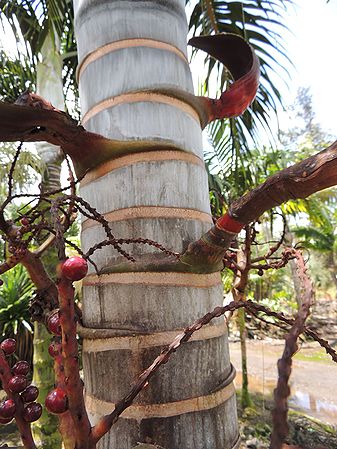
Floribunda Palms, trunk

fruiting palm, Hawaii, Floribunda Palms

infructesences in Hawaii
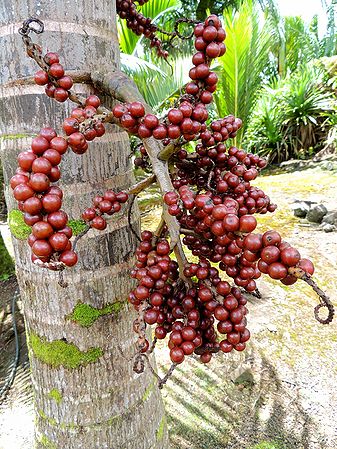
fruits on palm in Floribunda Palms, Hawaii

size of mature fruits


