Difference between revisions of "Chamaedorea costaricana"
Geoff Stein - Author & Editor
| Line 6: | Line 6: | ||
Synonyms: ''Chamaedorea quezaltica'' | Synonyms: ''Chamaedorea quezaltica'' | ||
| − | + | <center> | |
{| colspan="2" style="background: #FCFCFC; border: 1px solid black; vertical-align: top;" | | {| colspan="2" style="background: #FCFCFC; border: 1px solid black; vertical-align: top;" | | ||
| style="width: 50%; background: #f8e8df; border: 1px solid black; vertical-align: top;" | | | style="width: 50%; background: #f8e8df; border: 1px solid black; vertical-align: top;" | | ||
| Line 38: | Line 38: | ||
*'''Availability''': moderately rare only (occasionally shows up in non-specialty nurseries) | *'''Availability''': moderately rare only (occasionally shows up in non-specialty nurseries) | ||
|} | |} | ||
| + | {{#Widget:AdResBan}} | ||
<gallery> | <gallery> | ||
File:Chamaedorea costaricana AN.JPG|Sherman Oaks, California | File:Chamaedorea costaricana AN.JPG|Sherman Oaks, California | ||
Latest revision as of 22:09, 29 July 2015
Common Name: Bamboo Palm; Costarican Bamboo Palm
Chamaedorea costaricana is one of the better of the large, clustering Chamaedoreas in terms of filling large areas in a 'wall-like' fashion, though it does best when not in full, baking sun or high, dry winds. It is one of many Chamaedoreas with the common name 'Bamboo Palm' for the obvious reason of having tall, green, ringed stems. Younger plants can sometimes be confused with Chamaedorea seifrizii and Chamaedorea pochutlensis, which is generally a more densely clustering palm with smaller stems. Also neither of those palms have ligules at their leaf bases as Chamaedorea costaricana does (see a photo below)
Synonyms: Chamaedorea quezaltica
|
Appearance and Biology
|
Horticultural Characteristics
|

Sherman Oaks, California

Balboa Park, San Diego, California

Golden Gate park, San Francisco, California

Lotusland, Santa Barbara, California

Huntington gardens near Pasadena, California

Los Angeles arboretum near Pasadena, California

Lotusland

Lotusland

Lotusland
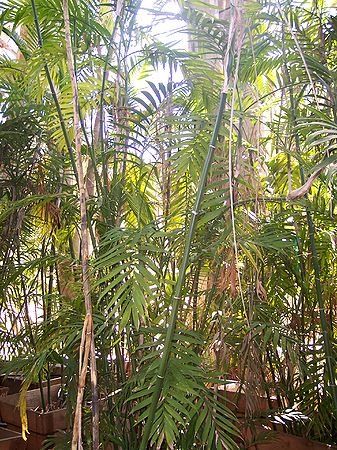
Lotusland
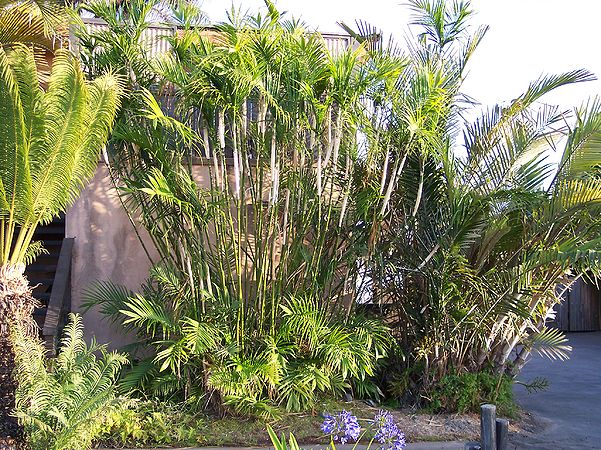
Ventura, California in the Sullivan garden

Los Angeles arboretum

Ventura in Sullivan garden


Close up focusing on the ligules at the leaf bases (seen in the two upper most leaves on this shot)


plant in flower, Lotusland, Santa Barbara

in flower, Lotusland

flower closer

closeup of flowers

fruits in Huntington Gardens


.jpg)


