Coccothrinax moaensis
<google>CH02</google>

| Coccothrinax (koh-koh-THRY-naks) moaensis | |||||||
|---|---|---|---|---|---|---|---|
 Maguana, Cuba, Photo by Carlo Morici, edric. | |||||||
| Scientific Classification | |||||||
| |||||||
| Synonyms | |||||||
|
| |||||||
| Native Continent | |||||||
 | |||||||
| Morphology | |||||||
| |||||||
| Culture | |||||||
|
| |||||||
| Survivability index | |||||||
|
| |||||||
| Common names | |||||||
|
| |||||||
Contents
Habitat and Distribution
Coccothrinax moaensis is native to Cuba, where it occurs only in the region of Moa in S.E. Cuba. "The land of Moa" as it is called by some naturalists, is a very peculiar area from a botanical point of view. Its soils are derived from very old serpentine rocks, and they are "extreme" in that they are naturally loaded with lots of metals and unusual elements. This palm is mainly found at lower elevations and even not too far from the coastline. Its distribution extends south to Maguana (Prov. of Guantá�namo) and also inland, while the species clearly follows the patches of serpentine soils. The area is rainy (1.500-2.200 mm/year) and hot (27-28° C as average annual temperature). According to the different localities, Coccothrinax moaensis can be found growing together with other endemic palms, such as Bactris cubensis , Thrinax rivularis , Copernicia rigida and others. (Carlo Morici)
Description
This small palm was described in 1971 by the Hungarian and Cuban botanists A. Borhidi and O. Muñ�iz, and it was one of the first of many species described by these men in Eastern Cuba. It was originally considered a subspecies of Coccothrinax yuraguana but later, in 1981 Muñ�iz, decided to give it specific rank and called it C. moaensis. Trunk type: Solitary, Coccothrinax moaensis is a medium sized Coccothrinax, and one of the slowest growing Coccothrinax, spineless in all its parts.
The especially thick leaves are orbicular and the palman (the undivided part of a palmate leaf between the petiole and segments of the blade, of particular pertinence to leaves of fan palms) is characteristic in being small, so the deeply divided segments form an eye-catching pinwheel. The fibre sheaths are often swollen in the middle, giving the trunk a pleasant "bumpy" appearance. Inflorescences and infructescences are short, curved, and they eventually hang with fleshy purple fruits. {Carlo Morici) Editing by eddric.
Culture
Requirements: Full sun, fair to moderate water, well drained position. Hardiness, USDA zones 10a-11.
Comments and Curiosities
In horticulture, this outstanding, medium-sized Coccothrinax unfortunately is largely unknown, perhaps for the lack of propagating material and its remote habitat. It is native only to a few localities in eastern Cuba in the region of Moa and Maguana, where it experiences a hot, humid climate and is confined to soils derived from serpentine rock. Such soils are very high in heavy metals (Moa is a nickel mining area) which are toxic to most plants and usually produce a stunted and very diverse vegetation with many species that are highly adapted and endemic. Many palm enthusiasts may also be familiar with this type of vegetation from New Caledonia, where many palms are confined to serpentine. Originally described in 1971 by botanists Attila Borhidi and Onaney Muñiz as Coccothrinax yuraguana ssp. moaensis, Muñiz decided later that the palm was different enough to deserve to be a species in its own right. It produces a slender, solitary trunk clothed in the wiry, tightly clasping fibers of the leaf sheaths. The leaves are quite unmistakable, flat, completely circular, to about 80 cm (30 in.) in diameter and deeply divided into about 20 thick, rigid, strongly V-shaped segments with rounded tips. Their deep divisions, almost to the base of the leafblade, few segments and their circular outline give them the appearance of pinwheels and make this palm a superb ornamental. In cultivation, it is slow to establish but not difficult and will succeed in all tropical and some warm temperate climates if sun and a freely draining substrate are provided. Special thanks to Tobias Spanner (Rare Palm Seeds.com), for his comment above, edric.
External Links
- Glossary of Palm Terms
- Pronunciation Key
- http://www.palms.org/palmsjournal/2005/vol49n2p57-71.pdf
- http://www.plantapalm.com/vpe/virtualtours/cuba/vpe_palmsofcuba1.htm
- http://perfildaplanta.blogspot.com/2010/07/roystoneas-confusoes-imperiais-parte-ii.html
References
Special thanks to Geoff Stein, (Palmbob) for his hundreds of photos, edric.
Special thanks to palmweb.org, Dr. John Dransfield, Dr. Bill Baker & team, for their volumes of information and photos, edric.
- IMAGE GALLERY

Photo by Mike Harris, edric.

Photo by Carlo Morici, edric.

Photo by Carlo Morici, edric.
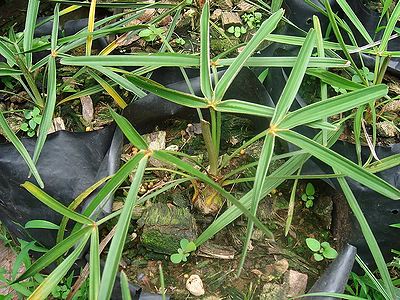
Photo by Kom, edric.

Quemado del Negro, Cuba, Photo by Carlo Morici, edric.

Maguana, Cuba, Photo by Carlo Morici, edric.

Quemado del Negro, Cuba, Photo by Carlo Morici, edric.

Quemado del Negro, Cuba, Photo by Carlo Morici, edric.

Maguana, Cuba, Photo by Carlo Morici, edric.


Many Special Thanks to Ed Vaile for his long hours of tireless editing and numerous contributions.