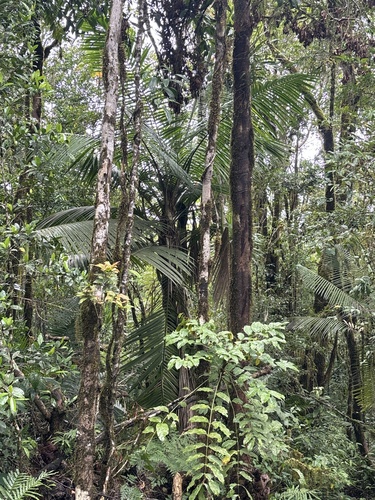
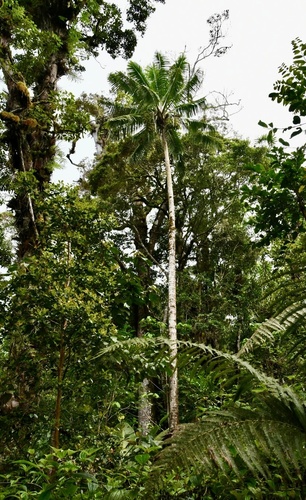
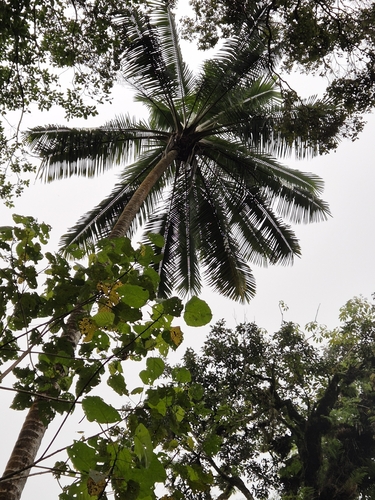
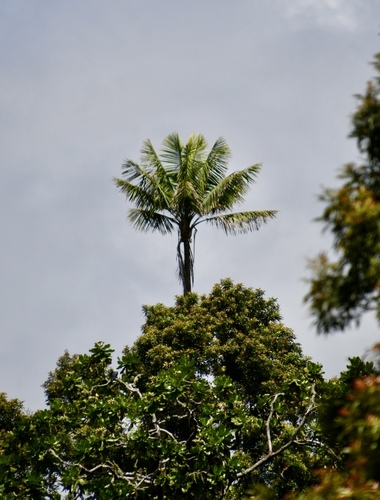
Ravenea moorei J.Dransf. & N.W.Uhl is a tall, single-trunked feather palm found only on Ngazidja (Grande Comore), the largest island of the Comoro archipelago between Madagascar and the African coast. Of the two Comoro species of Ravenea it is much the bigger: a rather coconut-like tree whose grey-brown trunk reaches about 20 m and rises from a broad, bulbous foot, topped by a crown of long, straight leaves with 55–80 narrow leaflets on each side. Male and female flowers are borne on separate trees, and female trees carry yellow to orange, single-seeded fruits about 16 mm across. The species was recognised only in 1986; before then, plants raised from the first wild seed were grown as Ravenea hildebrandtii. Known in the wild from a handful of forest sites on the western slopes of the active volcano Mt. Karthala, it has a very small wild population, and for decades a single male tree in the Palm House at Kew was thought to be possibly the last of its kind.
Also known asGrand inazi (Comoros); inazi (Comoros, application uncertain)
Distribution and habitat

Kew gives the native range as the Comoros, where the palm is restricted to Ngazidja (Grande Comore); it has not been recorded from the other islands or from Madagascar.
It grows in submontane rainforest, including secondary and degraded forest, on basalt lava on the western flanks of Mt. Karthala. The classic account placed it at 500–800 m, and later summaries at 600–1000 m. Surveys in November 2023 and November 2024 found it at three sites between 750 and 1200 m: near the type locality above Boboni, in forest above Mdjoiezi, and beside the road to the Karthala summit. A record of seed gathered at about 500 m in the La Grille massif above Mitsamiouli, at the north end of the island, has never been confirmed in the field. The known range coincides closely with the wettest zone of Ngazidja, a factor that may make the palm sensitive to any future drying of the climate.
Description

- Habit and stem: a robust, solitary, dioecious tree palm without a crownshaft. The trunk grows to about 20 m tall (15–20 m in recent accounts) and is 11–35 cm thick (about 23 cm in a typical tree), with grey-brown bark and leaf scars that are visible but not prominent. The base swells into a hemispherical foot as wide as 105 cm and roughly 40 cm high, while near the crown the stem narrows to about 13 cm (estimated from a photograph). Internodes in the lower trunk are some 20 cm long, becoming much shorter towards the top; the base of the crown is bulbous.
- Leaves: 11–19 in the crown (about 15 in a typical tree), straight and pointing upwards or spreading, with the outer half twisted to stand on edge; each is 2.26–3 m long and about 70 cm wide. The sheath, up to 60 × 19.5 cm, soon splits; its edges bear long, fine fibres and its outer face is thickly felted, white where shaded and browning in the light, the felt thinning towards the tip. The short petiole measures 10–25 cm in length, 2.4–4.5 cm in width and 1–1.5 cm in thickness, flat above and roughly rounded beneath, with a sparse felt below only. The rachis measures 1.3–2.4 m, rounded beneath and shallowly channelled or keeled above (the keel up to 10 mm wide, narrowing to a sharp ridge towards the tip), grooved on each side, thinly hairy to whitish-waxy below, and 1.7–2 × 1.2 cm across at mid-leaf. There are 60–80 leaflets on each side in the original description (55–70 in recent field counts), crowded near the base: basal leaflets 15–54 × 0.8–1.7 cm, mid-leaf leaflets 49–70 × 2–2.5 cm set 2.5–2.8 cm apart, and apical leaflets 12–43 × 0.4–1.7 cm. Each leaflet has about five main veins, the midrib being the strongest and raised on the upper side; beneath, the midrib carries a few large, pale, evenly spaced ramenta (chaffy scales), cross-veins are hard to see, and a deciduous felt is present near the base.
- Male inflorescence: one per leaf axil, about 90 cm long and branched to two orders; it is short relative to the crown and is often hidden among the leaf bases. The peduncle is about 35 cm long and 1.5 cm thick, round in section; the many slender rachillae reach 15 cm in length and 1.5 mm in thickness. The original description was based on dead material only.
- Female inflorescence: one per axil, spreading or hanging, about 1.5 m in length, branched once and shorter than the leaves. The peduncle, 60–90 cm long, is elliptic in section, about 19–20 × 12 mm near the base and about 15 × 11 mm towards the tip, green with a soft brown felt that falls away. The prophyll is tubular and two-keeled, about 20 × 5 cm, thin, pale-brown-hairy and fraying into fibres with age; the longest peduncular bract is about 130 × 5 cm. The hairless, dotted rachis is about 60 cm long and carries around 100 stiff, straight, green, hairless rachillae: the lower ones 30–47 cm long with a flattened base of 7 × 3.5 mm, the upper ones 15–20 cm. The bracteole below the lowest rachilla is ovate and drawn out at the tip, about 45 × 11 mm; pedicels measure 0.5–5 × 1–1.5 mm. The female flowers themselves have not yet been described.
- Fruit and seed: globose, about 16 mm in diameter when fresh (11–14 mm dry), yellow to orange, single-seeded, with the stigmatic remains placed laterally to almost basally. The persistent sepals are triangular, about 1.2 × 1 mm, and the persistent petals are similar but smaller. The skin is smooth and wrinkles on drying; the flesh is about 1.3 mm thick and there is no distinct inner stony layer. The seed is spherical, 9–11 mm across and dark brown.
Similar species. The only other Comoro Ravenea, Ravenea hildebrandtii, is its closest relative (sister species) but is a much smaller understorey palm with a trunk usually under 4 m and only 5–6 cm thick, fewer leaflets (20–45 per side) and female inflorescences that often reach beyond the leaves. The two grow side by side at two sites on Mt. Karthala, and some trees there that look like Ravenea moorei have a more slender build and elongated female inflorescences, which may point to hybridisation. Dransfield and Beentje considered Ravenea moorei probably closest among the Madagascar species to Ravenea robustior. The Comoro endemic Chrysalidocarpus lanceolatus and Chrysalidocarpus cabadae differ in usually being clustering palms with a crownshaft.
Ecology

The wild population is very small. During the 2023 survey, Kew and University of the Comoros botanists counted about 50 plants, of which 12 were mature; at the largest site, beside the Karthala summit road, 33 individuals including 8 adults were found, some of them flowering and fruiting. Female trees with ripe fruit and others with remains of old inflorescences were seen, and the presence of seedlings and juveniles indicates that the palm is still regenerating. Earlier, in October 1993, a visitor to the La Grille locality saw just two female trees. Male inflorescences are short and tucked among the leaf bases, so the sex of tall trees is hard to determine in the field. Pollination and seed dispersal have not been studied. Genomic work on the Comoro palms, including possible gene flow between the two Ravenea species, is in progress.
Uses
No traditional uses have been documented. The name "grand inazi" is used for the palm on the Comoros, and the label of the type collection records the local name inazi; this word closely resembles mnazi, the Swahili term for the coconut, so its application may be loose. Outside the Comoros the palm is grown only in a few botanic gardens and private collections.
Cultivation
- Where grown: seed from Moore's 1963 collection was shared with several gardens. The best-known plant is a male tree raised from that seed in the Palm House at the Royal Botanic Gardens, Kew, now more than 12 m tall (about 14 m, or 46 ft); Kew regards it as the last authenticated survivor of that introduction. Because it is male it cannot set seed, and its size makes it unlikely to survive a move during the planned renovation of the Palm House (from 2027). Young plants collected in 2023 around a fruiting female now grow in Kew's tropical nursery, and a nursery run by the University of the Comoros is raising seedlings for trial plantings in Moroni. Palms grown under this name are also reported from southern California (San Diego and Orange County), Hawaii and Nong Nooch Tropical Garden in Thailand; some of these may derive from the 1993 La Grille seed, and their identity has not been checked against wild material.
- Climate: a palm of permanently wet, frost-free tropical forest. Growers place it in USDA zone 10a, corresponding to an average annual minimum of −1.1 to +1.7 °C.
- Propagation: only from seed, and both male and female trees are needed to obtain it.
Conservation
Conservation status: Critically Endangered.
The palm survives only in a few forest patches on Mt. Karthala, mostly inside Karthala National Park. Even there, illegal clearance for bananas and other crops and the felling of timber trees are degrading its habitat: at the largest site, forest that was still largely closed in November 2023 had been heavily opened up by November 2024, and a large Weinmannia tree felled next to the biggest female damaged the ground where many seedlings had been growing. Invasive shrubs such as strawberry guava (Psidium cattleyanum) and Koster's curse (Miconia crenata) smother disturbed forest and block regeneration, and cyclones and a drier climate could add further pressure. An outline conservation plan drawn up with national-park staff in 2024 gives priority to this species: research into its distribution and genetics, protection and monitoring of the known stands, replanting, and building an international ex situ collection from legally gathered seed.
Name history
- Original publication: Ravenea moorei J.Dransf. & N.W.Uhl, Principes 30: 159 (1986), in a paper on Ravenea in the Comoro Islands.
- Type: Ngazidja (Grande Comore), on lava between Boboni and Kafeni below the Chemin du Capitaine Dubois, about 650–700 m, 6 November 1963, Moore & Moelévoce 9028 (holotype BH; isotypes K, P).
- Taxonomic history: Moore's 1963 collections were first identified as Ravenea hildebrandtii, and plants grown from them were cultivated under that name. Dransfield and Uhl separated the larger palm as a new species in 1986, so that two Ravenea species are now recognised on the Comoros. The genus belongs to subfamily Ceroxyloideae, tribe Ceroxyleae, together with Ceroxylon, Juania and Oraniopsis.
- Etymology: the genus name honours Louis Frédéric Jacques Ravené (1823–1879), a Berlin patron of horticulture; the epithet honours Harold E. Moore Jr., the American palm specialist who collected the type and introduced the species to cultivation.
- Pronunciation: Ravenea rah-vehn-EH-ah; moorei moor'-ee.