Dypsis louvellii
<google>CH02</google>

| Dypsis louvelli | |||||||
|---|---|---|---|---|---|---|---|
 Habitat - Madagascar. Photo, Phil Arrowsmith. | |||||||
| Scientific Classification | |||||||
| |||||||
| Synonyms | |||||||
|
| |||||||
| Native Continent | |||||||
 | |||||||
| Morphology | |||||||
| |||||||
| Culture | |||||||
|
| |||||||
| Survivability index | |||||||
|
| |||||||
| Common names | |||||||
|
| |||||||
Contents
Habitat and Distribution
Endemic to Central Madagascar, Analamazaotra and environs. Lowland and montane forest, usually in valley bottoms; alt. 300-1100 m.
Description
Solitary slender palm of the forest undergrowth, rarely exceeding 1 m tall. STEM 7-10 mm in diam., internodes 4-10 mm long, surface glabrous. LEAVES c. 5-10 in the crown, tending to be held ± horizontally; leaf sheath 6-7 long, 1.0-1.4 cm in diam., drying dull brown, bearing abundant dark brown scales, the mouth with two short triangular auricle to 4 x 3 mm; petiole absent or very short, not exceeding about 2 cm; blade entire bifid, rather plicate, or, very rarely, divided into 3 distant narrow leaflets on each side; blade 19-50 cm long with a spread of 4.5-10 cm, the two lobes diverging at a very acute angle, 10-25 x 1.5-4 cm, where divided into leaflets, the leaflets 17-21 x 0.7-0.9 cm, adaxially with sparse punctiform scales, abaxially densely covered with brown punctiform scales. INFLORESCENCE interfoliar, arcuate, branching to 1 order, rarely the lowermost 1 or 2 first order branches branched to the second order; peduncle 20-35 x 0.15-0.2 cm, sparsely brown scaly; prophyll sometimes borne up to 2 cm above base of peduncle, 6-10 x 0.3-0.5 cm; peduncular bract exceeding the prophyll, 9-23 x 0.4 cm; rachis usually conspicuously shorter than the peduncle, 5-10 cm; rachillae generally few in number, 9-17, generally somewhat reflexed, 1.3-4 cm long, c. 1 mm in diam., sparsely brown scaly, bearing rather densely arranged triads. STAMINATE FLOWERS at anthesis ± ovoid, 1.6 mm long; sepals rounded to broadly triangular, about 0.7 x 0.7 mm, strongly keeled, inconspicuously dentate at the margins, abaxially slightly papillose, obscurely striate; petals connate in basal 0.25 mm, the lobes triangular, to 1 x 1 mm, abaxially smooth, glabrous; stamens 3 antesepalous, filaments to 0.75 x 0.3 mm, basally joined in the lowermost 0.2 mm, anthers somewhat sagittate, 0.5 x 0.3 mm, introrse; pistillode conical, minute, about 0.1 mm high. PISTILLATE FLOWERS at anthesis about 1.6 mm in diam.; sepals rounded to broadly triangular, about 0.7 x 0.7 mm, strongly keeled, inconspicuously dentate at the margins, abaxially slightly papillose, obscurely striate; petals about 1.5 x 1.5 mm, rounded to broadly triangular; staminodes 3, free, irregularly strap-shaped 0.2-0.4 x 0.2 mm; ovary irregularly reniform, about 1.2 mm at widest point, stigmas 3, eccentric near the apex, about 0.1 mm long. Immature fruit narrowly fusiform. Mature FRUIT scarlet, irregularly ellipsoidal, apically somewhat pointed, 14 x 8 mm; epicarp minutely papillose, mesocarp soft, fleshy; endocarp broad fusiform, 12 x 5 mm, 0.5 mm thick, with brown, sparsely anastomosing fibres. SEED 11 x 4 mm, conforming to the endocarp shape; endosperm homogeneous; embryo lateral. Editing by edric.
No specimens were cited in the protologue (Jumelle & Perrier 1913). Of the three specimens cited by Jumelle (1918), we have found only Perrier 11968 and thus designate this collection as type. This is a beautiful, distinctive species, characterised by its dwarf habit, usually with narrow, rather plicate, entire bifid leaves and inflorescences with long arcuate peduncle and short rachis, bearing rather few somewhat reflexed short rachillae. The staminate flowers have three antesepalous stamens with short sagittate anthers, no staminodes and a very small, scarcely discernible pistillode. At present the species seems to have a very restricted distribution. (J. Dransfield and H. Beentje. 1995).
Culture
Comments and Curiosities
A neat palmlet of the undergrowth of montane forest, first collected at Analamazaotra, Andasibe (Perinet). This is an easily distinguished species because of its deeply bifid leaf and slender inflorescence with few short rachillae. It has frequently been collected at the type locality where it is no longer very common near to the main trails. Louvel, after whom the palm is named, was a Forest Officer at the old French Forestry Station at Perinet (modern day Andasibe). (J. Dransfield and H. Beentje. 1995).
Conservation: Vulnerable; all recent collections are from one small area. (J. Dransfield and H. Beentje. 1995).
External Links
References
Special thanks to Geoff Stein, (Palmbob) for his hundreds of photos, edric.
- IMAGE GALLERY

Perinet, Madagascar. Photo by Dr. John Dransfield, edric.
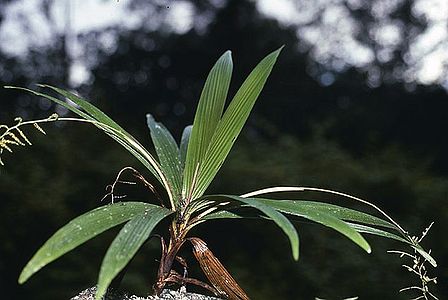
Analamazaotra, Madagascar. Photo by Dr. Henk Beentje, edric.

Madagascar. Photo by Dr. John Dransfield, edric.

Perinet, Mantadia, Madagascar. Photo by Dr. John Dransfield, edric.
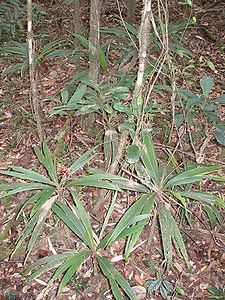
Habitat - Madagascar. Photo, Phil Arrowsmith.

Hawaii.

Madagascar. Photo, Phil Arrowsmith.
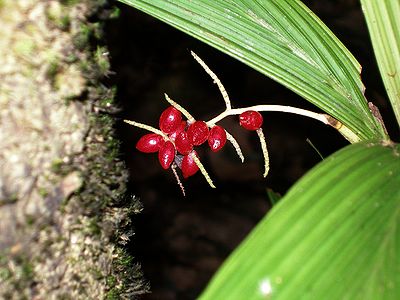
Madagascar. Fruit. Photo, Phil Arrowsmith.
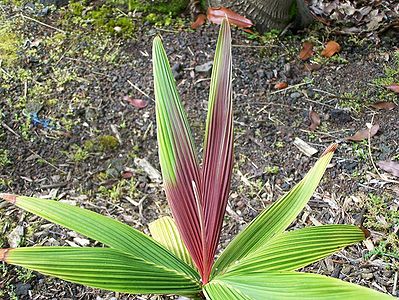
Photo by Bill Austin, edric.

Marcus Garden, Hawaii, photo by Paul Craft, edric.


Many Special Thanks to Ed Vaile for his long hours of tireless editing and numerous contributions.