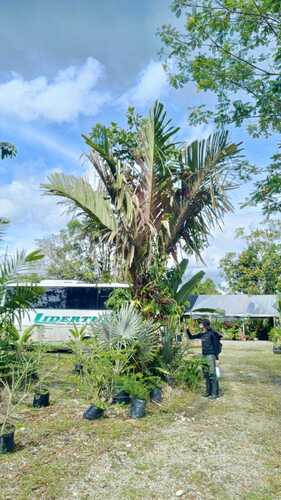
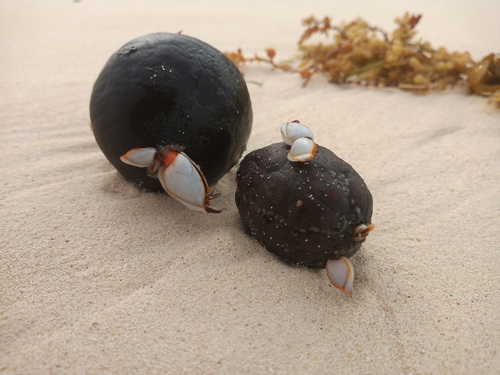
Manicaria saccifera Gaertn. is a stout, usually single-stemmed palm of tidal and freshwater swamps along the Caribbean and Atlantic lowlands of tropical America, from Belize through Central America to Colombia, Venezuela, Trinidad, the Guianas and the mouth of the Amazon, with outlying populations in the Pacific lowlands of Colombia and north-western Ecuador and in the western Amazon. It is famous for its leaves: stiff, deeply furrowed blades with toothed edges, mostly undivided and among the largest undivided leaves in the plant world, regularly 5–8 m long. Its second hallmark is the bract that sheathes each flower cluster, a seamless brown sleeve of naturally interwoven fibres that can be pulled off whole and worn as a cap. The rough, warty, often two- or three-lobed fruits float, and drift seeds from the palm turn up on beaches far from its range, hence the name Sea Coconut. Former names that still turn up in older literature include Manicaria plukenetii and Pilophora testicularis. Across its range the leaves are used for long-lasting thatch, and the palm has fed, sheltered and clothed peoples such as the Warao of the Orinoco Delta for centuries; in cultivation it is very tender and is grown mainly in wet tropical gardens.
Also known asSea Coconut; Troolie Palm; truli (Guyana); bussu, ubussu or ubuçu (Brazil; the bract fibre is sold as tururi); temiche, timiche or timití (Venezuela); yahuhi or yawihi (Warao, Orinoco Delta); cabecinegro, jícara or jiquera (Colombia); confra or comfre (Guatemala, Belize); palma real (Costa Rica); yolillo palm
Distribution and habitat

Kew lists Manicaria saccifera as native to Belize, Guatemala, Honduras, Nicaragua, Costa Rica and Panamá in Central America, and to Trinidad and Tobago, Venezuela, Guyana, Suriname, French Guiana, northern Brazil, Colombia, Ecuador and Peru in South America. It is recorded only as introduced in the Dominican Republic.
In Central America it is a palm of the Atlantic (Caribbean) slope. In Guatemala it is confined to coastal Izabal, where thousands of plants grow on the seasonally flooded flats of the Livingston area, in brackish creek swamps close to the sea (Hellmuth 2021); Standley & Steyermark (1958) and Williams (1981) characterise it as a palm of brackish coastal swamps. In north-eastern Costa Rica and south-eastern Nicaragua it forms, with the raffia palm Raphia taedigera, the palm swamps known locally as yolillales; the Tortuguero canals of Limón province are an easy place to see it. In these swamps Raphia taedigera dominates the wettest, longest-flooded ground, whereas Manicaria saccifera tends to grow in flooded forest of more complex structure and greater tree diversity (Rueda et al. 2013). Roughly half of the yolillal area of both countries lies inside protected areas such as Tortuguero National Park and the Barra del Colorado refuge in Costa Rica and the Indio Maíz reserve in Nicaragua (Serrano-Sandí et al. 2013).
In South America it is common on the Pacific coast of Colombia (the Chocó), where it grows in swampy, flooded ground, especially along rivers and creeks (Copete et al. 2018). In Ecuador it has been found only once, in the north-west near where the Río Santiago meets the Río Cayapas (Borchsenius 1998). In the Orinoco Delta of Venezuela it is restricted mainly to the intermediate delta zone that lies behind the coastal mangrove belt; there it favours places reached by the tides and exposed to the almost constant north-easterly trade winds, and it often forms dense pure stands called temichales (Wilbert 1976). Wallace (1853) found it in tide-flooded swamps near the Amazon mouth. In Brazil it is known mainly from Amapá, Pará and Amazonas, where it is plentiful in the várzea floodplain and island forests of the estuary, including the Marajó archipelago (Monteiro et al. 2021). On the floodplains of the Colombian Pacific lowlands it forms extensive, nearly pure stands in the forest understorey (Rentería et al. 2019). In north-western Amazonia, where both species of the genus occur, large plants indistinguishable from coastal Manicaria saccifera are scarce and poorly collected (Bernal & Galeano 2010). In Peru it was first recorded in 1993 at Roca Eterna near Iquitos, between the Napo and Amazon rivers, and has since been found along the Yahuashyacu, a tributary of the Ampiyacu in Loreto; there it grows on igapó, ground flooded by acidic black-water streams (Grández-Ríos et al. 2022).
The species is a lowland plant of very wet climates, growing from near sea level in tidal swamps, on inland floodplains and in permanently waterlogged soils. In Costa Rica it is an obligate swamp species that hardly occurs away from the flooded ground (Myers 2013a, 2013b).
Description

The account below combines the classic description by Wessels Boer (1965), as reproduced by Wilbert (1976), with field measurements from Colombia (Copete et al. 2018), Venezuela (Wilbert 1976), Ecuador (Borchsenius 1998) and the grower record.
- Habit and stem: a subcanopy palm, normally solitary. The stem reaches up to about 10 m (33 ft) and is 15–35 cm thick; Wessels Boer gave up to 6 m and about 30 cm. In the Orinoco Delta, stems of 2–8 m were seen, dark brown and marked with prominent leaf-scar rings 2–3 cm wide, the palms often standing on low mounds 30–50 cm high (Wilbert 1976). In Guatemala the trunk is usually short or almost absent, though plants of 8 m or more occur (Standley & Steyermark 1958). The upper stem is clothed in old leaf bases that trap debris, and the base shows conspicuous scars. Stems are sometimes curved or crooked. A cultivated plant was found to branch dichotomously (Fisher & Zona 2006), and Copete et al. (2018) describe plants as solitary or occasionally clustering.
- Leaves: about 10–17 held at once, rising stiffly upwards; dead leaves hang down the trunk for some time before falling. The fibrous sheath wraps the young leaves and is about 70 cm long; the petiole is stout and grooved, about 1.2 m long and 8 cm thick (Wessels Boer 1965); Wilbert measured petioles of 1.2–2 m. The blade is huge, firm and rigid, folded into deep furrows by about 120 primary veins set 3–4 cm apart near its middle, with a toothed margin and a two-lobed tip. It is simple when young but is torn by the wind into irregular pinnate segments of many folds, even on juvenile plants. Blade length is usually 3–8 m (rachis about 3.3–8 m, mostly 4.7–7.4 m) and width up to about 2.3 m; Wilbert recorded leaves 5–8 m long and 1.5–1.8 m wide, Braun reported 9 m, and leaves of 10 m are often cited, which has earned the species a reputation for the largest undivided leaf in the plant kingdom. Wallace (1853) gave blades about 9 m (thirty feet) by 1.2–1.5 m (four or five feet). Young parts are brown-felted beneath, soon becoming smooth.
- Inflorescence: borne among the leaves, almost erect, usually about 1–1.7 m long including the stalk (60 cm in small plants), and set on average about 1.9 m above the ground in Colombia. A flattened outer bract (prophyll) about 35–70 cm long is hidden between the leaf sheaths; the inner (peduncular) bract, about 1.1 m long, is a spindle-shaped, pointed, seamless sack of tightly interwoven brown fibres that encloses the whole inflorescence until long after flowering. The peduncle is up to about 1 m long, the rachis about 60 cm, carrying up to 45 (mean about 35) mostly unbranched rachillae, occasionally forked (Wessels Boer 1965; Copete et al. 2018). One plant may carry up to five inflorescences at different stages.
- Flowers: of both sexes on the same inflorescence, rigid and yellowish. Female flowers sit near the base of each rachilla between two males (triads); upwards the rachillae carry only pairs of male flowers, each set in a shallow pit with a bract 7–12 mm long below it. On average a rachilla carries about 3 female and over 200 male flowers, an inflorescence roughly 200 female and 15,000 male (Copete et al. 2018). Male flowers: sepals 3–4 mm, overlapping; petals 6–7 mm, lance-shaped, thick and woody; stamens 20–34 in the classic description (Colombian material averaged about 35), crowded, the filaments about 1.5 mm and anthers 3 mm. Female flowers: sepals about 7 × 8 mm; petals about 10 × 6 mm, pointed, thick and woody; pistil globose with a sessile, three-lobed, papillose stigma 3–4 mm long.
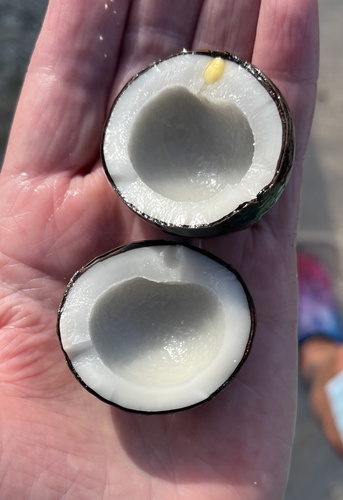
- Fruit and seed: depressed-globose, with one to three seeds; fruits with two or three seeds are lobed like two or three fused balls. The corky brown skin is covered with hard, angular, pyramidal warts that do not rub off. One-seeded fruits measure about 4–5 cm (Standley & Steyermark 1958; Copete et al. 2018) to 7–8 cm, two- and three-seeded ones up to 9.5 cm (Wilbert 1976). The seed is globose, very hard, about 4 cm across, with uniform (homogeneous) endosperm and a basal embryo; immature seeds are filled with a clear liquid like coconut water. A bunch measured by Wilbert weighed 12 kg, was 87.5 cm long and held 67 fruits (22 one-seeded, 25 two-seeded and 20 three-seeded), about a third of the weight being liquid. Seedlings first produce two-lobed (bifid) leaves.
Telling it apart
The only other species in the genus, Manicaria martiana, from black-water rivers of the north-western Amazon, is a slender palm with bare stems, smaller leaves that fall cleanly, narrow leaf segments of one to a few folds scaly beneath, and few fruits per bunch. Manicaria saccifera is massive, with thick stems (13–35 cm across in Peruvian material, against 6–11 cm in Manicaria martiana; Grández-Ríos et al. 2022) clothed in old leaf bases, large leaves that persist long after dying, broad many-folded segments that are smooth beneath, larger inflorescences with longer rachillae and conspicuous bracteoles, and many fruits with blunt pyramidal warts (Bernal & Galeano 2010). The large, nearly entire, saw-edged leaves and the felt-like sack around each flower cluster make Manicaria saccifera hard to confuse with any other palm in its swamps.
Ecology

Pollination. In the Colombian Chocó, Manicaria saccifera is monoecious, self-incompatible and does not set seed without pollination. Each inflorescence is first female and then male (protogynous); flowers open by day, female flowers all at once and male flowers in succession over up to two days, and stigmas stay receptive for about 72 hours. During flowering the inflorescence warms up by about 4.0 °C (female phase) and 4.7 °C (male phase) above the air. The female phase offers no reward and attracts insects by scent, while the male phase provides pollen and a breeding site. Eight to ten insect species visit the flowers, but the small sap beetle Mystrops cercus (Nitidulidae) accounted for 99.9% of pollination: it is the only visitor that arrives in numbers during the female phase and the only one able to pass the two barriers of the fibrous bract and the female petals, which keep out insects larger than about 2 mm. Stingless bees (Trigona fulviventris, Trigona ferricauda) and rove beetles visit only the male phase (Copete et al. 2018). The authors regard this one-to-one dependence as an unusual case of pollinator exclusion and mutual reliance.
Phenology. In the Chocó the palm flowers all year, peaking in April and May, when about 61% of plants carried one or two inflorescences; flowering was not linked to rainfall and only about a quarter of plants flowered at the same time. Fruits were present throughout the year (Copete et al. 2018). The Warao likewise say the palm has no fixed flowering or fruiting season (Wilbert 1976).
Dispersal and regeneration. The corky fruits float and are spread by water (hydrochory); seeds drift for long periods before stranding and sprouting, and some cross oceans as sea beans. In the Tortuguero swamps of Costa Rica, Manicaria saccifera seeds left on the ground disappeared quickly whatever their density or position, pointing to heavy removal or predation; seeds germinated sooner on better-drained slope forest than in the swamp, yet adult palms are almost restricted to swamps (Myers 2013a, 2013b). Fallen fruits attract deer, peccaries, pacas, agoutis, monkeys and curassows, and palm weevils lay their eggs in the stems; the fat larvae are eaten by the Warao (Wilbert 1976). In Guatemala the stems are heavily covered with mosses, ferns (Nephrolepis) and other epiphytes (Standley & Steyermark 1958).
Associated communities. The yolillal swamps it shares with Raphia taedigera are poor in tree species but support distinctive bird communities in north-eastern Costa Rica (Beneyto et al. 2013).
Uses
Manicaria saccifera has many uses; one survey in the Colombian Pacific recorded 36 different uses (cited in Copete et al. 2018), and in the Medio Atrato of Chocó it ranks among the palms of highest use value (Valois-Cuesta et al. 2013). In the Amazon estuary the leaves are carried to towns and sold for roofing, and floating fruits are collected to feed pigs (Smith 2015).
Thatch and shelter. Because the leaves are enormous, entire and stiff, they make durable thatch, valued locally for its long life. Wallace (1853) described how the leaves are split along the midrib and set diagonally across the roof frame, the vein furrows then running almost vertically and draining rain like tiny gutters; such a roof lasts ten or twelve years, and people would travel for a week by canoe to fetch a load. In Guyana the troolie leaves were once traded in quantity to thatch sugar-estate buildings before corrugated iron arrived (Im Thurn, quoted by Wilbert 1976). Q'eqchi' Maya in coastal Guatemala say confra thatch outlasts both cohune and guano palm roofs (Hellmuth 2021). The Warao fold the leaves along the rachis for roofing, set up windbreak screens of them on the windward side of their open houses, shelter canoes under arched leaves, stick single leaves in the ground as rain shields and hold them over their heads as capes. They also sail with them: two or three crew each hold up a whole leaf as a sail on the open delta channels (Wilbert 1976). Other accounts mention leaf sails, rafts and boats used on rivers and estuaries.
Bract fibre. The seamless fibrous bract is pulled off before the inflorescence opens fully. Stretched over the head it becomes a peaked cap (the Warao yasi nona; caps of this kind are sold to tourists in Panama); whole, it serves as a bag for storing paint or kapok, and opened and pressed flat it was used by Amazonian peoples to wrap and protect feather ornaments (Wallace 1853; Wilbert 1976). In Colombia the bracts (called capotes) are a major source of fibre for handicrafts and textiles, the leaf veins are woven into baskets and unexpanded leaves are made into brooms (Copete et al. 2018). In the central Chocó, Afro-Colombian and Emberá communities turn the peduncular bract into a wide range of handicrafts sold along an established market chain (Rentería et al. 2019). In Brazil the bract fibre, known as tururi, is a craft material: riverside people of the estuary gather the sacks on the floodplains between December and February, process them by hand and ship them in bundles by boat to Belém (Monteiro et al. 2015; Monteiro et al. 2021), and the natural fibre mat is now being studied as a reinforcement in composite materials and as a biocompatible scaffold for tissue engineering (James et al. 2020).
Food and water. The liquid in immature fruits is a ready source of clean drinking water: a Warao can quench thirst from a single bunch, and canoe crews carry bunches when river water is unfit to drink (Wilbert 1976). Forest workers in the Colombian Pacific, including along the Anchicayá River, drink it in the same way (Copete et al. 2018). The jelly-like endosperm of young fruits is eaten, and the sweet, spongy haustorium inside germinating seeds is a popular snack. The Warao formerly extracted sago from the trunk; one palm yielded only about 3 kg, so it served as an emergency food, though the Warao regarded it as an acceptable offering to the spirits of the underworld (Wilbert 1976). The seeds contain oil (Williams 1981) and their kernel fat was analysed as early as the 1930s (Collin 1933).
Medicine and other uses. The Warao drink strained fruit water against cough and fever and use it, alone or with grated palm heart, for congestion and breathing problems (Wilbert 1976); elsewhere the fruit pulp is applied as a poultice for kidney complaints. In the Peruvian Amazon the Okaina, who call the palm shiruy, burn the stems to an ash that serves as forest salt and is stirred into ampiri, a tobacco paste boiled for 7–8 hours and used in ceremonies; the Muruy and Okaina also eat the fruits (Grández-Ríos et al. 2022). A similar use of Manicaria stem ash in ampiri is reported for the Bora. Hard, mature seeds serve as spinning tops for children (Wilbert 1976).
Culture. The Warao call the leaves yahuhi, "plumes of the sun", from their likeness to giant feathers, and link the palm to a god of the underworld and a mythical Temiche Master Snake (Wilbert 1976).
Cultivation
A demanding palm, grown mainly in botanical gardens in the wet tropics; it has been planted in Hawaii, southern Florida, northern Queensland (Innisfail), Thailand and at the Rio de Janeiro Botanical Garden, where at least one plant grows in full sun.
- Climate: strictly tropical and very cold-sensitive. The traditional grower rating is USDA zone 10b (average coldest night of the year +1.7 to +4.4 °C), but it needs warmth all year and grows best in sheltered, humid places.
- Water and soil: in nature an obligate swamp palm of waterlogged, often brackish ground; in cultivation it needs constantly moist to wet soil.
- Light: a subcanopy palm in the wild, yet a plant at the Rio de Janeiro Botanical Garden thrives in full sun.
- Propagation: by fresh seed only. Seeds of cultivated plants took about four months to germinate (Braun 1968, cited by Wilbert 1976); the first seedling leaves are two-lobed. In trials in Costa Rica, seeds germinated faster on drier ground than in flooded swamp (Myers 2013a).
Conservation
Conservation status: Least Concern.
Much of its habitat in Costa Rica and Nicaragua lies in protected areas, but about half of the palm-swamp area of both countries is unprotected (Serrano-Sandí et al. 2013). Bracts and leaves are harvested widely from wild stands, and felling the trunk for sago kills the plant; in the Colombian Chocó, where the palm depends on a single pollinating beetle, studies have addressed sustainable harvest of its bracts (Ledezma Rentería et al. 2016). There, harvested and unharvested stands differ little in structure, but bract collection appears to slightly reduce recruitment and regeneration, a possible sign that it lowers the palm's reproductive output (Rentería et al. 2019).
Name history
- Original publication. Gaertner, De Fructibus et Seminibus Plantarum 2: 468 (1791), a work based on fruits and seeds.
- Former names. Pilophora testicularis Jacq. and Pilophora saccifera (Gaertn.) H.Wendl. were placed in the genus Pilophora; Manicaria plukenetii Griseb. & H.Wendl. (later treated as Manicaria saccifera var. plukenetii (Griseb. & H.Wendl.) Drude), Manicaria saccifera var. mediterranea Trail and Manicaria atricha Burret are all now included in Manicaria saccifera.
- Taxonomy. Manicaria is placed in subfamily Arecoideae as the only genus of tribe Manicarieae. Wessels Boer (1965) gave the classic description of the species. For many years all Manicaria were treated as one species, until Bernal & Galeano (2010) showed that two species grow in north-western Amazonia and reinstated Manicaria martiana. Wallace (1853) had already noted that a smaller "bussu" growing along the Rio Negro and in the upper Amazon basin was probably a different species. Coastal and Amazonian populations of Manicaria saccifera seem to differ in habit, a point still under study.
- Etymology. Manicaria comes from the Latin manica, a sleeve or glove, for the fibrous bract around the inflorescence; saccifera means "bearing a sack", for the sack-like peduncular bract.
- Vernacular names. Temiche (Venezuela) is of Arawakan origin, truli or troolie (Guyana) is Cariban, and ubussu (Brazil) is a Tupian word meaning "big leaves" (Wilbert 1976).
- Pronunciation. Manicaria man-ih-KAH-ree-ah, saccifera sahk-sih-FEHR-ah.