Difference between revisions of "MULTICOLOR"
| Line 1: | Line 1: | ||
| − | Introduced from the South Sea Islands through the late John Gould Veitch. | + | '''Multicolor is also known as Little Miss Cobra Head and Cobra Head.''' |
| + | |||
| + | '''Introduced from the South Sea Islands through the late John Gould Veitch.''' | ||
| + | |||
REF: Veitchs' Catlg. of Pl. 1871, p. 15, fig. p.4 ; Fl and Pom. 1872, p. 89, fig | REF: Veitchs' Catlg. of Pl. 1871, p. 15, fig. p.4 ; Fl and Pom. 1872, p. 89, fig | ||
REF: Brown, B. Frank 1995 Crotons of the World p.78. | REF: Brown, B. Frank 1995 Crotons of the World p.78. | ||
| − | The leaves are very irregular in shape, oblong, spathu-late, tapering at the base, and contracting in an irregular manner at the centre. They attain a length of 8 to 9 inches. The young leaves are of a light-green blotched with yellow, but turning with age on the upper surface into a glossy green, puckered and irregularly blotched with yellow, reddish yellow, and red; the midrib is crimson, the secondary veins yellowish, the under surface being red, and from this great diversity of colouring it received the name Multicolor. | + | '''The leaves are very irregular in shape, oblong, spathu-late, tapering at the base, and contracting in an irregular manner at the centre. They attain a length of 8 to 9 inches. The young leaves are of a light-green blotched with yellow, but turning with age on the upper surface into a glossy green, puckered and irregularly blotched with yellow, reddish yellow, and red; the midrib is crimson, the secondary veins yellowish, the under surface being red, and from this great diversity of colouring it received the name Multicolor.''' |
| − | + | ||
| − | + | ||
| − | + | ||
| − | + | ||
| − | + | ||
| + | REF: This section is from the book "The Gardener V1", by William Thomson. | ||
[[Category:NARROW LEAF]] | [[Category:NARROW LEAF]] | ||
[[Category:MASTER NAME LIST]] | [[Category:MASTER NAME LIST]] | ||
| − | + | <center><gallery caption="IMAGE GALLERY" perrow="2" widths="500px" heights="500px"> | |
| − | + | Image:Multicolor-Cobra head.jpg|Photo showing Cobra head by Robertico in Costa Rica. | |
| − | + | Image:Multicolor-Ron.jpg|Photo by Ron Kiefert. | |
| − | + | Image:Multicolor2.jpg|Picture taken by Fawnridge. | |
| − | + | Image:Multicolor-Robertico's garden.jpg|Photo in Robertico's garden in Costa Rica. | |
| − | + | Image:Multicolor-Randy.JPG|Photo by Ron Kiefert of Randy Weisner's plant. | |
| − | + | Image:Multicolor-Robertico.jpg|Photo by Robertico in Costa Rica. | |
| − | + | Image:Multicolor-3.jpg|Photo by Robertico in Costa Rica. | |
| − | + | Image:Multicolor-4.jpg|Photo by Robertico in Costa Rica. | |
| − | + | Image:Multicolor-5.jpg|Photo by Robertico in Costa Rica. | |
| + | Image:Multicolor-6.jpg|Photo by Robertico in Costa Rica. | ||
| + | </gallery></center> | ||
Revision as of 01:45, 4 April 2014
Multicolor is also known as Little Miss Cobra Head and Cobra Head.
Introduced from the South Sea Islands through the late John Gould Veitch.
REF: Veitchs' Catlg. of Pl. 1871, p. 15, fig. p.4 ; Fl and Pom. 1872, p. 89, fig
REF: Brown, B. Frank 1995 Crotons of the World p.78.
The leaves are very irregular in shape, oblong, spathu-late, tapering at the base, and contracting in an irregular manner at the centre. They attain a length of 8 to 9 inches. The young leaves are of a light-green blotched with yellow, but turning with age on the upper surface into a glossy green, puckered and irregularly blotched with yellow, reddish yellow, and red; the midrib is crimson, the secondary veins yellowish, the under surface being red, and from this great diversity of colouring it received the name Multicolor.
REF: This section is from the book "The Gardener V1", by William Thomson.
- IMAGE GALLERY

Photo showing Cobra head by Robertico in Costa Rica.

Photo by Ron Kiefert.
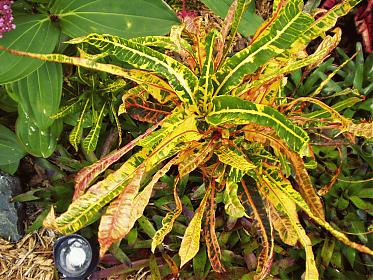
Picture taken by Fawnridge.

Photo in Robertico's garden in Costa Rica.

Photo by Ron Kiefert of Randy Weisner's plant.

Photo by Robertico in Costa Rica.

Photo by Robertico in Costa Rica.

Photo by Robertico in Costa Rica.

Photo by Robertico in Costa Rica.

Photo by Robertico in Costa Rica.


