Difference between revisions of "Chrysalidocarpus ambositrae"
| Line 44: | Line 44: | ||
<center><gallery caption="IMAGE GALLERY" perrow="3" widths="200px" heights="200px"> | <center><gallery caption="IMAGE GALLERY" perrow="3" widths="200px" heights="200px"> | ||
Image:Dypsis sp. from Ambositra.jpg|Madagascar. | Image:Dypsis sp. from Ambositra.jpg|Madagascar. | ||
| − | image:Ambositra22juillet2006.jpg|Madagascar. | + | image:Ambositra22juillet2006.jpg|Dypsis sp. from Ambositra, Madagascar. |
| − | image:SANY00131.jpg|Madagascar. | + | image:SANY00131.jpg|Dypsis sp. from Ambositra, Madagascar. |
| − | image:SANY00221.jpg|Madagascar. | + | image:SANY00221.jpg|Dypsis sp. from Ambositra, Madagascar. |
image:92_1.JPG|Madagascar. | image:92_1.JPG|Madagascar. | ||
image:Ambositra-palm-in-habitat.jpg|Madagascar. | image:Ambositra-palm-in-habitat.jpg|Madagascar. | ||
Revision as of 07:24, 26 October 2012
<google>CH02</google>

| Dypsis ambositrae | |||||||
|---|---|---|---|---|---|---|---|
 Madagascar. | |||||||
| Scientific Classification | |||||||
| |||||||
| Synonyms | |||||||
|
| |||||||
| Native Continent | |||||||
 | |||||||
| Morphology | |||||||
| |||||||
| Culture | |||||||
| |||||||
| Survivability index | |||||||
|
| |||||||
| Common names | |||||||
|
| |||||||
Contents
Habitat and Distribution
Endemic to Madagascar only, Central Madagascar, near Ambositra. Open forest and plateaus; among rocks or in riverine forest remnants, medium or steep mid slope; alt. 1300-1500 m.
Description
Solitary palm , often splits and doubles or even triples at or above ground elevation, usually stays solitary when in regularly burnt terrain. Trunk 3-7 m. tall, 12 cm. in diam.; internodes 10-20 cm., pale brown to grey (green and ringed when young), nodal scars 0.5 cm., grey; wood hard; base of stem slightly wider, with some surface roots; slight bulge in upper trunk in one older tree; crownshaft pale waxy grey-green. Crown holds 7-11 leaves, spiral, gracefully arching, with stiff pinnae; crownshaft 64-103 cm. long, pale green with a white bloom, ligules 2 cm.; petiole 3-30 cm. long, 3-6 x 2.2-4.5 cm. in diam., channelled with soft edges; rachis 2.1-2.8 m., in mid-leaf 2.2-3.5 cm. wide, green; pinnae 74-84 on each side of the rachis, grouped only very slightly in 2s-5s, in one plane, the pinnae on opposite sides of the rachis at an angle of roughly 130° +-, stiff with only the apices pendulous, apices attenuate, unequally bifid, the proximal 69-144 x 0.3-1.8 cm., (first interval c. 29 cm., more distal 3.5-9 cm.), median 89-114 x 2.3-3 cm (leaflet interval 0.2-2 cm, group interval 2-3.5 cm), distal 18-58 x 0.8-2.5 cm, abaxially with distant tufts of pale grey ramenta over almost whole length of midrib, with scattered scales very faint to invisible, main veins faint, with only the midrib very prominent on the adaxial surface. INFLORESCENCE: Interfoliar, branched to 2 (3 in a few cases) orders, with the basal part within the closed sheath, the prophyll hidden and the peduncular bract spreading from the top of the sheath; peduncle 68-123 cm. long, distally 9 x 5 cm. in diam., green, glabrous, curved outside the sheath; prophyll c. 91 cm., borne at 32 cm. above the base of the peduncle, 11.5 cm. wide, narrowly 2-winged; peduncular bract deciduous, about 80 cm., beaked (about 5 cm.) and closed distally, pale waxy grey, inserted about 48 cm. from the base of the peduncle; open peduncular bract 14 x 7 cm.; rachis 84-102 cm., with 23-24 branched and 14-17 unbranched first order branches, in a few cases some of the proximal branches branched twice more, but not more than 3 in the entire inflorescence; all axes green with white bloom; first order branches proximally 2-3 x 0.5-1 cm.; rachillae 14-32 cm., 3-4 mm. in diam., with flattish base and distant to rather dense triads, hardly sunken in slight pits with entire, obtuse or acute bracts. STAMINATE FLOWERS with sepals 2.2-2.5 x 1.6-2.2 mm., keeled, gibbous at the base, broadly ovate, obtuse, the margins membranous; petals connate for 0.2-0.5 mm., the free lobes 2.8-3 x 2.8-3.2 mm., ovate or elliptic, acute, sometimes with hooded apex; stamens 6, uniseriate, the filaments connate for 0.2-0.5 mm., 2.8-3.2 mm. long, anthers 2.1-2.3 x 1 mm.; pistillode 2.2-2.3 mm., columnar, 0.8-1 mm. in diam. PISTILLATE FLOWERS with sepals 2.4-3 x 3-4.1 mm., broadly ovate, rounded; petals hardly connate at the base, 3.5-4.1 x 4-5 mm., imbricate but for the apiculate apex, broadly ovate, concave; staminodes 6, 0.3-1.6 mm., narrow and flat; ovary asymmetrical, 2.7-4.8 x 2.8-4 mm., with indistinct pyramidal stigmas. FRUIT only known from carbonized remnants, about 14 x 10.5 mm., possibly with fibrous endocarp, possibly with ruminate endosperm. Editing by edric.
With its slightly grouped pinnae, and glabrous inflorescences branched to 2 orders, this species is allied to D. oreophila and D. tsaratananensis, from which it is easily distinguishable by its larger crownshaft, longer leaves with larger pinnae, the much longer inflorescences, and the larger fruit.
Culture
A trouble free palm in Southern California. It can handle a variety of conditions from full inland sun to filtered sun on the coast. Puts out about three or four leaves a year.
Comments and Curiosities
A graceful palm of the high plateaux, which would probably do quite well in cultivation. We have looked for seeds but not found any, so far. This species will probably become extinct in the near future, unless some rapid action is taken to safeguard the remaining trees, now numbering less than ten. The name comes from the town which lies between the known populations. (J. Dransfield and H. Beentje. 1995).
Conservation: Critical. In 1992 twelve trees of this species were known, all growing in or next to agricultural areas; in 1994, at least five of these had been cut down or burnt. (J. Dransfield and H. Beentje. 1995).
This is a tillering palm, it exhibits saxophone style root growth (it has a heel), keep top third of heel above soil elevation!
External Links
- Glossary of Palm Terms
- Pronunciation Key
- http://www.kew.org/plants/palms/dypsis_ambositrae.html
- THE SAXOPHONE STYLE ROOT GROWTH (HEEL)
References
- Journal of the International Palm Society Vol.51(1). Page 4.
Special thanks to Geoff Stein, (Palmbob) for his hundreds of photos, edric.
- IMAGE GALLERY

Madagascar.

Dypsis sp. from Ambositra, Madagascar.

Dypsis sp. from Ambositra, Madagascar.

Dypsis sp. from Ambositra, Madagascar.
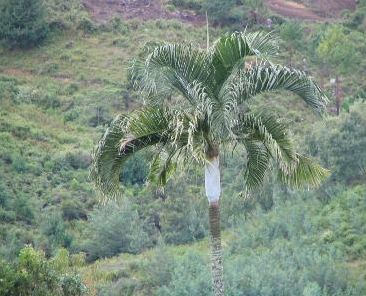
Madagascar.

Madagascar.

Madagascar.

Madagascar.

Madagascar. Photo by Jörg Schumann, Thirnax Palms & Cycads, (I got all those fresh Madfox seeds from) edric.

KEW.

Madagascar.

Madagascar.

Madagascar.

Madagascar.

Madagascar.

Floribunda Palms, Hawaii.

Floribunda Palms, Hawaii.

Floribunda Palms, Hawaii.

Floribunda Palms, Hawaii.

Floribunda, Hawaii.

SoCal. Photo by Stevo, edric.

SoCal. Photo by Stevo, edric.

SoCal. Photo by Stevo, edric.

Juvenille, California, nevermind the crazy apple mouthed lady.

Photo by Matt Bradford, Spring Valley, CA. edric.

Photo by Matt Bradford, Spring Valley, CA. edric.

Photo by Brett, SoCal, edric.

Photo by Brett, SoCal, edric.

Photo by Brett, SoCal, edric.

Photo by Brett, SoCal, edric.

Photo by Brett, SoCal, edric.

Photo by Brett, SoCal, edric.

Photo by Brett, SoCal, edric.

Photo by Brett, SoCal, edric.

Photo by Brett, SoCal, edric.

Photo by Brett, SoCal, edric.

Photo by Brett, SoCal, edric.

Photo by Brett, SoCal, edric.

Photo by Brett, SoCal, edric.

Photo by Brett, SoCal, edric.

Photo by Brett, SoCal, edric.

Photo by Brett, SoCal, edric.

SoCal. photo by Nick, edric.

A little chlorotic, cause: not enough Perlite in the mix, edric, Oak Hill FL.

edric, Oak Hill FL.

edric, Oak Hill FL.

edric, Oak Hill FL.

Spear opens a few days later, edric, Oak Hill FL.

edric, Oak Hill FL.

New spear, edric, Oak Hill FL.

New spear, edric, Oak Hill FL.

New spear, edric, Oak Hill FL.

New spear, edric, Oak Hill FL.

New spear, edric, Oak Hill FL.

New spear, edric, Oak Hill FL.

New spear, edric, Oak Hill FL.

New leaf fully open on Feb. 15th 2012 and here's the new spear at Easter, edric, Oak Hill FL.

New leaf fully open on Feb. 15th 2012 and here's the new spear at Easter, edric, Oak Hill FL.

New leaf fully open on Feb. 15th 2012 and here's the new spear at Easter, edric, Oak Hill FL.

Close-up of the new leaf that opened in Feb. 2012, edric, Oak Hill FL.

Close-up of the new leaf that opened in Feb. 2012, edric, Oak Hill FL.

Close-up of the new leaf that opened in Feb. 2012, edric, Oak Hill FL.

Close-up of the new leaf that opened in Feb. 2012, edric, Oak Hill FL.

April 22, said spear at Easter, nearly open, edric, Oak Hill Fl.

April 22, said spear at Easter, nearly open, edric, Oak Hill Fl.

April 22 2012 said spear at Easter, nearly open, edric, Oak Hill Fl.

April 22 2012 said spear at Easter, nearly open, edric, Oak Hill Fl.

July 23 2012 new spear opens, edric, Oak Hill FL.

July 23 2012 new spear opens, edric, Oak Hill FL.

July 23 2012 new spear opens, edric, Oak Hill FL.

July 23 2012 new spear opens, edric, Oak Hill FL.

July 23 2012 new spear opens, edric, Oak Hill FL.

July 23 2012 new spear opens, edric, Oak Hill FL.

August 18 2012, New leaf fully open, edric, Oak Hill FL.

August 18 2012 New leaf fully open, edric, Oak Hill FL.

August 18 2012 New leaf fully open, edric, Oak Hill FL.

10/02/2012, new leaf opens, edric, Oak Hill FL.

10/02/2012, new leaf opens, edric, Oak Hill FL.

edric, Oak Hill FL.

24 months old, Mosquito Hawk for scale, edric, Oak Hill FL.

24 months old, Mosquito Hawk for scale, edric, Oak Hill FL.

24 months old, Mosquito Hawk for scale, edric, Oak Hill FL.

30 months old, edric, Oak Hill FL.

30 months old, edric, Oak Hill FL.

26 months old, edric, Oak Hill FL.

26 months old, edric, Oak Hill FL.

26 months old, edric, Oak Hill FL.

34 months old, edric, Oak Hill FL.

34 months old, edric, Oak Hill FL.

60 days old, edric, Oak Hill FL.

60 days old, edric, Oak Hill FL.

60 days old, edric, Oak Hill FL.

60 days old, edric, Oak Hill FL.

78 days old, March now going outside, edric, Oak Hill FL.

78 days old, March now, going outside, edric, Oak Hill FL.

78 days old, March now, going outside, edric, Oak Hill FL.

78 days old, March now going outside, edric, Oak Hill FL.

78 days old, March now, going outside, edric, Oak Hill FL.

78 days old, March now, going outside, edric, Oak Hill FL.
78 days old, March now, going outside, edric, Oak Hill FL.

78 days old, March now, going outside, edric, Oak Hill FL.

78 days old, March now, going outside, edric, Oak Hill FL.

Seed detail, approx. .50 inches across, 1.27 centimeters, edric, Oak Hill FL.

Seed detail, approx. .50 inches across, 1.27 centimeters, edric, Oak Hill FL.

Seed detail, approx. .50 inches across, 1.27 centimeters, edric, Oak Hill FL.

Seed detail, approx. .50 inches across, 1.27 centimeters, edric, Oak Hill FL.

Seed detail, approx. .50 inches across, 1.27 centimeters, edric, Oak Hill FL.

Seed detail, approx. .50 inches across, 1.27 centimeters, edric, Oak Hill FL.


Many Special Thanks to Ed Vaile for his long hours of tireless editing and numerous contributions.