Difference between revisions of "Chrysalidocarpus bejofo"
| Line 71: | Line 71: | ||
Image:Dyp bejof cr.jpg|"Broadleaf Form" Hawaii. | Image:Dyp bejof cr.jpg|"Broadleaf Form" Hawaii. | ||
Image:Dypsis bejofo close up.jpg|"Broadleaf Form" Hawaii. | Image:Dypsis bejofo close up.jpg|"Broadleaf Form" Hawaii. | ||
| − | image:F120614k1.JPG|"Broadleaf Form" | + | image:F120614k1.JPG|"Broadleaf Form", Hawaii |
image:Dyps bejo 01.jpg|"Broadleaf Form" Hawaii. photo by BGL | image:Dyps bejo 01.jpg|"Broadleaf Form" Hawaii. photo by BGL | ||
image:Dypsis bejouf hawaii.jpg|"Broadleaf Form" in Hawaii | image:Dypsis bejouf hawaii.jpg|"Broadleaf Form" in Hawaii | ||
Revision as of 16:39, 19 March 2013
<google>CH02</google>

| Dypsis (DIP-sis) bejofo (beh-JO-foh) | |||||||
|---|---|---|---|---|---|---|---|
 Andranomenahely catchment, Makir, Toamasina, Madagascar. Photo by Dr. William J. Baker, edric. | |||||||
| Scientific Classification | |||||||
| |||||||
| Synonyms | |||||||
|
| |||||||
| Native Continent | |||||||
 | |||||||
| Morphology | |||||||
| |||||||
| Culture | |||||||
|
| |||||||
| Survivability index | |||||||
|
| |||||||
| Common names | |||||||
|
| |||||||
Contents
Habitat and Distribution
Madagascar. Only known from Maroantsetra and Mananara, around the Bay of Antongil. Moist lowland forest; steep slope; 200-400 m.
Description
Solitary canopy palm. TRUNK 15-25 m high, 25-40 cm in diam., near the crown about 20 cm in diam.; internodes 20-35 cm, pale reddish brown, near the crown 2-10 cm, dark green to ashy grey; crownshaft white, waxy. LEAVES 7-10 in the crown, sub-tristichous, porrect and arching; sheath 1-2 m, 25-40 cm in diam., abaxially white waxy and distally dense red-brown scaly, adaxially peach-coloured; petiole 12-34 cm long, 4.5-15 cm wide, densely pubescent; rachis 3-6 m long, brown-scaly, in mid-leaf 2.5-5 x 1.5-4 cm, channelled in the proximal 2 m; pinnae 80-100 on each side of the rachis, in groups of 5-7 and fanned within the groups, group interval 8-10 cm, rich green, stiff or arched, the distal part often bent down, the proximal 90-200 x 0.4-1.7 cm and often with the most proximal pendulous, median 72-144 x 1.3-4 cm (interval 0.5-2 cm), distal 30-69 x 0.6- 1.8 cm, main vein 1, with few ramenta 5-6 mm long on the midrib, otherwise glabrous and waxy, apices unequally bifid, attenuate. INFLORESCENCE infrafoliar, branched to 2 (- 3) orders, 0.5 x 0.5-1 m, yellow-green with sub-pendulous rachillae; peduncle 13-20 cm long, 5-10 x 3-7 cm in diam., green with scattered scales; prophyll 20-30 cm long, to 19 cm wide, borne on the peduncle at 2-4 cm, with scattered scales; peduncular bract inserted at 5-9 cm from the base of the peduncle, 54-91 cm long and 10-17 cm wide, with scattered scales, flushed pink or pale lavender, split except for the beak; non-tubular peduncular bract rarely present, once seen 18 cm long; rachis 20-52 cm long, glabrous or with scattered scales, with 15-17 first order branches, these proximally 1.3-6 x 0.5-2.2 cm in diam.; rachillae 20- 44 cm long (to 73 cm in fruit), green, stiff, 3.5-10 mm in diam., glabrous, with dense, slightly sunken triads; rachilla bract 2 mm long. STAMINATE FLOWERS scented like Sambucus nigra; sepals 2.3-2.8 x 2.1-2.4 mm; petals connate for about 1 mm, free parts 4.1-4.5 x 2.3-2.5 mm; stamens 6, slightly biseriate (offset 0.2 mm), filaments 1.5-1.8 mm, cylindrical, anthers 2.2-2.7 x 0.7-1 mm; pistillode 4 x 1 mm. PISTILLATE FLOWERS in young fruit with sepals 2.8-3.2 x 2.5-3.7 mm; petals 3.7-4.3 x 4-5.3 mm. FRUIT with very fibrous endocarp, 20- 25 x 18-21 mm. SEED ellipsoid, black, deeply grooved, 17-23 x 15-20.5 mm; endosperm deeply penetrated, the grooves regular and dense, 2-9 mm deep. (J. Dransfield and H. Beentje. 1995) Editing by edric.
When this tree is sterile it resembles D. pilulifera, which is less massive and has less strikingly plumose leaves. It is probably close to D. hovomantsina and D. canaliculata. The seed is most unusual and distinctive and until recently we thought of a form unique within the genus. However, in 1994 JD saw similar, but smaller, seed with entirely different seedlings in cultivation in Australia, seed source unknown, but 'from Madagascar'. (J. Dransfield and H. Beentje. 1995).
Culture
Comments and Curiosities
One of the most impressive palms of Madagascar. The massive trunk and enormous leaves, sometimes arranged in three rows in an arching crown, give this tree a majestic appearance. This would be a spectac ular ornamental tree for grand landscaping in the tropics. Seeds have been widely distributed. The local name has supplied us with the specific epithet. (J. Dransfield and H. Beentje. 1995).
Conservation: Endangered. Only known from two sites, where numbers are low.
This is a tillering palm, it exhibits saxophone style root growth (it has a heel), keep top third of heel above soil elevation!
External Links
References
Phonetic spelling of Latin names by edric.
Special thanks to Geoff Stein, (Palmbob) for his hundreds of photos, edric.
Special thanks to palmweb.org, Dr. John Dransfield, Dr. Bill Baker & team, for their volumes of information and photos, edric.
- IMAGE GALLERY

Sahavary, Masoala, Madagascar. Photo by Dr. John Dransfield, edric.

Maroantsetra, Madagascar. Photo by Dr. John Dransfield, edric.

Andranomenahely catchment, Makir, Toamasina, Madagascar. Photo by Dr. William J. Baker, edric.

Andranomenahely catchment, Makir, Toamasina, Madagascar. Photo by Dr. William J. Baker, edric.

Andranomenahely catchment, Makir, Toamasina, Madagascar. Photo by Dr. William J. Baker, edric.

Andranomenahely catchment, Makir, Toamasina, Madagascar. Photo by Dr. William J. Baker, edric.

Andranomenahely catchment, Makir, Toamasina, Madagascar. Photo by Dr. William J. Baker, edric.

Habitat - Photo Marcus.

True form.
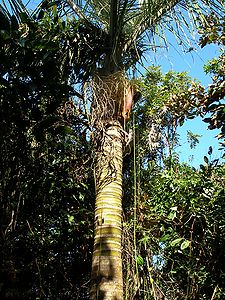
Habitat - Photo Phil Arrowsmith.


Habitat - Photo Marcus.

Habitat - Photo Marcus, Jeff Marcus for Scale.

Photo - Marcus.

Floribunda Palms, Hawaii, Jeff Marcus for scale, photo by BGL, edric.

New Caledonia. Photo by Ben, edric.

"Broadleaf Form", Hawaii.

"Broadleaf Form", Hawaii.

"Broadleaf Form" Hawaii.

"Broadleaf Form" Hawaii.

"Broadleaf Form" Hawaii.

"Broadleaf Form", Hawaii

"Broadleaf Form" Hawaii. photo by BGL

"Broadleaf Form" in Hawaii

"Broadleaf Form" also called Dypsis Bejofa

"Broadleaf Form" also called Dypsis Bejofa


.jpg)


Many Special Thanks to Ed Vaile for his long hours of tireless editing and numerous contributions.