Difference between revisions of "Brahea moorei"
(Created page with "__noeditsection__ <google>CH02</google> [[Image: {{Palmbox |image= |image_caption= |genus=Brahea |species= |subspecies=moorei |variety= |cultivar= |synonyms= |continent=america |...") |
|||
| (49 intermediate revisions by 2 users not shown) | |||
| Line 1: | Line 1: | ||
__noeditsection__ | __noeditsection__ | ||
| − | |||
| − | |||
{{Palmbox | {{Palmbox | ||
| − | |image= | + | |image=Brahea_moorei_07.jpg |
| − | |image_caption= | + | |image_caption=Algarve/Portugal. Photo by Charles Wychgel |
| − | |genus=Brahea | + | |genus=Brahea (brah-HEH-ah) |
| − | |species= | + | |species=<br>moorei (moor'-ee) |
| − | |subspecies= | + | |subspecies= |
|variety= | |variety= | ||
|cultivar= | |cultivar= | ||
|synonyms= | |synonyms= | ||
|continent=america | |continent=america | ||
| − | |habit=Solitary | + | |habit=Solitary & acaulescent |
|leaf_type=Costapalmate | |leaf_type=Costapalmate | ||
| − | |height= | + | |height=2-4 Feet |
|trunk_diameter= | |trunk_diameter= | ||
|sun_exposure= | |sun_exposure= | ||
| Line 20: | Line 18: | ||
|soil_type= | |soil_type= | ||
|msi= | |msi= | ||
| − | |common_names= | + | |common_names=Dwarf Rock Palm |
}} | }} | ||
| − | |||
==Habitat and Distribution== | ==Habitat and Distribution== | ||
| − | + | ''Brahea moorei'' is found in Mexico, Northeast. Sierra Madre Oriental, in north-eastern Mexico. Dry, high altitude oak forest on rocky limestone slopes, between 1500, and 2000 m. | |
| + | [[Image:Bm5.jpg|thumb|left|500px|Balearic Islands (spaiñ). Photo by Sergi]] | ||
==Description== | ==Description== | ||
| + | This Brahea is so unique that it cannot be confused with any other Brahea. Beautiful soft leaf ideal for small gardens. Non trunked to creeping habit and genetically dwarf. First true leaves appear at about age three to four years old and are about 6 to 9 inches wide. Ten year old trees have leaves that are about 3 feet wide and full spread of trees are about 5 feet wide. It takes about ten years for this tree to fully mature and produce the waxy coating on the flower stock and new emerging leaves. The waxy coating that is also on the new leaf as the new leaf opens, remains on the tips of the leaf ridges as well as the underside of the leaf. Goats in habitat limit the production of seeds since the flower stocks are eaten and limit natural propagation. Flower stocks are three times as long as the smooth petioles. Trees in fruit exhibit stalks upright above the tree topped with clusters of yellow fruit. Germination rate is excellent although it may take as long as a year. Seeds are not produced during periods of drought. (Palm Society, Northern California) | ||
| + | Habit: Solitary and acaulescent, often caespitose; crown holds 5-7 leaves, Leaf Size: 2’ wide, Foliage: Mature plant; Dark green with white appearing both on top in between leaflets and, more completely, on the bottom of the leaf., greyish to silvery blue underneath, Flower Color: White, The inflorescence is erect, and stands above the foliage, Fruit Color: Purple. | ||
==Culture== | ==Culture== | ||
| − | + | Growth Rate: Slow, Height: 2-4’, Salt Tolerance: Low, Soil Preference: Alkaline, Drought Tolerance: High, Light Requirements: High | |
| + | Hazards: None reported, Pest Problems: Palmetto weevils, Disease Problems: Phytophthora root and bud rot. USDA Hardiness Zone: 8a; No damage at 14°F. | ||
| + | <center>[[file:PFC_for_PP.png|500px|link=http://www.palmpedia.net/palmsforcal/index.php5/Brahea_moorei]]</center> | ||
==Comments and Curiosities== | ==Comments and Curiosities== | ||
| + | "Rare in cultivation, this is basically a trunkless palm. Has large blue-green fan leaves that are nearly circular and have a chalky white on the underside. Very cold hardy for a Brahea, but doesnt like it too wet. Has spineless petioles (think only the only other Brahea that has spineless petioles is B. nitida). Probably the smallest, or second smallest species of the genus." (Geoff Stein) | ||
| + | The smallest of the Braheas is immediately recognizable by its short habit, the absence of a trunk (which actually is underground), the lush, dark green leaves with stunning white undersides, and the long inflorescences that extend well beyond them. Brahea moorei is native to the dry, high altitude oak forest in the Sierra Madre Oriental in northeastern Mexico between 1400 and 2000 m (4600 to 6600 ft.). In cultivation, it is suitable for temperate and subtropical climates and can handle severe frosts down to about -10°C (14°F) without damage. Due to its small size, the Dwarf Rock Palm is an ideal, tough and very attractive ground cover for shade or sun. (RPS.com) | ||
| + | |||
| + | <br style="clear:both;"/> | ||
| + | {{#Widget:AdResban}} | ||
| + | <center><gallery caption="IMAGE GALLERY" perrow="" widths="" heights=""> | ||
| + | image:Bmsp_148_0.jpg|Palm Patch Nursery, Los Altos Hills, CA. Photo by Dennis Valdez | ||
| + | image:Bmsp_148_1.jpg|Palm Patch Nursery, Los Altos Hills, CA. Photo by Dennis Valdez | ||
| + | image:Moorei.jpg|Yucca-do, Mexico. Photo by Richard Travis | ||
| + | image:Moorei02.jpg|Yucca-do, Mexico. Photo by Richard Travis | ||
| + | image:Moorei03.jpg|Yucca-do, Mexico. Photo by Richard Travis | ||
| + | image:Brahea_moorei.jpg|B. moorei in foreground. Photo-Walker's Palms | ||
| + | image:Bc4cf5.jpg|SoCal. Photo by Geoff Stein | ||
| + | image:F4ee2a.jpg|"Flowers in May 2009 in San Antonio, Tx." Photo by Agaveguy | ||
| + | image:6cfbfd.jpg|SoCal. Photo by Geoff Stein | ||
| + | image:4edadb.jpg|SoCal. Photo by Geoff Stein | ||
| + | image:715807.jpg|"University of California Botanical Garden at Berkeley." Photo by Growin | ||
| + | image:2b5f68.jpg|"University of California Botanical Garden at Berkeley." Photo by Growin | ||
| + | image:BmDSC_3284.jpg|At Gary's place. South Escondido, CA. Photo by Gary T. Le Vine | ||
| + | image:Bm1.jpg|Balearic Islands (spaiñ). Photo by Sergi | ||
| + | image:Bm2.jpg|Balearic Islands (spaiñ). Photo by Sergi | ||
| + | image:Bm3.jpg|Balearic Islands (spaiñ). Photo by Sergi | ||
| + | image:Bm4.jpg|Balearic Islands (spaiñ). Photo by Sergi | ||
| + | image:Bm5.jpg|Balearic Islands (spaiñ). Photo by Sergi | ||
| + | image:Brahea-moorei-01-2010.jpg|Algarve/Portugal. Photo by Charles Wychgel | ||
| + | image:Brahea_moorei_07.jpg|Algarve/Portugal. Photo by Charles Wychgel | ||
| + | image:Brahea_moorei_4-09.JPG|South Kona, Hawaii. Photo by Al in Kona | ||
| + | image:Brahea_moorei_4-'09.JPG|South Kona, Hawaii. Photo by Al in Kona | ||
| + | image:Braheamoorei002.jpg|Central Valley, Ca. Photo by Glenn | ||
| + | image:Braheamoorei003.jpg|Central Valley, Ca. Photo by Glenn | ||
| + | image:Braheamoorei004.jpg|Central Valley, Ca. Photo by Glenn | ||
| + | image:Braheamoorei005.jpg|Central Valley, Ca. Photo by Glenn | ||
| + | image:Brahea_moorei_inflorenscence.jpg|Photo by Glenn | ||
| + | image:Brahea_moorei_fullsun.jpg|Full sun. Berkeley, CA; USDA Zone 9, wet winters. Photo by Glenn | ||
| + | image:Mex_feb_3.jpg|Northern Mexico. Photo by Tad | ||
| + | image:17tho.jpg|Brahea moorei shining in the woodland on a slightly more open and drier slope. This really is a beautifully elegant palm, holding it's heavily waxy glaucous leaves upright for inspection with long inflorescences drooping over the whole plant. A trunked Brahea dulcis lurks behind. Photo-Adventures in Mexico | ||
| + | image:17thp.jpg|although small in stature the Brahea moorei here are often very ancient. Here you can clearly see the creeping trunk that must be several decades old. Photo-Adventures in Mexico | ||
| + | image:post-376-0-76894200-1364835027.jpg|Central Valley, Ca. Photo by Glenn | ||
| + | image:post-376-0-45265500-1364835056.jpg|Central Valley, Ca. Photo by Glenn | ||
| + | image:296caac.jpg|Brahea moorei, west of Cd Victoria. Photo by richtrav | ||
| + | image:2qakbbp.jpg|Brahea moorei, west of Cd Victoria. Photo by richtrav | ||
| + | File:post-465-0-12861100-1422573639.jpg|The state of Paraná-south Brazil. Photo by Alberto Leonardo Barkema. | ||
| + | |||
| + | image:BraMoo.jpg|In habitat. Photo-Rare Palm Seeds.com | ||
| + | image:BraMoo_seeds.jpg|Photo-Rare Palm Seeds.com | ||
| + | </gallery></center> | ||
==External Links== | ==External Links== | ||
*[http://eunops.org/content/glossary-palm-terms Glossary of Palm Terms] | *[http://eunops.org/content/glossary-palm-terms Glossary of Palm Terms] | ||
*[http://www.calflora.net/botanicalnames/pronunciation.html MODERN BOTANICAL LATIN] | *[http://www.calflora.net/botanicalnames/pronunciation.html MODERN BOTANICAL LATIN] | ||
*[http://www.jlhudsonseeds.net/Pronunciation.htm "Just To Be Clear"] | *[http://www.jlhudsonseeds.net/Pronunciation.htm "Just To Be Clear"] | ||
| + | *http://www.palms.org/principes/1992/vol36n3p128-132.pdf | ||
| + | *[http://www.youtube.com/watch?v=6FqGZ0yBLU4&feature=player_embedded At Gary Le Vine's place. Video by Troy Donovan.] | ||
| + | *[http://www.oasisdesigns.co.uk/mex07/mex07/adventures_in_mexico_17th.htm Adventures in Mexico] | ||
==References== | ==References== | ||
Phonetic spelling of Latin names by edric. | Phonetic spelling of Latin names by edric. | ||
| − | Special thanks to Geoff Stein, (Palmbob) for his hundreds of photos | + | Special thanks to Geoff Stein, (Palmbob) for his hundreds of photos. |
| − | Special thanks to palmweb.org, Dr. John Dransfield, Dr. Bill Baker & team, for their volumes of information and photos | + | Special thanks to [http://palmweb.org/?q=node/2 Palmweb.org], Dr. John Dransfield, Dr. Bill Baker & team, for their volumes of information and photos. |
Glossary of Palm Terms; Based on the glossary in Dransfield, J., N.W. Uhl, C.B. Asmussen-Lange, W.J. Baker, M.M. Harley & C.E. Lewis. 2008. Genera Palmarum - Evolution and Classification of the Palms. Royal Botanic Gardens, Kew. All images copyright of the artists and photographers (see images for credits). | Glossary of Palm Terms; Based on the glossary in Dransfield, J., N.W. Uhl, C.B. Asmussen-Lange, W.J. Baker, M.M. Harley & C.E. Lewis. 2008. Genera Palmarum - Evolution and Classification of the Palms. Royal Botanic Gardens, Kew. All images copyright of the artists and photographers (see images for credits). | ||
| − | |||
| − | |||
| − | |||
| − | |||
| − | |||
{{SpeciesListBackLink}} | {{SpeciesListBackLink}} | ||
[[Category:BRAHEA|moorei]] | [[Category:BRAHEA|moorei]] | ||
Latest revision as of 08:30, 30 December 2015
| Brahea (brah-HEH-ah) moorei (moor'-ee) | |||||||
|---|---|---|---|---|---|---|---|
 Algarve/Portugal. Photo by Charles Wychgel | |||||||
| Scientific Classification | |||||||
| |||||||
| Synonyms | |||||||
|
| |||||||
| Native Continent | |||||||
 | |||||||
| Morphology | |||||||
| |||||||
| Culture | |||||||
|
| |||||||
| Survivability index | |||||||
|
| |||||||
| Common names | |||||||
|
| |||||||
Contents
Habitat and Distribution
Brahea moorei is found in Mexico, Northeast. Sierra Madre Oriental, in north-eastern Mexico. Dry, high altitude oak forest on rocky limestone slopes, between 1500, and 2000 m.

Description
This Brahea is so unique that it cannot be confused with any other Brahea. Beautiful soft leaf ideal for small gardens. Non trunked to creeping habit and genetically dwarf. First true leaves appear at about age three to four years old and are about 6 to 9 inches wide. Ten year old trees have leaves that are about 3 feet wide and full spread of trees are about 5 feet wide. It takes about ten years for this tree to fully mature and produce the waxy coating on the flower stock and new emerging leaves. The waxy coating that is also on the new leaf as the new leaf opens, remains on the tips of the leaf ridges as well as the underside of the leaf. Goats in habitat limit the production of seeds since the flower stocks are eaten and limit natural propagation. Flower stocks are three times as long as the smooth petioles. Trees in fruit exhibit stalks upright above the tree topped with clusters of yellow fruit. Germination rate is excellent although it may take as long as a year. Seeds are not produced during periods of drought. (Palm Society, Northern California)
Habit: Solitary and acaulescent, often caespitose; crown holds 5-7 leaves, Leaf Size: 2’ wide, Foliage: Mature plant; Dark green with white appearing both on top in between leaflets and, more completely, on the bottom of the leaf., greyish to silvery blue underneath, Flower Color: White, The inflorescence is erect, and stands above the foliage, Fruit Color: Purple.
Culture
Growth Rate: Slow, Height: 2-4’, Salt Tolerance: Low, Soil Preference: Alkaline, Drought Tolerance: High, Light Requirements: High Hazards: None reported, Pest Problems: Palmetto weevils, Disease Problems: Phytophthora root and bud rot. USDA Hardiness Zone: 8a; No damage at 14°F.

Comments and Curiosities
"Rare in cultivation, this is basically a trunkless palm. Has large blue-green fan leaves that are nearly circular and have a chalky white on the underside. Very cold hardy for a Brahea, but doesnt like it too wet. Has spineless petioles (think only the only other Brahea that has spineless petioles is B. nitida). Probably the smallest, or second smallest species of the genus." (Geoff Stein)
The smallest of the Braheas is immediately recognizable by its short habit, the absence of a trunk (which actually is underground), the lush, dark green leaves with stunning white undersides, and the long inflorescences that extend well beyond them. Brahea moorei is native to the dry, high altitude oak forest in the Sierra Madre Oriental in northeastern Mexico between 1400 and 2000 m (4600 to 6600 ft.). In cultivation, it is suitable for temperate and subtropical climates and can handle severe frosts down to about -10°C (14°F) without damage. Due to its small size, the Dwarf Rock Palm is an ideal, tough and very attractive ground cover for shade or sun. (RPS.com)
- IMAGE GALLERY

Palm Patch Nursery, Los Altos Hills, CA. Photo by Dennis Valdez

Palm Patch Nursery, Los Altos Hills, CA. Photo by Dennis Valdez

Yucca-do, Mexico. Photo by Richard Travis

Yucca-do, Mexico. Photo by Richard Travis

Yucca-do, Mexico. Photo by Richard Travis

B. moorei in foreground. Photo-Walker's Palms

SoCal. Photo by Geoff Stein

"Flowers in May 2009 in San Antonio, Tx." Photo by Agaveguy

SoCal. Photo by Geoff Stein

SoCal. Photo by Geoff Stein
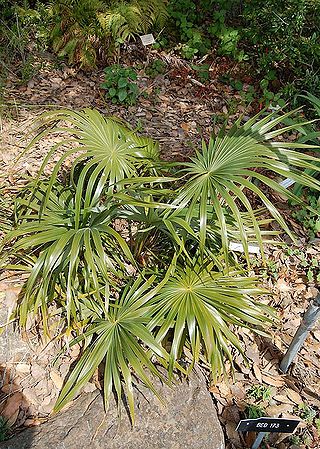
"University of California Botanical Garden at Berkeley." Photo by Growin

"University of California Botanical Garden at Berkeley." Photo by Growin

At Gary's place. South Escondido, CA. Photo by Gary T. Le Vine

Balearic Islands (spaiñ). Photo by Sergi

Balearic Islands (spaiñ). Photo by Sergi

Balearic Islands (spaiñ). Photo by Sergi

Balearic Islands (spaiñ). Photo by Sergi

Balearic Islands (spaiñ). Photo by Sergi

Algarve/Portugal. Photo by Charles Wychgel

Algarve/Portugal. Photo by Charles Wychgel

South Kona, Hawaii. Photo by Al in Kona

South Kona, Hawaii. Photo by Al in Kona

Central Valley, Ca. Photo by Glenn

Central Valley, Ca. Photo by Glenn

Central Valley, Ca. Photo by Glenn

Central Valley, Ca. Photo by Glenn

Photo by Glenn
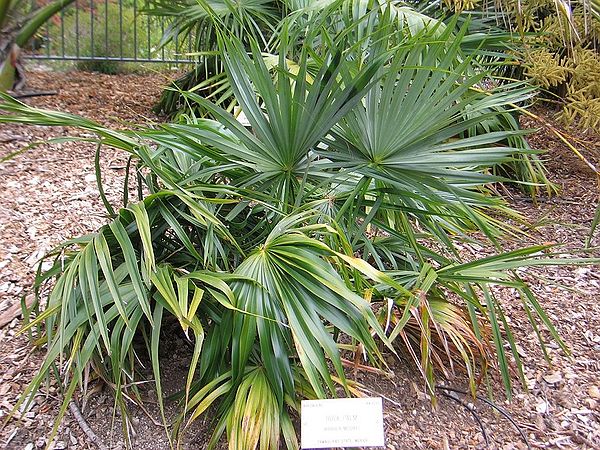
Full sun. Berkeley, CA; USDA Zone 9, wet winters. Photo by Glenn

Northern Mexico. Photo by Tad
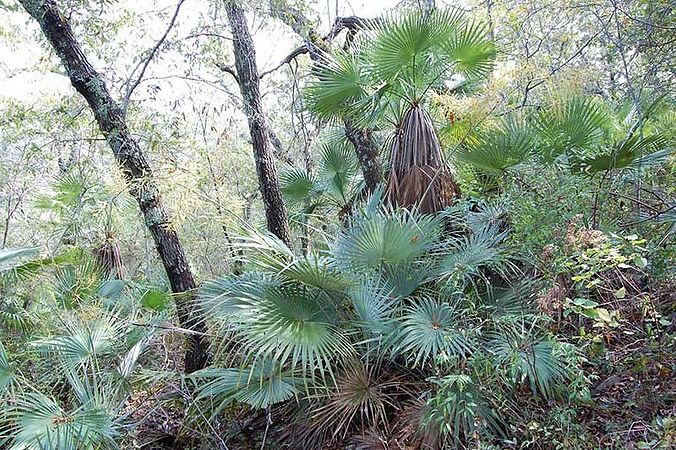
Brahea moorei shining in the woodland on a slightly more open and drier slope. This really is a beautifully elegant palm, holding it's heavily waxy glaucous leaves upright for inspection with long inflorescences drooping over the whole plant. A trunked Brahea dulcis lurks behind. Photo-Adventures in Mexico

although small in stature the Brahea moorei here are often very ancient. Here you can clearly see the creeping trunk that must be several decades old. Photo-Adventures in Mexico

Central Valley, Ca. Photo by Glenn

Central Valley, Ca. Photo by Glenn

Brahea moorei, west of Cd Victoria. Photo by richtrav

Brahea moorei, west of Cd Victoria. Photo by richtrav

The state of Paraná-south Brazil. Photo by Alberto Leonardo Barkema.

In habitat. Photo-Rare Palm Seeds.com

Photo-Rare Palm Seeds.com


External Links
- Glossary of Palm Terms
- MODERN BOTANICAL LATIN
- "Just To Be Clear"
- http://www.palms.org/principes/1992/vol36n3p128-132.pdf
- At Gary Le Vine's place. Video by Troy Donovan.
- Adventures in Mexico
References
Phonetic spelling of Latin names by edric.
Special thanks to Geoff Stein, (Palmbob) for his hundreds of photos.
Special thanks to Palmweb.org, Dr. John Dransfield, Dr. Bill Baker & team, for their volumes of information and photos.
Glossary of Palm Terms; Based on the glossary in Dransfield, J., N.W. Uhl, C.B. Asmussen-Lange, W.J. Baker, M.M. Harley & C.E. Lewis. 2008. Genera Palmarum - Evolution and Classification of the Palms. Royal Botanic Gardens, Kew. All images copyright of the artists and photographers (see images for credits).
Many Special Thanks to Ed Vaile for his long hours of tireless editing and numerous contributions.