Difference between revisions of "Dypsis pervillei"
| Line 1: | Line 1: | ||
| − | + | ||
__noeditsection__ | __noeditsection__ | ||
| − | |||
| − | |||
{{Palmbox | {{Palmbox | ||
|image=DypPer.jpg | |image=DypPer.jpg | ||
| Line 23: | Line 21: | ||
|common_names= | |common_names= | ||
}} | }} | ||
| − | |||
==Habitat and Distribution== | ==Habitat and Distribution== | ||
Madagascar; The only certain site is Betampona. Deep in the Forest. (J. Dransfield and H. Beentje. 1995)/Palmweb. | Madagascar; The only certain site is Betampona. Deep in the Forest. (J. Dransfield and H. Beentje. 1995)/Palmweb. | ||
| + | [[Image:DypPer.jpg|thumb|left|400px|In habitat. Photo-Rare Palm Seeds.com]] | ||
==Description== | ==Description== | ||
No data about habit. LEAVES: sheath 8-9 cm long, distally redpubescent or with scattered scales, with auricles 3-15 mm high and triangular; petiole 2-9 cm long, 2-3.5 mm in diam., with scattered reddish scales; rachis 19-35 cm long, in mid-leaf 1.5-2 mm wide, with scattered scales; leaflets 9-12 on each side of the rachis, in groups of 2-5, interval within the groups 0.5-0.7 cm, interval between the groups 4-9 cm, proximal leaflets 8-16 x 0.4-1.3 cm, median 11-23 x 0.8-1.5 cm, sigmoid, main vein 1, long acuminate, with scattered scales on minor veins on the abaxial side but glabrescent, with scattered scales on margins, distal pair 9-15 x 1-2 cm, connate for 2-2.5 cm, apices 5-10 mm wide and truncate and dentate, with 2-3 main veins. INFLORESCENCE unbranched, 25-60 cm; peduncle 12-31 cm long, 2-4 mm in diam., densely red-scaly; prophyll 8-14 cm long, 6-7 mm wide, borne at 1-4 cm above the base of the peduncle, with dense white or reddish scales, glabrescent, opening at the very apex; peduncular bract inserted at 4-11 cm from the base of the peduncle, 6-18 cm long, open in the distal 1-3.5 cm, with scattered scales; rachilla 14-24 cm long, 2-3 mm in diam., densely puberulous; triads in slight pits. STAMINATE FLOWERS with sepals 1-1.6 x 0.9-1.7 mm; petals 2.6-2.8 x 1.3-1.5 mm; stamens 6, not seen, described by Baillon and Beccari as: filaments slender, biseriate according to Baillon but ± equal according to Beccari, anthers dorsifixed, versatile, oblong, obtuse, the locules parallel or slightly divergent at the base. PISTILLATE BUDS with sepals 1.2-1.4 x 1.3-1.9 mm; petals about 3 x < 1 mm; staminodes at least four, 0.2-0.5 mm; gynoecium 2-2.5 x 1-1.7 mm. FRUIT unknown. (J. Dransfield and H. Beentje. 1995)/Palmweb. Editing by edric. | No data about habit. LEAVES: sheath 8-9 cm long, distally redpubescent or with scattered scales, with auricles 3-15 mm high and triangular; petiole 2-9 cm long, 2-3.5 mm in diam., with scattered reddish scales; rachis 19-35 cm long, in mid-leaf 1.5-2 mm wide, with scattered scales; leaflets 9-12 on each side of the rachis, in groups of 2-5, interval within the groups 0.5-0.7 cm, interval between the groups 4-9 cm, proximal leaflets 8-16 x 0.4-1.3 cm, median 11-23 x 0.8-1.5 cm, sigmoid, main vein 1, long acuminate, with scattered scales on minor veins on the abaxial side but glabrescent, with scattered scales on margins, distal pair 9-15 x 1-2 cm, connate for 2-2.5 cm, apices 5-10 mm wide and truncate and dentate, with 2-3 main veins. INFLORESCENCE unbranched, 25-60 cm; peduncle 12-31 cm long, 2-4 mm in diam., densely red-scaly; prophyll 8-14 cm long, 6-7 mm wide, borne at 1-4 cm above the base of the peduncle, with dense white or reddish scales, glabrescent, opening at the very apex; peduncular bract inserted at 4-11 cm from the base of the peduncle, 6-18 cm long, open in the distal 1-3.5 cm, with scattered scales; rachilla 14-24 cm long, 2-3 mm in diam., densely puberulous; triads in slight pits. STAMINATE FLOWERS with sepals 1-1.6 x 0.9-1.7 mm; petals 2.6-2.8 x 1.3-1.5 mm; stamens 6, not seen, described by Baillon and Beccari as: filaments slender, biseriate according to Baillon but ± equal according to Beccari, anthers dorsifixed, versatile, oblong, obtuse, the locules parallel or slightly divergent at the base. PISTILLATE BUDS with sepals 1.2-1.4 x 1.3-1.9 mm; petals about 3 x < 1 mm; staminodes at least four, 0.2-0.5 mm; gynoecium 2-2.5 x 1-1.7 mm. FRUIT unknown. (J. Dransfield and H. Beentje. 1995)/Palmweb. Editing by edric. | ||
| Line 44: | Line 42: | ||
Phonetic spelling of Latin names by edric. | Phonetic spelling of Latin names by edric. | ||
| − | Special thanks to Geoff Stein, (Palmbob) for his hundreds of photos | + | Special thanks to Geoff Stein, (Palmbob) for his hundreds of photos. |
| − | Special thanks to [http://palmweb.org/?q=node/2 Palmweb.org], Dr. John Dransfield, Dr. Bill Baker & team, for their volumes of information and photos | + | Special thanks to [http://palmweb.org/?q=node/2 Palmweb.org], Dr. John Dransfield, Dr. Bill Baker & team, for their volumes of information and photos. |
Glossary of Palm Terms; Based on the glossary in Dransfield, J., N.W. Uhl, C.B. Asmussen-Lange, W.J. Baker, M.M. Harley & C.E. Lewis. 2008. Genera Palmarum - Evolution and Classification of the Palms. Royal Botanic Gardens, Kew. All images copyright of the artists and photographers (see images for credits). | Glossary of Palm Terms; Based on the glossary in Dransfield, J., N.W. Uhl, C.B. Asmussen-Lange, W.J. Baker, M.M. Harley & C.E. Lewis. 2008. Genera Palmarum - Evolution and Classification of the Palms. Royal Botanic Gardens, Kew. All images copyright of the artists and photographers (see images for credits). | ||
| Line 52: | Line 50: | ||
Dransfield, J. & Beentje, H. 1995. The Palms of Madagascar. Royal Botanic Gardens, Kew and The International Palm Society. | Dransfield, J. & Beentje, H. 1995. The Palms of Madagascar. Royal Botanic Gardens, Kew and The International Palm Society. | ||
| − | <center><gallery caption="IMAGE GALLERY" perrow=" | + | <center><gallery caption="IMAGE GALLERY" perrow="" widths="" heights=""> |
image:DypPer.jpg|In habitat. Photo-Rare Palm Seeds.com | image:DypPer.jpg|In habitat. Photo-Rare Palm Seeds.com | ||
image: | image: | ||
Revision as of 11:21, 24 June 2014
| Dypsis (DIP-sis) pervillei (pehr-vehl'-leh) | |||||||
|---|---|---|---|---|---|---|---|
 In habitat. Photo-Rare Palm Seeds.com | |||||||
| Scientific Classification | |||||||
| |||||||
| Synonyms | |||||||
|
| |||||||
| Native Continent | |||||||
 | |||||||
| Morphology | |||||||
| |||||||
| Culture | |||||||
|
| |||||||
| Survivability index | |||||||
|
| |||||||
| Common names | |||||||
|
| |||||||
Contents
Habitat and Distribution
Madagascar; The only certain site is Betampona. Deep in the Forest. (J. Dransfield and H. Beentje. 1995)/Palmweb.
Description
No data about habit. LEAVES: sheath 8-9 cm long, distally redpubescent or with scattered scales, with auricles 3-15 mm high and triangular; petiole 2-9 cm long, 2-3.5 mm in diam., with scattered reddish scales; rachis 19-35 cm long, in mid-leaf 1.5-2 mm wide, with scattered scales; leaflets 9-12 on each side of the rachis, in groups of 2-5, interval within the groups 0.5-0.7 cm, interval between the groups 4-9 cm, proximal leaflets 8-16 x 0.4-1.3 cm, median 11-23 x 0.8-1.5 cm, sigmoid, main vein 1, long acuminate, with scattered scales on minor veins on the abaxial side but glabrescent, with scattered scales on margins, distal pair 9-15 x 1-2 cm, connate for 2-2.5 cm, apices 5-10 mm wide and truncate and dentate, with 2-3 main veins. INFLORESCENCE unbranched, 25-60 cm; peduncle 12-31 cm long, 2-4 mm in diam., densely red-scaly; prophyll 8-14 cm long, 6-7 mm wide, borne at 1-4 cm above the base of the peduncle, with dense white or reddish scales, glabrescent, opening at the very apex; peduncular bract inserted at 4-11 cm from the base of the peduncle, 6-18 cm long, open in the distal 1-3.5 cm, with scattered scales; rachilla 14-24 cm long, 2-3 mm in diam., densely puberulous; triads in slight pits. STAMINATE FLOWERS with sepals 1-1.6 x 0.9-1.7 mm; petals 2.6-2.8 x 1.3-1.5 mm; stamens 6, not seen, described by Baillon and Beccari as: filaments slender, biseriate according to Baillon but ± equal according to Beccari, anthers dorsifixed, versatile, oblong, obtuse, the locules parallel or slightly divergent at the base. PISTILLATE BUDS with sepals 1.2-1.4 x 1.3-1.9 mm; petals about 3 x < 1 mm; staminodes at least four, 0.2-0.5 mm; gynoecium 2-2.5 x 1-1.7 mm. FRUIT unknown. (J. Dransfield and H. Beentje. 1995)/Palmweb. Editing by edric.
On the type sheet labels (underneath the "Madagascar N. O. 1841" in ink) there is a note in pencil "plus probable Ste. Marie". In a little pocket on one of the type sheets there is some anther material (with some loose staminate petals 2-2.4 x 1.2 mm) with uniseriate filaments about 1 mm long and thin, and anthers 1.4-1.5 x 0.7-0.8 mm, dorsifixed with parallel locules. Though difficult to key out from D. heterophylla (except for the rachilla), we feel this is nevertheless a distinct species, related to D. curtisii and D. soanieranae. (J. Dransfield and H. Beentje. 1995)/Palmweb.
Culture
Cold Hardiness Zone: 10a
Comments and Curiosities
Another of those rare palms with unbranched inflorescences, not seen for many years. The name refers to the collector of the type, Auguste Pervillé, who collected in Madagascar between 1837 and 1841. (J. Dransfield and H. Beentje. 1995)/Palmweb.
Conservation: Presumably extinct. Not seen for seventy years. (J. Dransfield and H. Beentje. 1995)/Palmweb.
External Links
- Glossary of Palm Terms
- MODERN BOTANICAL LATIN
- "Just To Be Clear"
- https://maps.google.com/maps/ms?msid=203080657982474830488.0004bb99c72810c246937&msa=0
References
Phonetic spelling of Latin names by edric.
Special thanks to Geoff Stein, (Palmbob) for his hundreds of photos.
Special thanks to Palmweb.org, Dr. John Dransfield, Dr. Bill Baker & team, for their volumes of information and photos.
Glossary of Palm Terms; Based on the glossary in Dransfield, J., N.W. Uhl, C.B. Asmussen-Lange, W.J. Baker, M.M. Harley & C.E. Lewis. 2008. Genera Palmarum - Evolution and Classification of the Palms. Royal Botanic Gardens, Kew. All images copyright of the artists and photographers (see images for credits).
Dransfield, J. & Beentje, H. 1995. The Palms of Madagascar. Royal Botanic Gardens, Kew and The International Palm Society.
- IMAGE GALLERY
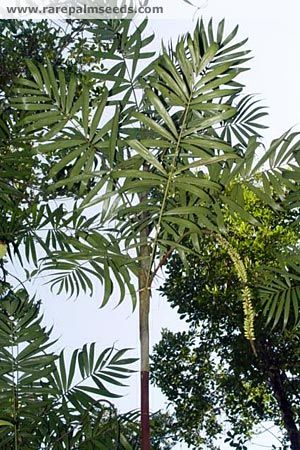
In habitat. Photo-Rare Palm Seeds.com

Kew.

Many Special Thanks to Ed Vaile for his long hours of tireless editing and numerous contributions.