Desmoncus polyacanthos Mart. is a slender, spiny climbing palm, one of the New World counterparts of the Asian rattans, and the most widespread member of its genus. It ranges from Trinidad and the southern Windward Islands through Venezuela and the Guianas into Amazonian Colombia, Ecuador, Peru, Bolivia and Brazil, with a separate group of populations in the Atlantic coastal forest of eastern Brazil. Its pencil- to finger-thick stems, usually in clumps, scramble up into the forest subcanopy, gripping their hosts with the whip-like leaf tip, which carries pairs of backward-pointing hooks, and with short, strongly hooked spines along the leaf axis. The best field marks are these small recurved spines (under 1 cm, with conspicuously swollen bases) and the smooth-skinned fruits, which lack the fibres seen under the skin of related species. It is also, after Desmoncus mitis, the most variable species of Desmoncus, and over 40 names, among them Desmoncus ulei, Desmoncus oxyacanthos, Desmoncus mirandanus and Desmoncus campylacanthus, are now regarded as belonging to it. Across Amazonia its tough, flexible stems, sold as jacitara in Brazil and cashavara or vara casha in Peru, are among the most widely used climbing-palm canes of South America, split into strands for baskets, sieves, manioc presses and woven chair seats.
Also known asSuriname bramble palm; Brazil bramble palm; jacitara (Brazil, Portuguese); cashavara (Peru, Spanish); vara casha (Peru, Spanish); jijebɨ meme, "sieve vine" (Maijuna, Peru)
Distribution and habitat

Native range: Bolivia, northern, north-eastern and south-eastern Brazil, Colombia, Ecuador, French Guiana, Guyana, Peru, Suriname, Trinidad and Tobago, Venezuela and the Windward Islands.
Henderson's 2011 revision mapped the species between latitudes 10°37′ N and 21°31′ S and longitudes 35°09′ W and 78°38′ W. It occurs in two main blocks:
- Northern South America and Amazonia: Trinidad, Venezuela (from the Coastal Range in Miranda to Apure, Barinas, Zulia, Amazonas, Bolívar and Delta Amacuro), Guyana, Suriname, French Guiana, the Brazilian Amazon (Amazonas, Roraima, Pará, Maranhão, Acre), the Colombian departments of Meta, Cundinamarca and Amazonas, eastern Ecuador, Peru (Loreto, Amazonas, San Martín, Pasco, Junín, Ucayali, Madre de Dios) and Bolivia. Specimens from the central Colombian Amazon are curiously scarce, which probably reflects too little collecting rather than a real gap.
- Atlantic coastal forest of Brazil: two separate areas in eastern Brazil, south to Rio de Janeiro, with northern outliers in Ceará, Alagoas and Pernambuco.
In the Lesser Antilles a single sterile specimen from St Vincent supports an earlier report from that island, and a herbarium sheet in Paris is labelled only "Martinique".
The palm grows in a wide range of lowland vegetation: rainforest on unflooded ground (terra firme), seasonally flooded forest, open white-sand campina, coastal restinga and scrub woodland near the sea. In the Amazon estuary of Pará it is found in both várzea and terra firme forest. In the Peruvian Amazon it is chiefly a plant of seasonally flooded forest, both primary and secondary, on the higher and lower natural river levees (locally also called restingas, not to be confused with the Brazilian coastal restinga); it is submerged by the annual river rise but recovers quickly afterwards. Craftworkers in Iquitos obtain their cane mainly from flooded forest along the Río Nanay and the lower Amazon near Tamshiyacu; at Jenaro Herrera (Loreto), where it has been studied, the mean temperature is about 25.9 °C. Along the Guiana coast it grows a little further inland than the strictly coastal Desmoncus horridus subsp. horridus, and in eastern Brazil a little further inland than Desmoncus orthacanthos, which occupies the seaward restinga. Recorded altitudes run from sea level to about 1120 m, with an average of about 205 m; two specimens from Ecuador, at 1000–1121 m, come from unusually high elevations for the species.
Description

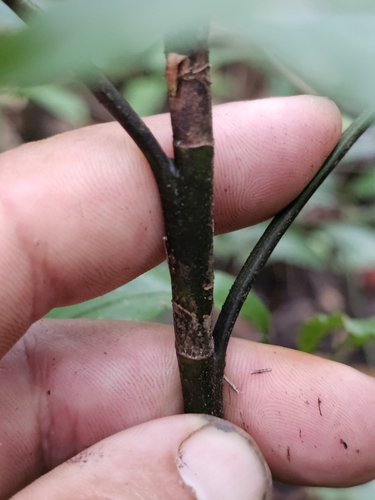
- Habit and stem: a climbing palm whose stems are usually clustered, although single-stemmed plants have also been reported; in Peru a single clump may hold more than 40 flexible, spiny stems. Stems are 1–37 m long (about 7.2 m on average) and only 0.5–2.9 cm thick (about 1.4 cm). The tubular leaf sheaths, which are entire and spiny, wrap the stem.
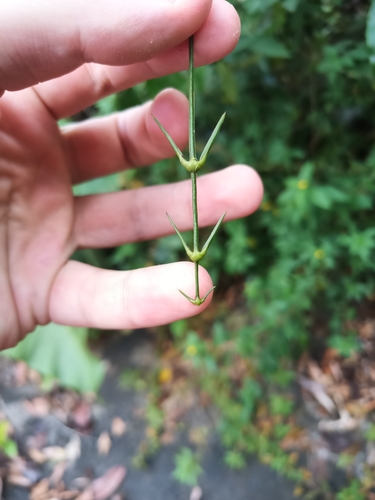
- Leaves: pinnate, 6–50 on a stem; petiole very short, 0.5–13.5 cm (about 3.2 cm). Rachis 25–173 cm long (about 64 cm) and 1.8–12.9 mm wide, armed mostly on the lower side with short spines, usually less than 1 cm long, curved backwards and with markedly swollen bases. Leaflets 4–15 on each side (usually 8), without thread-like tips, without a tuft of spines at the base and without spinules or dense felt on the upper surface at the base; the lowest leaflet 3.3–40 cm long and 0.3–5.8 cm wide. The cirrus (the whip-like extension of the leaf axis) is well developed and carries acanthophylls, which are short, rigid, reflexed hooks derived from leaflets. There are no transitional hooks between the last leaflets and the first acanthophylls, so a wide gap separates the two, and the cirrus bears spines underneath mainly near its base.
- Inflorescence: borne among the leaves and branched once. Peduncle 1.6–12.4 mm wide; the woody peduncular bract is 16.5–34 cm long (about 26 cm), broad, and lightly to densely set with short spines that are triangular in section, swollen at the base and angled obliquely, pale brownish at the base and brown at the tip, with felted margins; occasionally the bract is almost or entirely unarmed. The inflorescence axis is stouter than its 5–37 (usually about 15) rachillae, which are crowded and spirally arranged, each standing above a pointed bracteole and a swelling (pulvinus) in its axil. Rachillae hairless or slightly felted when young; the lowest 3.3–13 cm long and 0.6–2 mm wide.
- Flowers: unisexual, arranged in triads of one female flower flanked by two male flowers; male flowers with 5–6 stamens.
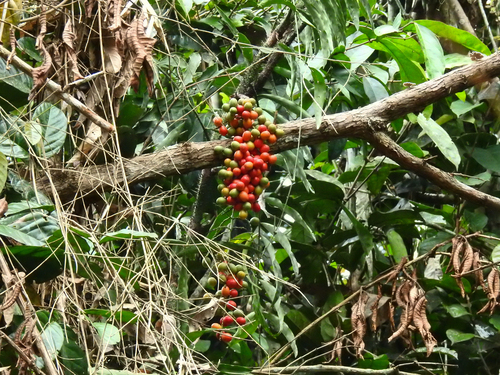
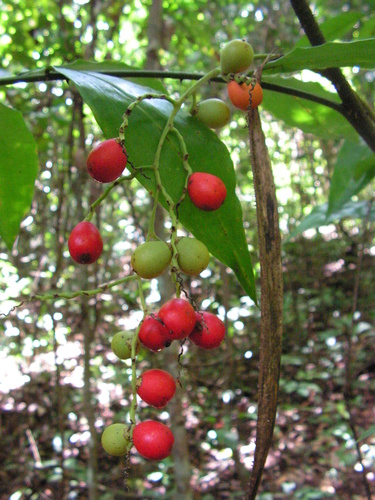
- Fruit and seed: one-seeded, globose to obovoid, with fleshy mesocarp, 11.2–23.5 mm long and 7.9–17.9 mm wide (about 16.4 × 11.9 mm), yellow turning red when ripe, with a smooth surface and no visible fibres beneath the skin. In Peru 100 fresh fruits weigh about 291 g and an infructescence about 83 g. The persistent corolla at the base of the fruit is less than a quarter of the fruit's length and tears irregularly into three lobes, which often split again. The endocarp is globose to obovoid with a rounded tip; its three pores lie on the side, unevenly spaced, the two sterile pores closer together.
Variation
Wessels Boer showed that the habitat strongly changes the look of a plant: in full sun the leaf sheaths carry many rather straight, swollen-based spines, in deep shade they are almost spineless, and plants of sunny riverbanks grow larger and very spiny. This plasticity misled earlier botanists, notably Bailey, into describing many local forms as separate species. Henderson treated Desmoncus polyacanthos as a species complex, a widespread species with numerous local variants, and the second most variable in the genus after Desmoncus mitis. Plants from the Atlantic coastal forest differ statistically from Amazonian ones in only three features (rachis length, number of leaflets and rachilla width), so no subspecies are recognised. Henderson instead used informal morphotypes:
- ulei morphotype: the commonest form, rather uniform across western and southern Venezuela, Trinidad, the Guianas, most of the Brazilian Amazon, Meta and Cundinamarca in Colombia, southern Loreto, Madre de Dios and western Bolivia (where fruit size varies a great deal).
- mirandanus morphotype: the Coastal Range of northern Venezuela; inflorescences larger, with more rachillae (about 19 against about 12 in other Venezuelan plants).
- large morphotype: much of the western Amazon and sub-Andean foothills, including eastern Ecuador, central and eastern Loreto around Iquitos (mostly ovate, rarely lanceolate leaflets, coarse sparse spines on the bract and large fruits), western Acre and Ucayali.
- amazonas morphotype: north-western Peru (department of Amazonas) and the far south of Ecuador (Zamora-Chinchipe); large plants with ovate leaflets, densely spiny bracts and big fruits.
- sanmartin morphotype: southern San Martín, Peru; densely spiny sheaths and long, nearly linear leaflets.
- pasco morphotype: Pasco, Peru; much larger plants with stout stems, long lanceolate leaflets and large inflorescences with densely spiny bracts.
- polyacanthos morphotype: the Atlantic coastal forest of eastern Brazil.
Some unusual individuals stand out: two plants from near the Rio Tapajós have exceptionally broad leaflets, and the type of Desmoncus ulei, from the Rio Negro near Manaus, has straight spines on the leaflet veins.
Telling it apart
The short, backward-curved, strongly swollen-based spines on the leaf axis separate Desmoncus polyacanthos from Desmoncus horridus, whose rachis spines are long and straight. Its smooth fruits distinguish it from the closely related species (Desmoncus setosus, Desmoncus vacivus, Desmoncus loretanus, Desmoncus horridus and others) whose fruit surface is roughened by fibres under the skin. Desmoncus mitis and Desmoncus pumilus differ in their inflorescence, whose thin axis is narrower than the few, widely spaced rachillae, and Desmoncus mitis also has spinules or dense felt at the leaflet bases. Desmoncus parvulus has spines along the whole underside of the cirrus.
Hybrids
All 18 herbarium specimens that Henderson considered to be of hybrid origin involve Desmoncus polyacanthos, crossed with Desmoncus pumilus, Desmoncus mitis or Desmoncus horridus, and all come from the central and western Amazon:
- with Desmoncus pumilus: plants from white-sand campinas in Amazonas and Pará where both grow, for example north of Presidente Figueiredo, and a group from disturbed low forest on white sand near the Tucuruí dam, which combine slender stems and narrow leaflets with fruits carrying Y-shaped fibres;
- with Desmoncus mitis: a Loreto specimen with spinulose leaflet bases, and five from eastern Acre that resemble the ulei morphotype except for the spinules, where Desmoncus mitis subsp. ecirratus also grows;
- with Desmoncus horridus: plants intermediate with subsp. palustris around San Carlos de Río Negro in Venezuelan Amazonas, with scarcely spiny bracts and fibrous fruits, and a specimen from Putumayo in Colombia with a densely spiny bract but Y-fibred fruits.
Ecology

Desmoncus polyacanthos is a light-seeking climber of forest gaps, edges and riverbanks as well as the forest interior. A biomechanical study in French Guiana found that its stems become stiffer towards the base, and that the leaf sheaths contribute much of the stiffness of young shoots and of the growing tips of older climbing stems. In this species the old sheaths stay on the stem after they die, so the relatively slender stems seldom slump into loops and coils below their points of attachment, unlike the larger Desmoncus horridus (studied as Desmoncus orthacanthos) growing nearby. Young plants have only a short free-standing phase: shoots either hook quickly onto surrounding vegetation or pause their upward growth until a support is reached.
The plants are monoecious. In the Peruvian Amazon the scented inflorescences attract small beetles, chiefly weevils of the genus Phyllotrox (Curculionidae) and sap beetles of the genus Epuraea (Nitidulidae), which arrive while the female flowers are receptive and remain overnight until the male flowers open the following day. Flowering there runs from about September to February, peaking in December and January as the rivers rise; fruits ripen from April to July, as the water falls, which favours seed dispersal and seedling establishment. Seeds are spread by floodwater and by animals: capuchin monkeys (Cebus), red-footed and yellow-footed tortoises (Chelonoidis carbonarius and Chelonoidis denticulatus, formerly placed in Geochelone) and various fruit-eating birds. Henderson noted that plants of the genus appear to flower rarely, which explains why fertile herbarium material is scarce.
In the Amazon estuary of Pará, the abundance and size of the palm are related to the structure of the forest canopy, and a study there concluded that it can be encouraged by selectively cutting canopy trees and by letting fallow land on terra firme regenerate to forest. In harvested stands in Peru, clumps regenerate vigorously from basal shoots: after cutting, about 91% of plants remained in good condition and only about 3% died within ten months.
Free-choice and confinement tests in north-eastern Brazil showed that the invasive red palm mite (Raoiella indica) survives much less well on leaves of Desmoncus polyacanthos than on coconut, so the species is a poor host for this pest.
Uses
The stem is the valuable part. Gatherers cut the stems at ground level, pull them down from the canopy, strip off the spiny leaf sheaths and outer layer, and coil the cane for transport to town. There it is split lengthwise into fine strands (skeins) that are woven in household workshops. A literature review of palm fibres in South America found Desmoncus polyacanthos to be the species most often reported for baskets and also the leading palm for furniture, with records from Brazil, Bolivia, Colombia, Guyana, Peru and Suriname, and counted its harvest among the few considered sustainable. A review of palm-stem uses in the Brazilian Amazon likewise placed it among the three palms whose stems are most often used by traditional communities, and the only climbing one. Its stem anatomy suits this use: compared with the stiff trunks of Socratea exorrhiza and Euterpe oleracea, its vascular bundles have less differentiated fibre caps, wider conducting cells, fibre walls with fewer layers and a syringyl-type lignin, all features linked to flexibility.
- Peru: around Iquitos and in Loreto the stems, called cashavara or vara casha because of their many spines, supply rural crafts and an urban furniture industry, chiefly for the woven seats and backs of chairs and armchairs. The fibre has physical and mechanical properties comparable with those of the aroid and cyclanth climbers (Heteropsis flexuosa and Thoracocarpus bissectus) traded locally for basketry, and a feasibility study judged that cane furniture made by a craft association at Jenaro Herrera could be exported profitably to the United States. The Maijuna call it jijebɨ meme ("sieve vine") and use the stems, gathered throughout the year, to bind the frames of sieves.
- Brazil: as jacitara, the cane is much used by craftworkers of the Rio Negro region. It is valued for tipitis (manioc presses) because its strips are more flexible and durable than the other materials used for them, such as Ischnosiphon petioles or the leaves of Mauritia flexuosa and Oenocarpus bacaba. Its fibres have been tested as reinforcement for composite materials: they contain about 67% cellulose and are stiffest and strongest when taken from the lower and middle parts of the stem.
- Amazon and Orinoco basins in general: strips from the stem are woven into baskets and into the tubular presses used to squeeze manioc dough; they have been used to bind tobacco leaves into tight rolls, and some indigenous groups wind them around blowgun tubes and use them to fix arrow points.
- Other uses: the stem fibres are twisted into rope, the polished seeds are strung as necklaces, and the fruits are occasionally eaten or used as fish bait.
Cultivation
A palm for warm, humid tropical conditions. It does best in a sheltered spot with soil that stays moist but drains freely, and needs a strong support such as a tree or trellis to climb. Outside the tropics it can be kept only under glass. Its formidable hooks and spines make it unsuitable for places where people pass.
The palm is raised from seed. Fruits are gathered once they have turned reddish, and the seeds are soaked in water at room temperature for 2–4 days before sowing. Peruvian nursery practice is to sow each seed about 2 cm deep (roughly twice its own size) directly into a drained 2 kg polythene bag filled with a mix of 30% sawdust, 30% worm compost, 30% ordinary soil and 10% sand, under about 50% shade. Germination is hypogeal and begins from the third week; the first leaf appears around the fifth week, the second around the eighth, and after five months some seedlings have three leaves and spines on the stem. Plants are exposed to more light for two weeks before planting out, at a height of about 50 cm. For enriching forest, seedlings are set 5 m apart in strips cut east to west through the forest, each next to a tree it can climb.
Experimental plantings in flooded secondary forest at Jenaro Herrera, Peru, give practical advice for transplanting young plants: seedlings moved with their root ball and with all leaves removed survived best (about 89%), whereas bare-rooted plants left with full foliage survived poorly (about 39%). New shoots appeared from the third month and multiplied from the sixth. In harvesting trials in wild clumps, cutting all over-mature and mature stems while also taking a quarter of the remaining stems produced the fastest regrowth and is the harvest intensity now recommended, with new stems averaging about 8.8 m of growth in ten months against about 2.8 m where only mature stems were removed.
Conservation
Conservation status: Least Concern.
The species is widespread and grows in many habitats, including seasonally flooded forest that is seldom cleared. Wild stems are, however, cut commercially in Peru and Brazil, and studies around Jenaro Herrera recommend leaving part of the young stems in each clump so that harvested stands recover.
Name history
Desmoncus polyacanthos was described by Martius in Historia Naturalis Palmarum 2: 85 (1824), with a plate published in 1826. The genus name, also coined by Martius, combines the Greek desmos, a band, and onkos, a hook, for the climbing hooks on the leaves; the epithet polyacanthos means "with many spines".
- Type: Brazil, Bahia, without precise locality or date, Martius s.n. (lectotype M, designated by Henderson 2011).
- Pronunciation: dez-MON-kus poh-lee-AH-kahn-tohs.
- Classification: genus Desmoncus, subtribe Bactridinae, tribe Cocoseae, subfamily Arecoideae.
- Taxonomic history: Drude emended the species in Flora Brasiliensis (1881), and Burret excluded Martius's name in his 1934 revision of the genus. Henderson found no grounds for either step, since Martius's description and illustration, based on a surviving specimen collected by Martius, match this widespread species exactly. Henderson's revision also reduced several names based on single local forms to synonymy.
- Synonyms with types in Henderson (2011): Desmoncus oxyacanthos Mart. (Rio de Janeiro, Sebastianopolis, Neuwied s.n., holotype M), also Desmoncus polyacanthos var. oxyacanthos (Mart.) Drude and Atitara oxyacantha (Mart.) Kuntze; Desmoncus ulei Dammer (Manaus, Rio Negro, February 1901, Ule 5388, lectotype MG); Desmoncus campylacanthus Burret (Rio de Janeiro, Serra de Bica, Glaziou 14366, lectotype P; holotype at B destroyed); Desmoncus prestoei L.H.Bailey (Trinidad, Broadway 5568, BH); Desmoncus peraltus L.H.Bailey (Trinidad, Arena, Bailey 101, BH); Desmoncus maguirei L.H.Bailey (Suriname, Kwakoegron, Maguire & Stahel 25011, NY); Desmoncus mirandanus L.H.Bailey (Venezuela, Miranda, Siquire Valley, 400–800 m, Pittier 7078, BH). Atitara polyacantha (Mart.) Kuntze is the homotypic synonym.
- Other synonyms: Kew also places here many names of Barbosa Rodrigues, Drude, Burret, Spruce and others, including Desmoncus phoenicocarpus, Desmoncus philippianus, Desmoncus phengophyllus, Desmoncus pycnacanthos, Desmoncus riparius and Desmoncus macroacanthos, together with their combinations in Atitara (see the former names above). Several of these lack type specimens; Henderson listed some among excluded names, and considered that the type of Desmoncus riparius (Spruce 46, from San Carlos de Río Negro) may be a hybrid between this species and Desmoncus horridus subsp. palustris. Desmoncus polyacanthos var. angustifolius Drude, cited by Glassman, does not appear in Drude's work, although a specimen (Spruce 627, M) bearing the name exists.