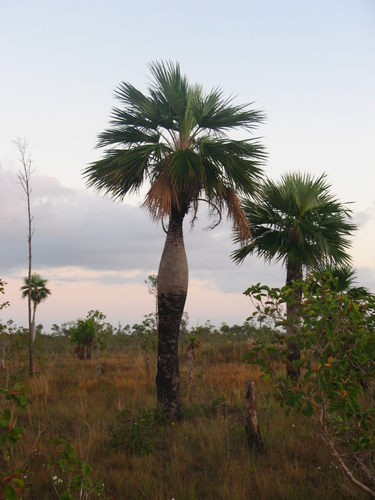
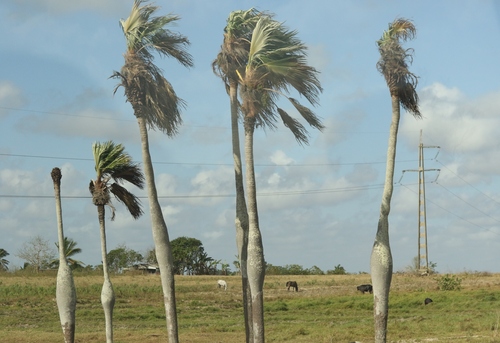
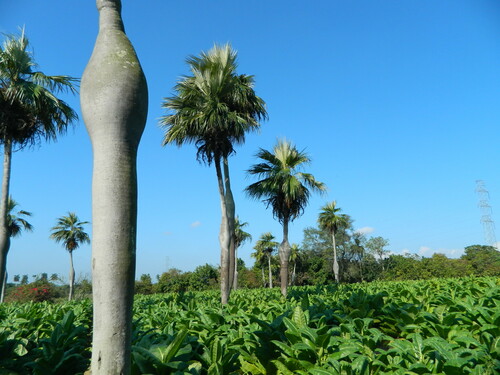
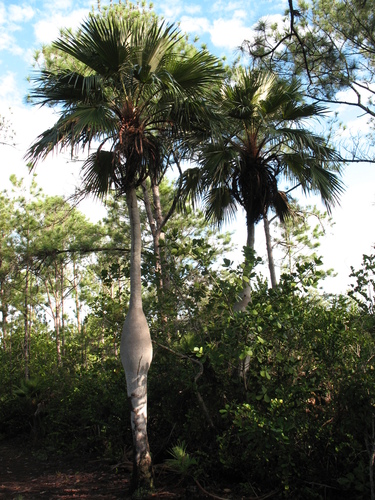
Colpothrinax wrightii Schaedtler, the barrigona palm or Cuban bottle palm, is a solitary fan palm found only in the far west of Cuba, in Pinar del Río Province and on the Isla de la Juventud. It is easily recognised by its trunk, which is slender at the base and then balloons out a few metres above the ground into a broad "belly" before narrowing again below a rounded crown of stiff, costapalmate leaves that are dark green above and silvery beneath, with long, finely drawn-out drooping tips. No other Cuban palm combines a swollen trunk with fan leaves. Its synonym Pritchardia wrightii reflects its close kinship with the Hawaiian fan palms, which it resembles apart from the bulging stem. For rural Cubans it has long been a source of thatch and of hollowed trunk sections for vessels of all kinds; in cultivation it is rarely available, slow and demanding.
Also known asBarrigona Palm; palma barrigona, barrigona, barrigón (Cuba, Spanish: "pot-bellied palm"); palma barrigona de la Vuelta Abajo (western Cuba); Cuban bottle palm; Cuban barrel palm; Cuban pot-belly palm; Cuban belly palm; barrel palm; bottle palm; belly palm; pot-bellied palm
Distribution and habitat

Kew lists the species as native to Cuba only. Within Cuba it is confined to the west: the municipalities of Consolación del Sur, Guane, Mantua, Minas de Matahambre, Pinar del Río, San Juan y Martínez, San Luis, Sandino and Viñales in Pinar del Río Province, and the Isla de la Juventud (formerly Isla de Pinos). The known extremes of its range are Ceja Ana de Luna in Viñales to the north (about 22°40′ N), San Pedro on the Isla de la Juventud to the south (about 21°37′ N), San Andrés on the same island to the east and Laguna Herradura in Sandino to the west (about 84°11′ W). Classic localities include the area around Herradura and Las Barrigonas in Consolación del Sur, the savannas near San Luis, and the foothills of the Sierra de La Cañada on the island (Moya López & Hodel 2022).
It is a lowland palm, growing from sea level to about 200 m. The climate is dry tropical, with a dry season of five to six months and only 750–1600 mm of rain a year, yet during the wet season (roughly April to September) parts of the land are flooded for periods (Evans 2001). The palm originally grew on white, nutrient-poor sands and quartz-rich soils in open forest of Pinus tropicalis, with Acoelorraphe wrightii in the understorey; logging (mostly of the pines), followed by fire and grazing, has turned nearly all of that forest into semi-dry savanna, grassland and pasture, where the palm now stands as scattered individuals or in groves (Evans 2001; Moya López & Hodel 2022). Growers who have seen it in the wild also describe it on seasonally flooded woodland and fields with heavier clay soils, and on frequently flooded coastal fields on the Isla de la Juventud (Holton 2013). In the San Ubaldo–Sabanalamar pinelands of Guane it is among the five ecologically most important woody species, together with Acoelorraphe wrightii, Pinus caribaea, Chrysobalanus icaco and Anacardium occidentale (García Quintana et al. 2016). On the Isla de la Juventud it grows with Pinus tropicalis, Pinus caribaea and Coccothrinax miraguama in open pine woodland on sand (Amaro-Valdés 2024). Large colonies are known in Cuba as barrigonales.
Description

Measurements follow the monograph of the genus (Evans 2001) unless stated otherwise.
- Habit and trunk: solitary and unarmed, 6–12 m tall, occasionally to 15 m. The trunk is 15–20 cm thick at breast height and begins to swell about 2–3 m (a metre or more in some accounts) above the ground, reaching 30–40 cm, rarely 50 cm, at the widest point; the belly may be much less marked, or absent, in cultivated plants grown in wetter conditions (Puccio 2018). Young plants up to about 3–5 m tall have the trunk hidden in a thick mat, 5–10 cm deep, of persistent fibres from the leaf sheaths. As the palm matures and forms its belly, this dark brown, rough outer covering falls away to expose a smooth grey surface, so that the palm appears to shed its bark.
- Leaves: usually 10–20 in a rounded crown. The petiole is about 1–1.5 m long and 3.7–4.6 cm wide where it meets the blade. The glaucous sheath breaks down into a coarse, open network of flattened, twisted, somewhat wavy fibres 0.6–0.8 mm wide that does not hang down. The hastula is raised above the blade, 1.7–2.8 × 4.8–5.8 cm, its width 2.1–2.8 times its length, broadly to very broadly triangular with a blunt, more or less notched tip. The costa is 19.5–25 cm long (to 38.5 cm). The blade is 142–171 cm long in the middle and 39–44 cm at the sides, divided into single-fold segments: the central splits reach to within 76–111 cm of the base (one-third to one-half of the way), the outermost to within 1.5–2.5 (–3.5) cm, i.e. more than 90% of the way. Each half of the blade has 36–45 folds, the widest segment 3.4–5 cm across. The upper surface is dark green, the lower silvery, and the segment tips are long, narrow and pendulous.
- Inflorescence: each palm carries about five inflorescences bearing flowers and fruit, plus some ten old, persistent ones. The main axis is about 1.5 m long, with a peduncle of about 0.4 m, a prophyll about 20 × 5 cm, around six peduncular bracts 22–54.5 cm long and rachis bracts 10.5–65.5 cm long; the bracts are woolly, with hairs 2–3 mm long. There are 6–10 first-order branches, each 3–73 cm long (unbranched for 2–54.5 cm, branched for 1–27 cm) with its own prophyll 8.5–44.5 cm long. Basal branches carry 20–50 rachillae, apical ones fewer than ten; the rachillae are 3.5–17.5 cm long and covered in whitish to rusty hairs 0.4–0.5 mm long. All axes are creamy yellow at flowering and turn orange in fruit. Flowers sit on spurs 0.2–0.4 mm long, each subtended by a bracteole 0.8–1.7 mm long and 0.5–0.9 mm wide at the base.
- Flowers: bisexual and yellow. Receptacle 0.8–1.2 mm long; calyx 2.3–3.3 mm, free from the corolla for one-quarter to one-half of its length, with lobes 0.2–0.7 mm long. Corolla 5.3–6.2 mm long, its fleshy, valvate lobes parallel-sided with a small point at the tip, grooved inside with rolled or thickened margins, hooded at the apex and falling off along a clear abscission line. Six stamens with filaments 3.2–4.5 mm long, joined at the base for 2–2.7 mm (half to three-quarters of their length) into a stamen tube 1.5–2.7 mm across that is much longer than the calyx tube; anthers 2.2–3.9 × 0.8–1.2 mm. Pollen grains 30–40 × 25–35 µm, the exine on the non-apertural face finely pitted (foveolate). Gynoecium 3.5–4.9 × 1.2–2 mm, of three carpels 1.1–1.6 × 0.7–1.3 mm, with styles 2.2–3.4 mm long.
- Fruit and seed: fruit globose, 11–16 mm in diameter, green at first and blackish brown when ripe (Puccio 2018); seed 7–9 × 9–11 mm.
How to tell it apart
The swollen trunk together with costapalmate leaves separates this palm from every other Cuban species. The only other Cuban palm with a bulging trunk, Gastrococos crispa (known locally as barrigona de sierra), has pinnate leaves and a spiny stem. Within Colpothrinax, this species is marked out by its small fruits and seeds, by corolla lobes that are shed along a clean abscission line, and by its long stamen tube. Colpothrinax aphanopetala and Colpothrinax cookii of Central America instead keep their corolla lobes and have a short stamen tube. Because the deciduous lobes and long stamen tube are also found in Pritchardia, Evans (2001) interpreted them as the ancestral state in the genus and the persistent lobes of the Central American species as derived.
Ecology

- Regeneration: on cleared land, grazing, tobacco and other crops do not kill the adult palms directly but make it very hard for seedlings to establish, so many stands now consist of ageing adults; poor regeneration has been noted for decades (Moya López & Hodel 2022). In 1941, however, plants of all ages were still seen near San Luis, and seedlings, juveniles and adults grow together in some disturbed savannas on the Isla de la Juventud.
- Water and fire: the swollen trunk has been interpreted as a water store for the long dry season (Puccio 2018). The species also withstands seasonal waterlogging, and a plant survived for many years in the very wet Hilo Nursery Arboretum on Hawaii, which receives about 4000 mm of rain a year, before dying in the mid-1990s (Moya López & Hodel 2022).
- Flower visitors: the flowers are worked by honeybees, and the palm has been recorded as a honey plant in Cuba (Moya López & Hodel 2022). Sandy pine–palm communities where it grows on the Isla de la Juventud are visited by carpenter bees that pollinate other plants of the same habitat (Johnson et al. 2026).
- Insects and mites: the planthopper Ormenaria rufifascia has been recorded on it in Cuba (Howard & Halbert 2005). In Cuban botanic garden palm collections the introduced red palm mite (Raoiella indica) behaved as an invasive pest on this species (Ramos Lima et al. 2017).
Uses
In Pinar del Río the palm is used widely, especially from Sumidero to Guane and in the southern savannas (Moya López & Hodel 2022).
- Leaves: cut for roof thatch, for the walls of tobacco-drying sheds (casas de tabaco) and for hats. Harvesting is so common that it is rare to find a wild palm with an intact crown.
- Sheath fibres: from juvenile and adult plants, made into brooms.
- Fruit and seed: the fruits are gathered to feed pigs, and soft, immature seeds are occasionally eaten. Whole fruits contain about 5.3% oil by dry weight, rich in lauric, myristic, palmitic, oleic and linoleic acids, a much lower yield than that of Roystonea regia (Rodríguez-Leyes et al. 2007).
- Trunks: the bulging part of the trunk is hollowed into water jars and barrels, pipes, mortars for pounding coffee and rice, flowerpots and planters, feed and watering troughs, canoes (once used on the Cuyaguateje River), beehives, chairs, small tables and vases; the upper trunk yields pestles and ashtrays, and whole trunks serve as corner posts, roof supports and building material. These uses kill the palm. Adult palms are also still dug from the wild for ornamental planting, and their trunks are used as decorative posts in rural houses and tourist accommodation (Evans 2001; Moya López & Hodel 2022).
- Ornament: grown from seed for gardens and landscaping, for example at a hotel on the Isla de la Juventud.
Cultivation
- Climate: a strictly tropical palm, though it has been grown in some warm subtropical areas. Brief dips to about 0 °C are tolerated only exceptionally (Puccio 2018); in southern Florida plants look badly damaged after most winters with frost but usually recover within a couple of months (Holton 2013).
- Light, water and soil: full sun. Old grower advice recommends a moist but well-drained position, but experience in Florida is that the palm needs abundant water and a clay-based soil: at Fairchild Tropical Botanic Garden several plantings failed until one was set beside a pond, where it has grown large, and plants in dense white clay or marl next to a pond in Loxahatchee thrive (Holton 2013). Neutral to acidic soils are preferred, alkaline ones tolerated poorly; adults withstand long droughts, and moderate exposure to salty winds is tolerated (Puccio 2018).
- Growth rate: slow at first. Once established it may add about 25 cm (10 in) of height a year. Cultivated plants often develop only a weak swelling.
- Propagation: by seed only. Seeds soaked in water for three days and sown in a moist, acidic or neutral sandy loam at 26–28 °C begin to germinate after about a month (Puccio 2018). Germination is usually easy, but young plants are hard to keep: seedling losses in the first months are high, and in one Florida trial only seven of forty young plants survived about three years, those in water-retaining pots or a calcined-clay medium doing best (Holton 2013; Puccio 2018).
- Pests: the red palm mite Raoiella indica is a serious pest in Cuban collections (Ramos Lima et al. 2017).
- Where grown: in Cuba at the National Botanical Garden in Havana, the Havana botanical garden and Cienfuegos; abroad at Fairchild Tropical Botanic Garden (Miami) and nurseries in Palm Beach County, Florida, and in the Jena Botanical Garden, Germany. Plants once grown in Santa Barbara, California, and in Hilo, Hawaii, have died. Seed is rarely offered, so the species remains scarce in collections.
Conservation
Conservation status: Vulnerable.
Wild populations have shrunk through the conversion of their pinelands and savannas to pasture and crops, open-pit and silica-sand mining, dam building, invasive plants, and above all the felling of palms for their trunks and the constant harvesting of their leaves; on farmland, seedlings rarely survive to replace the old palms (García Quintana et al. 2016; Moya López & Hodel 2022). The species still persists as scattered individuals in shrubland and grassland and has been given legal protection in Cuba regulating its use (Evans 2001). It occurs in three protected areas: the Reserva Florística Manejada San Ubaldo–Sabanalamar in Pinar del Río, and the Reserva Ecológica Los Indios and the Área Protegida de Recursos Manejados Sierra de La Cañada on the Isla de la Juventud. It is also kept ex situ in several botanical gardens (Leadlay & Wyse Jackson 1989; Moya López & Hodel 2022).
Name history
- Discovery: Wright collected plants for Asa Gray of Harvard throughout Cuba between 1856 and 1867. In September of 1865 or 1866 he gathered, in the Vuelta Abajo of western Cuba, a palm called palma barrigona by local people (Wright 3964). Material was sent to Wendland, director of the royal gardens at Herrenhausen near Hannover, who regarded it as a new genus and species and gave it the informal name Colpothrinax wrightii. The Cuban common name itself was already recorded in 1792 (Evans 2001; Moya López & Hodel 2022).
- Early unpublished uses: Wright passed Wendland's name to the landowner and amateur botanist Sauvalle, who listed it, with the vernacular name palma barrigona de la Vuelta Abajo but no description, in his Flora Cubana (1871; entry 2382, 2381 in the 1873 edition). That list updated Grisebach's Catalogus Plantarum Cubensium (1866) with taxa Wright had collected in his last two years in Cuba. Kerchove de Denterghem also used the name without description in Les Palmiers (1878). Wendland formally established the genus Colpothrinax in 1879 (Botanische Zeitung 37: 148) (Evans 2001).
- Publication and authorship: Kew accepts Schaedtler as the author, from a note in the Hamburger Garten- und Blumenzeitung 31: 160 (1875). Moya López & Hodel (2022) argue that Schaedtler's short remark, describing a seedling with long, narrow, slightly drooping leaf tips and strong petioles, fits almost any fan palm and so does not validate the name. In their view the first valid publication was by Voss in the third edition of Vilmorin's Blumengärtnerei (1895), where the epithet was misspelled "wightii"; Evans (2001) attributed that work to Siebert and Voss. Beccari transferred the species to Pritchardia as Pritchardia wrightii in 1907 (Webbia 2: 203), a name now treated as a synonym.
- Type: no specimen was cited in 1895. A Wright 3964 sheet in the Berlin herbarium, where Siebert and Voss were working, was destroyed, but Beccari had photographed it. Voss had been university gardener at Göttingen (1882–1890), close to Wendland's herbarium at Herrenhausen (now in GOET), but no known sheet of Wright 3964 carries an annotation by either author. Evans (2001) therefore treated Glassman's 1972 choice of the Harvard (GH) specimen as a neotype rather than a lectotype. Moya López (2020) narrowed this to a single sheet, GH 00028451, with numerous duplicates of Wright 3964 at A, BRU, F, K, NY, P, US and other herbaria as isoneotypes (Moya López & Hodel 2022).
- Etymology: Colpothrinax joins the Greek kolpos (bosom, belly), for the swollen trunk, to the name of the related fan-palm genus Thrinax. The epithet honours Charles Wright (1811–1885), the American botanical collector who gathered the type (Puccio 2018).
- Pronunciation: genus kol-poh-TRIH-naks; epithet RYE-tee-eye.
- History in horticulture: the first known photograph of the palm in the wild was taken at Herradura in 1909 and published by Beccari in 1913. A section of trunk was shown in the Cuban exhibit at the Panama-Pacific International Exposition in San Francisco in 1915 and afterwards given to the California Academy of Sciences (Moya López & Hodel 2022).