Difference between revisions of "Dypsis angustifolia"
Dypsisdean (Talk | contribs) |
m (Joaocosta moved page Dypsis angusta to Dypsis angustifolia over redirect) |
||
| (8 intermediate revisions by 3 users not shown) | |||
| Line 1: | Line 1: | ||
__noeditsection__ | __noeditsection__ | ||
{{Palmbox | {{Palmbox | ||
| − | |image= | + | |image=DYPSIS AUGUSTIFOLIA IMG 2537.JPG |
| − | |image_caption= | + | |image_caption=Common Form with Thin Bifid Leaves. |
|genus=Dypsis (DIP-sis) | |genus=Dypsis (DIP-sis) | ||
| − | |species=<br>angustifolia <br>( | + | |species=<br>angustifolia <br>(ahn-GÛS-tih-foh-LEE-ah) |
|subspecies= | |subspecies= | ||
|cultivar= | |cultivar= | ||
| Line 20: | Line 20: | ||
}} | }} | ||
==Habitat and Distribution== | ==Habitat and Distribution== | ||
| − | + | ''Dypsis angustifolia'' is endemic to Madagascar. Central part of East Coast lowlands, [[Image:Dypsis Angustifolia broad leaf form..JPG|thumb|left|450px|Madagascar. Broadleaf Form, gets divisions in leaf blade, gets NO new red leaf. Photo by Clayton York, Utopia Palms & Cycads.]]Betampona and environs, northeast of Toamasina. Lowland rain forest; 400-500 m. | |
| − | [[Image: | + | |
==Description== | ==Description== | ||
Slender, clustering palm of the undergrowth. STEMS to 1 m. tall, 6-10 mm in diam., internodes 12-25 mm in diam., bearing scattered brown scales. LEAVES 6-7 in crown; sheaths 9-12 x 0.8 cm., tardily abscising, ± marcescent, striate, with scattered punctiform scales, auricles small, membranous, soon tattering; petiole 4-23 cm., about 2 mm. wide, ± triangular in cross section; blade entire bifid, distinctly plicate on drying, 28-50 cm, deeply cleft to about three quarters of the overall length, the two lobes 20-40 x 1.5-3 cm., occasionally one lobe further divided into 2 narrow leaflets, segment tips shallowly lobed, adaxially with scattered punctiform scales, abaxially paler and with abundant brown punctiform scales. INFLORESCENCES interfoliar, erect or curved, branched to 1 order only; peduncle 15-32 cm. long, about 1-2 mm in diam., sparsely covered with red scales in exposed portion; prophyll 10-25 x 0.5 cm., membranous, sparsely scaly; peduncular bract inserted far above and exceeding the prophyll by 5.5-9 cm., otherwise similar; rachis 3.5-10 cm., densely brown hairy; rachillae 5-9, inserted at right angles, 1-3 cm. long, about 2 mm in diam.; rachilla bracts inconspicuous, about 0.5 x 1 mm., almost entirely obscured by dense red-brown hairs. {{read more top}}STAMINATE FLOWER buds about 1 mm in diam., spherical; sepals 3, free, imbricate, rounded, about 0.6 mm in diam., striate, irregularly cleft at margin; petals ± free, longitudinally striate, broad triangular, valvate, 0.8 mm. long, 0.8 mm. wide at the very base; stamens 3 antesepalous, filaments united in a ring 0.2 mm high, free part 0.2 mm long, anthers didymous, about 0.2 x 0.1 mm, introrse; pistillode conical, minute. PISTILLATE FLOWERS globular; sepals broad, imbricate, 1 x 1 mm., margins erose; petals striate, valvate at tips, irregularly imbricate at base, about 1.5 x 1.5 mm.; staminodes 3, minute; ovary about 1 mm in diam. FRUIT, not examined. (J. Dransfield and H. Beentje. 1995)/Palmweb. Editing by edric. | Slender, clustering palm of the undergrowth. STEMS to 1 m. tall, 6-10 mm in diam., internodes 12-25 mm in diam., bearing scattered brown scales. LEAVES 6-7 in crown; sheaths 9-12 x 0.8 cm., tardily abscising, ± marcescent, striate, with scattered punctiform scales, auricles small, membranous, soon tattering; petiole 4-23 cm., about 2 mm. wide, ± triangular in cross section; blade entire bifid, distinctly plicate on drying, 28-50 cm, deeply cleft to about three quarters of the overall length, the two lobes 20-40 x 1.5-3 cm., occasionally one lobe further divided into 2 narrow leaflets, segment tips shallowly lobed, adaxially with scattered punctiform scales, abaxially paler and with abundant brown punctiform scales. INFLORESCENCES interfoliar, erect or curved, branched to 1 order only; peduncle 15-32 cm. long, about 1-2 mm in diam., sparsely covered with red scales in exposed portion; prophyll 10-25 x 0.5 cm., membranous, sparsely scaly; peduncular bract inserted far above and exceeding the prophyll by 5.5-9 cm., otherwise similar; rachis 3.5-10 cm., densely brown hairy; rachillae 5-9, inserted at right angles, 1-3 cm. long, about 2 mm in diam.; rachilla bracts inconspicuous, about 0.5 x 1 mm., almost entirely obscured by dense red-brown hairs. {{read more top}}STAMINATE FLOWER buds about 1 mm in diam., spherical; sepals 3, free, imbricate, rounded, about 0.6 mm in diam., striate, irregularly cleft at margin; petals ± free, longitudinally striate, broad triangular, valvate, 0.8 mm. long, 0.8 mm. wide at the very base; stamens 3 antesepalous, filaments united in a ring 0.2 mm high, free part 0.2 mm long, anthers didymous, about 0.2 x 0.1 mm, introrse; pistillode conical, minute. PISTILLATE FLOWERS globular; sepals broad, imbricate, 1 x 1 mm., margins erose; petals striate, valvate at tips, irregularly imbricate at base, about 1.5 x 1.5 mm.; staminodes 3, minute; ovary about 1 mm in diam. FRUIT, not examined. (J. Dransfield and H. Beentje. 1995)/Palmweb. Editing by edric. | ||
| Line 28: | Line 27: | ||
{{read more bottom}} | {{read more bottom}} | ||
==Culture== | ==Culture== | ||
| − | + | Cold Hardiness Zone: 10a | |
==Comments and Curiosities== | ==Comments and Curiosities== | ||
Now here is a Palm that has been sold under the Name Dypsis louvelii, there are a few species that as seedlings it's very hard to impossible to tell apart from Dypsis louvelii, the first is Dypsis Pulchella with this species even when they are mature it's near impossible to tell this species from louvelii unless you look at the flowers and the stamens, then you have Dypsis mocquerysana these look very simular as small plants as well. Then we have Dypsis angustifolia this seems to have at least two forms the thin leaf form as listed in Palms of Madagascar and a broader leaf form, which can have a reddish new leaf as well...! This is what has been sold as Louvelii in the last few years so you just might want to check your plants, unfortunately you will not be able to tell that it's not Louvelii until they start to clump, and then once they flower you can be 100% sure of what you have, so i will list some photos here of the inflorescence of Dypsis angustifolia and some of the habitat photos of the mature plants so all can see what these plants are going to grow into, not all of these will have new reddish new leaves but they will all clump and they do all look to be this broader leaf form. (J. Dransfield and H. Beentje. 1995)/Palmweb. | Now here is a Palm that has been sold under the Name Dypsis louvelii, there are a few species that as seedlings it's very hard to impossible to tell apart from Dypsis louvelii, the first is Dypsis Pulchella with this species even when they are mature it's near impossible to tell this species from louvelii unless you look at the flowers and the stamens, then you have Dypsis mocquerysana these look very simular as small plants as well. Then we have Dypsis angustifolia this seems to have at least two forms the thin leaf form as listed in Palms of Madagascar and a broader leaf form, which can have a reddish new leaf as well...! This is what has been sold as Louvelii in the last few years so you just might want to check your plants, unfortunately you will not be able to tell that it's not Louvelii until they start to clump, and then once they flower you can be 100% sure of what you have, so i will list some photos here of the inflorescence of Dypsis angustifolia and some of the habitat photos of the mature plants so all can see what these plants are going to grow into, not all of these will have new reddish new leaves but they will all clump and they do all look to be this broader leaf form. (J. Dransfield and H. Beentje. 1995)/Palmweb. | ||
| − | + | {{read more top}} | |
A diminutive palm of the forest undergrowth, known from Betampona and environs northeast of Toamasina. This is one of three species of Dypsis that have highly condensed inflorescences with very short fat flower-bearing branches that appear almost catkin-like. The species name is Latin for having narrow leaves. | A diminutive palm of the forest undergrowth, known from Betampona and environs northeast of Toamasina. This is one of three species of Dypsis that have highly condensed inflorescences with very short fat flower-bearing branches that appear almost catkin-like. The species name is Latin for having narrow leaves. | ||
| Line 38: | Line 37: | ||
"Dypsis angustifolia broad leaf form, now here is a form of a species that does not live up to its name.! | "Dypsis angustifolia broad leaf form, now here is a form of a species that does not live up to its name.! | ||
This Palm has been sold under the Name Dypsis louvelii, there are a few species that as seedlings it's very hard to impossible to tell apart from Dypsis louvelii, here are just a few the first is Dypsis Pulchella with this species even when they are mature it's near impossible to tell this species from louvelii unless you look at the flowers and the stamens, then you have Dypsis mocquerysana these look very simular as small plants as well. Then we have Dypsis angustifolia this seems to have at least two forms the thin leaf form as listed in Palms of Madagascar and a broader leaf form, which can have a reddish new leaf as well...! This is what has been sold as Louvelii in the last few years so you just might want to check your plants, unfortunately you will not be able to tell that it's not Louvelii until they start to clump, and then once they flower you can be 100% sure of what you have, so i will list some photos here of the inflorescence of Dypsis angustifolia and some of the habitat photos of the mature plants so all can see what these plants are going to grow into, not all of these will have new reddish new leaves but they will all clump and they do all look to be this broader leaf form, which I thought was lost quite a few years back when a large section of bush was cleared with this broad leaf form in it, but this form although I only have a few plants from this old locality did not seem to have this new red leaf like the ones from this new locality. So here are some habitat photos of Dypsis angustifolia with the broad leaves and also a broad leaf form, that gets a new red leaf." (Clayton York, Utopia Palms & Cycads), See photos 'Broad leaf form that has new red leaf, and var. NO new red leaf' below. | This Palm has been sold under the Name Dypsis louvelii, there are a few species that as seedlings it's very hard to impossible to tell apart from Dypsis louvelii, here are just a few the first is Dypsis Pulchella with this species even when they are mature it's near impossible to tell this species from louvelii unless you look at the flowers and the stamens, then you have Dypsis mocquerysana these look very simular as small plants as well. Then we have Dypsis angustifolia this seems to have at least two forms the thin leaf form as listed in Palms of Madagascar and a broader leaf form, which can have a reddish new leaf as well...! This is what has been sold as Louvelii in the last few years so you just might want to check your plants, unfortunately you will not be able to tell that it's not Louvelii until they start to clump, and then once they flower you can be 100% sure of what you have, so i will list some photos here of the inflorescence of Dypsis angustifolia and some of the habitat photos of the mature plants so all can see what these plants are going to grow into, not all of these will have new reddish new leaves but they will all clump and they do all look to be this broader leaf form, which I thought was lost quite a few years back when a large section of bush was cleared with this broad leaf form in it, but this form although I only have a few plants from this old locality did not seem to have this new red leaf like the ones from this new locality. So here are some habitat photos of Dypsis angustifolia with the broad leaves and also a broad leaf form, that gets a new red leaf." (Clayton York, Utopia Palms & Cycads), See photos 'Broad leaf form that has new red leaf, and var. NO new red leaf' below. | ||
| − | |||
| − | |||
Conservation: Endangered; occurring in two sites in low numbers. (J. Dransfield and H. Beentje. 1995) | Conservation: Endangered; occurring in two sites in low numbers. (J. Dransfield and H. Beentje. 1995) | ||
| − | = | + | {{read more bottom}} |
| − | + | <br clear="all"> | |
| − | + | {{#Widget:AdResban}} | |
| − | + | ||
| − | + | ||
| − | + | ||
| − | + | ||
| − | + | ||
| − | + | ||
| − | + | ||
| − | + | ||
| − | + | ||
| − | + | ||
| − | + | ||
| − | + | ||
| − | + | ||
<center><gallery caption="IMAGE GALLERY" perrow="" widths="" heights=""> | <center><gallery caption="IMAGE GALLERY" perrow="" widths="" heights=""> | ||
image:B210db24-523d-4913-a96c-58637f30b8d3z.jpg|Near Foulpointe, Madagascar. Photo by Dr. John Dransfield, Royal Botanic Gardens, Kew/Palmweb. | image:B210db24-523d-4913-a96c-58637f30b8d3z.jpg|Near Foulpointe, Madagascar. Photo by Dr. John Dransfield, Royal Botanic Gardens, Kew/Palmweb. | ||
| Line 92: | Line 76: | ||
image: | image: | ||
</gallery></center> | </gallery></center> | ||
| + | ==External Links== | ||
| + | *[http://eunops.org/content/glossary-palm-terms Glossary of Palm Terms] | ||
| + | *[http://www.calflora.net/botanicalnames/pronunciation.html MODERN BOTANICAL LATIN] | ||
| + | *[http://www.jlhudsonseeds.net/Pronunciation.htm "Just To Be Clear"] | ||
| + | *[http://www.utopiapalmsandcycads.com/DYPSISangustifoliaboardleafform.htm Utopia Palms & Cycads, GREAT PHOTOS!] | ||
| + | ==References== | ||
| + | Phonetic spelling of Latin names by edric. | ||
| + | Special thanks to Geoff Stein, (Palmbob) for his hundreds of photos. | ||
| + | |||
| + | Special thanks to [http://palmweb.org/?q=node/2 Palmweb.org], Dr. John Dransfield, Dr. Bill Baker & team, for their volumes of information and photos. | ||
| + | |||
| + | Glossary of Palm Terms; Based on the glossary in Dransfield, J., N.W. Uhl, C.B. Asmussen-Lange, W.J. Baker, M.M. Harley & C.E. Lewis. 2008. Genera Palmarum - Evolution and Classification of the Palms. Royal Botanic Gardens, Kew. All images copyright of the artists and photographers (see images for credits). | ||
| + | |||
| + | Dransfield, J. & Beentje, H. 1995. Palms of Madagascar. Royal Botanic Gardens, Kew and The International Palm Society. | ||
*[http://www.palmpedia.net/wiki/Category:Palms_of_Madagascar SUB CATEGORY PALMS OF MADAGASCAR] | *[http://www.palmpedia.net/wiki/Category:Palms_of_Madagascar SUB CATEGORY PALMS OF MADAGASCAR] | ||
{{SpeciesListBackLink}} | {{SpeciesListBackLink}} | ||
[[Category:Palms of Madagascar]] | [[Category:Palms of Madagascar]] | ||
[[Category:DYPSIS|angustifolia]] | [[Category:DYPSIS|angustifolia]] | ||
Latest revision as of 08:02, 14 February 2023
| Dypsis (DIP-sis) angustifolia (ahn-GÛS-tih-foh-LEE-ah) | |||||||
|---|---|---|---|---|---|---|---|
 Common Form with Thin Bifid Leaves. | |||||||
| Scientific Classification | |||||||
| |||||||
| Synonyms | |||||||
|
| |||||||
| Native Continent | |||||||
 | |||||||
| Morphology | |||||||
| |||||||
| Culture | |||||||
|
| |||||||
| Survivability index | |||||||
|
| |||||||
| Common names | |||||||
|
| |||||||
Contents
Habitat and Distribution
Dypsis angustifolia is endemic to Madagascar. Central part of East Coast lowlands,
Description
Slender, clustering palm of the undergrowth. STEMS to 1 m. tall, 6-10 mm in diam., internodes 12-25 mm in diam., bearing scattered brown scales. LEAVES 6-7 in crown; sheaths 9-12 x 0.8 cm., tardily abscising, ± marcescent, striate, with scattered punctiform scales, auricles small, membranous, soon tattering; petiole 4-23 cm., about 2 mm. wide, ± triangular in cross section; blade entire bifid, distinctly plicate on drying, 28-50 cm, deeply cleft to about three quarters of the overall length, the two lobes 20-40 x 1.5-3 cm., occasionally one lobe further divided into 2 narrow leaflets, segment tips shallowly lobed, adaxially with scattered punctiform scales, abaxially paler and with abundant brown punctiform scales. INFLORESCENCES interfoliar, erect or curved, branched to 1 order only; peduncle 15-32 cm. long, about 1-2 mm in diam., sparsely covered with red scales in exposed portion; prophyll 10-25 x 0.5 cm., membranous, sparsely scaly; peduncular bract inserted far above and exceeding the prophyll by 5.5-9 cm., otherwise similar; rachis 3.5-10 cm., densely brown hairy; rachillae 5-9, inserted at right angles, 1-3 cm. long, about 2 mm in diam.; rachilla bracts inconspicuous, about 0.5 x 1 mm., almost entirely obscured by dense red-brown hairs.| read more |
|---|
| STAMINATE FLOWER buds about 1 mm in diam., spherical; sepals 3, free, imbricate, rounded, about 0.6 mm in diam., striate, irregularly cleft at margin; petals ± free, longitudinally striate, broad triangular, valvate, 0.8 mm. long, 0.8 mm. wide at the very base; stamens 3 antesepalous, filaments united in a ring 0.2 mm high, free part 0.2 mm long, anthers didymous, about 0.2 x 0.1 mm, introrse; pistillode conical, minute. PISTILLATE FLOWERS globular; sepals broad, imbricate, 1 x 1 mm., margins erose; petals striate, valvate at tips, irregularly imbricate at base, about 1.5 x 1.5 mm.; staminodes 3, minute; ovary about 1 mm in diam. FRUIT, not examined. (J. Dransfield and H. Beentje. 1995)/Palmweb. Editing by edric.
This species is closely related to D. zahamenae from which it can be distinguished by the blade being narrow, and divided to three quarters rather than one third of its length, by the inflorescence rachis, being usually more elongate with more distant rachillae, by the rachilla bracts being inconspicuous and, almost entirely obscured by hairs, rather than being large and conspicuous, and by the staminate flower buds being rounded rather than pointed, with striate rather than smooth shining petals. In all but one collection (one of the two specimens collected under Beentje 4494) there is a well developed long petiole, whereas in D. zahamenae the petiole is usually very short or absent. Previously considered to be a variety of D. humbertii (= D. zahamenae) we consider it to be sufficiently distinct to be elevated to a specific rank. (J. Dransfield and H. Beentje. 1995)/Palmweb. |
Culture
Cold Hardiness Zone: 10a
Comments and Curiosities
Now here is a Palm that has been sold under the Name Dypsis louvelii, there are a few species that as seedlings it's very hard to impossible to tell apart from Dypsis louvelii, the first is Dypsis Pulchella with this species even when they are mature it's near impossible to tell this species from louvelii unless you look at the flowers and the stamens, then you have Dypsis mocquerysana these look very simular as small plants as well. Then we have Dypsis angustifolia this seems to have at least two forms the thin leaf form as listed in Palms of Madagascar and a broader leaf form, which can have a reddish new leaf as well...! This is what has been sold as Louvelii in the last few years so you just might want to check your plants, unfortunately you will not be able to tell that it's not Louvelii until they start to clump, and then once they flower you can be 100% sure of what you have, so i will list some photos here of the inflorescence of Dypsis angustifolia and some of the habitat photos of the mature plants so all can see what these plants are going to grow into, not all of these will have new reddish new leaves but they will all clump and they do all look to be this broader leaf form. (J. Dransfield and H. Beentje. 1995)/Palmweb.
| read more |
|---|
|
A diminutive palm of the forest undergrowth, known from Betampona and environs northeast of Toamasina. This is one of three species of Dypsis that have highly condensed inflorescences with very short fat flower-bearing branches that appear almost catkin-like. The species name is Latin for having narrow leaves. "Dypsis angustifolia, this is the true form with thin entire bifid leaves, which the species was named after, that always has a green new leaf with this form. This species has an inflorescence simular to that of some of the Calyptrocalyx... being that it can have up to what looks like 4 sperate peduncle/rachilla emerging from behind each leaf sheath which are joined at the base of the inflorescence (see photo), like what is seen in some of the calyptrocalyx species. It's a very easy species to grow and has quite thick leaves so it would probably tolerate colder conditions than it receives here with temps down to 2 to 3C, and still looks like it is actively growing in our winter months, this plant is quite old so they do not take up much room and could be grown as an indoor potted plant for most of it's life in the right conditions with out any problems, much like a Chamaedorea palm." (Clayton York, Utopia Palms & Cycads), See photos 'true form' below. "Dypsis angustifolia broad leaf form, now here is a form of a species that does not live up to its name.! This Palm has been sold under the Name Dypsis louvelii, there are a few species that as seedlings it's very hard to impossible to tell apart from Dypsis louvelii, here are just a few the first is Dypsis Pulchella with this species even when they are mature it's near impossible to tell this species from louvelii unless you look at the flowers and the stamens, then you have Dypsis mocquerysana these look very simular as small plants as well. Then we have Dypsis angustifolia this seems to have at least two forms the thin leaf form as listed in Palms of Madagascar and a broader leaf form, which can have a reddish new leaf as well...! This is what has been sold as Louvelii in the last few years so you just might want to check your plants, unfortunately you will not be able to tell that it's not Louvelii until they start to clump, and then once they flower you can be 100% sure of what you have, so i will list some photos here of the inflorescence of Dypsis angustifolia and some of the habitat photos of the mature plants so all can see what these plants are going to grow into, not all of these will have new reddish new leaves but they will all clump and they do all look to be this broader leaf form, which I thought was lost quite a few years back when a large section of bush was cleared with this broad leaf form in it, but this form although I only have a few plants from this old locality did not seem to have this new red leaf like the ones from this new locality. So here are some habitat photos of Dypsis angustifolia with the broad leaves and also a broad leaf form, that gets a new red leaf." (Clayton York, Utopia Palms & Cycads), See photos 'Broad leaf form that has new red leaf, and var. NO new red leaf' below. Conservation: Endangered; occurring in two sites in low numbers. (J. Dransfield and H. Beentje. 1995) |
- IMAGE GALLERY

Near Foulpointe, Madagascar. Photo by Dr. John Dransfield, Royal Botanic Gardens, Kew/Palmweb.

Foulpointe, Madagascar. Photo by Dr. William J. Baker, Royal Botanic Gardens, Kew/Palmweb.

Madagascar. Photo by Dr. John Dransfield, Royal Botanic Gardens, Kew/Palmweb.

Madagascar. Photo by Dr. John Dransfield, Royal Botanic Gardens, Kew/Palmweb.

Madagascar. True form, entire bifid leaf. Photo by Clayton York, Utopia Palms & Cycads.

Madagascar. True form, entire bifid leaf. Photo by Clayton York, Utopia Palms & Cycads.

Madagascar. True form, entire bifid leaf. Photo by Clayton York, Utopia Palms & Cycads.

Madagascar. True form, entire bifid leaf. Photo by Clayton York, Utopia Palms & Cycads.

Madagascar. True form, entire bifid leaf. Photo by Clayton York, Utopia Palms & Cycads.

Madagascar. True form, entire bifid leaf. Photo by Clayton York, Utopia Palms & Cycads.

Madagascar. Broad leaf form gets divisions in leaf blade, gets new red leaf. Photo by Clayton York, Utopia Palms & Cycads.

Madagascar. Broad leaf form gets divisions in leaf blade, gets new red leaf. Photo by Clayton York, Utopia Palms & Cycads.

Madagascar. Broad leaf form gets divisions in leaf blade, gets new red leaf. Photo by Clayton York, Utopia Palms & Cycads.

Sunshine Coast Queensland Australia. Broad leaf form gets divisions in leaf blade, gets new red leaf. Photo by Clayton York, Utopia Palms & Cycads.

Sunshine Coast Queensland Australia. Broad leaf form gets divisions in leaf blade, gets new red leaf. Photo by Clayton York, Utopia Palms & Cycads.

Sunshine Coast Queensland Australia. Broad leaf form gets divisions in leaf blade, gets new red leaf. Photo by Clayton York, Utopia Palms & Cycads.

Sunshine Coast Queensland Australia. Broad leaf form gets divisions in leaf blade, gets new red leaf. Photo by Clayton York, Utopia Palms & Cycads.

Madagascar. Broad leaf form, gets divisions in leaf blade, gets NO new red leaf. Photo by Clayton York, Utopia Palms & Cycads.

Madagascar. Broad leaf form, gets divisions in leaf blade, gets NO new red leaf. Photo by Clayton York, Utopia Palms & Cycads.

Madagascar. Broadleaf Form, gets divisions in leaf blade, gets NO new red leaf. Photo by Clayton York, Utopia Palms & Cycads.

Common Form with Thin Bifid Leaves.

Madagascar. Photo by Utopia Palms & Cycads.
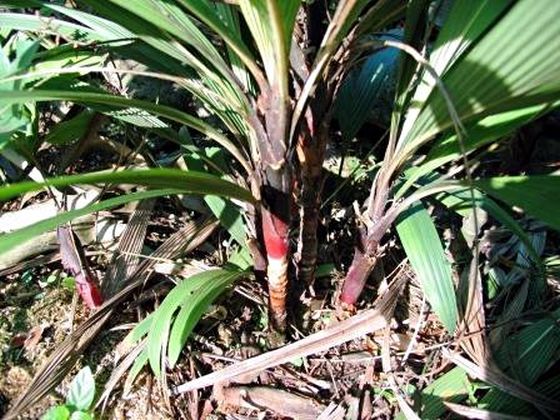
Madagascar. Photo by Utopia Palms & Cycads.
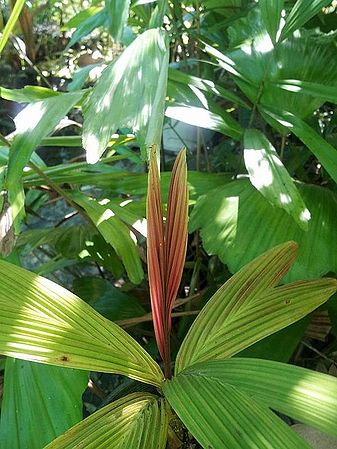
8/4/2013, Sunshine Coast Hinterland, Queensland, Australia. Photo by Wal.

In habitat. Photo-Rare Palm Seeds.com

In habitat. Photo-Rare Palm Seeds.com


wal.jpg)


External Links
- Glossary of Palm Terms
- MODERN BOTANICAL LATIN
- "Just To Be Clear"
- Utopia Palms & Cycads, GREAT PHOTOS!
References
Phonetic spelling of Latin names by edric.
Special thanks to Geoff Stein, (Palmbob) for his hundreds of photos.
Special thanks to Palmweb.org, Dr. John Dransfield, Dr. Bill Baker & team, for their volumes of information and photos.
Glossary of Palm Terms; Based on the glossary in Dransfield, J., N.W. Uhl, C.B. Asmussen-Lange, W.J. Baker, M.M. Harley & C.E. Lewis. 2008. Genera Palmarum - Evolution and Classification of the Palms. Royal Botanic Gardens, Kew. All images copyright of the artists and photographers (see images for credits).
Dransfield, J. & Beentje, H. 1995. Palms of Madagascar. Royal Botanic Gardens, Kew and The International Palm Society.
Many Special Thanks to Ed Vaile for his long hours of tireless editing and numerous contributions.