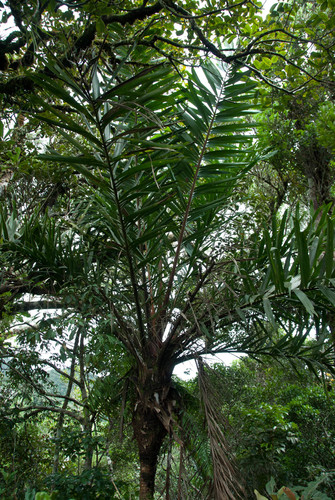
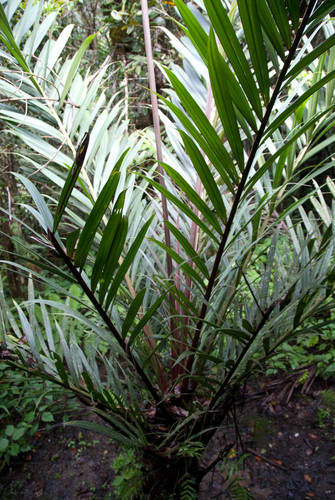
Dypsis marojejyi Beentje is a heavy, single-stemmed feather palm of the forest undergrowth on the Marojejy massif in north-eastern Madagascar. Its short, thick trunk carries a large crown of 18–20 leaves that wither in place instead of dropping cleanly, so the crown collects falling leaf litter, ferns and the roots of neighbouring trees. The long leaves bear stiff leaflets arranged in fanned clusters, the flowering branches divide to three orders and the seed has a ruminate endosperm. In the palm trade the name has long been attached to the "Madagascar foxtail" or "Mad Fox", a slimmer palm that is now usually sold as Dypsis coursii; true Dypsis marojejyi is essentially a palm of its mountain forest, and its describers knew of no plants in gardens.
Also known asmenamosona beratyraty (Betsimisaraka); menamoso (Tsimihety)
Distribution and habitat

Kew gives Madagascar as the only native range; the palm has no introduced range. When it was described it was known only from Marojejy (SAVA region, north-east Madagascar), now a national park. Herbarium collections come from both sides of the massif: the eastern summit trail north and north-west of Mandena, from above the second camp up to the third camp; the western slopes of Mont Beondroka; and, on the western side, the valley of the Ambatoharanana towards the upper Antsahaberoka basin. A 1994 gathering from the Anjanaharibe-Sud Special Reserve, north of Andapa, at 1220 m, has also been identified as this species; if that identification holds, the palm reaches the neighbouring massif to the west.
It grows in submontane rain forest, typically at 700–1100 m, on steep hillsides and on the broad ridges, where it can be locally abundant. Collectors have recorded it in cloud forest on a steep ridge at 925 m, in cloud forest at about 745 m on Mont Beondroka, and in mossy montane forest on quartzite at 1280 m near the third camp of the summit trail, where it was again noted as locally abundant. The 1959 western collection grew in very wet forest on lateritic clay over gneiss and granite. On the summit trail it occurs from the second camp up to the treeline, below the zone of Dypsis coursii. The climate is wet tropical, tempered by altitude and frequent mist.
Description

The account follows the original description by Beentje in The Palms of Madagascar (1995). The published text of the inflorescence and male flowers is incomplete in the copies available, so only the flower parts that survive are given.
Habit and stem
- Solitary, squat and robust.
- Trunk 3–6 m tall and 20–30 cm across, narrowing to about 20 cm just below the crown; internodes about 2 cm long.
- Basal stilt roots present (recorded from the type material; whether they are always present is uncertain).
Leaves
- 18–20 leaves in the crown. Old leaves and the remains of their sheaths stay on the upper trunk, so the crown gathers debris.
- Sheath about 20 cm long and about 40 cm wide, open (no crownshaft), densely clothed in rusty-brown hairs.
- Petiole very short, 0–10 cm, 3–3.5 × 2 cm in section, thickly covered in reddish hairs.
- Rachis 3–4 m long, 1.1–2.3 cm wide at mid-leaf, with reddish felt.
- About 60 leaflets on each side, stiff, bright to dark green, set in clusters of 3–6 that fan out in different planes, giving the leaf a somewhat plumose look. Gaps between clusters 4–9 cm; leaflets within a cluster 0.5–2 cm apart.
- Basal leaflets 29–41 × 0.3–0.4 cm; middle leaflets 45–70 × 2.5–5 cm; apical leaflets 15–35 × 0.7–2.7 cm. The terminal pair is several-folded and fused over as much as 3 cm.
- Each leaflet has 3–5 main veins carrying ramenta, with scattered reddish scales on the minor veins; tips unequally acute, the upper ones jagged (praemorse).
- The emerging leaf is a dark liver colour.
Inflorescence
- Diffusely branched to three orders, much more openly than in Dypsis perrieri.
Flowers
- Male flowers: anthers 1.8–2 × 0.8–1 mm, attached near the middle (versatile); sterile pistil about 1.3 × 0.6–0.9 mm.
- Female flowers: sepals 1.3–2.5 × 1.7–3.5 mm; petals 2.7–4.6 × 2.5–5 mm; six staminodes of 0.2–0.6 mm; ovary in bud about 2.5 × 0.8 mm.
Fruit and seed
- Fruit 22–25 × 14–18 mm, pale yellow-green, ellipsoid or a little obovoid, rounded at the apex, the surface pustulate; endocarp a dense network of fused fibres.
- Seed slightly obovoid, 18–20 × 13–16 mm, pointed at the base and rounded at the tip. Endosperm ruminate, with closely packed intrusions 2–5 mm deep.
Distinguishing features
The Latin diagnosis rests on the combination of a solitary, litter-trapping palm with withered leaves kept on a short, broad stem, long clustered leaflets, an inflorescence branched to three orders, and ruminate endosperm. Dypsis perrieri also traps litter and has leaves of similar size, but its leaflets are not clustered and its inflorescence is far less branched. Dypsis coursii, which grows higher on the same mountain, is a smaller palm with a much thinner stem (8–18 cm), a crown of only about four leaves, shorter and broader leaflets, and an inflorescence branched to two orders.
Plants grown as "Mad Fox" differ from the wild palm in several ways reported by growers: their trunks stay well under 20 cm thick even when mature and flowering, their inflorescences are far smaller than those illustrated for Dypsis marojejyi, and they flower on very short trunks. Cutting a seed is a simple first test, because a palm without ruminate endosperm cannot be this species.
Ecology

The crown works as a litter basket. Dead leaves and sheaths are not shed, and fallen debris from the canopy builds up between them. Roots of nearby trees grow up into this trapped humus and, as the palm lengthens, keep growing from one sheath to the next in a zigzag, until they are left exposed on the trunk. Ferns grow freely in the crown as well.
Herbarium labels give an outline of the reproductive cycle on Marojejy: flower buds in October, open flowers with young fruit in November, young fruit in November–December and mature fruit in February. Pollen from one of the 1988 gatherings was sampled for study at Kew. Pollinators and seed dispersers have not been observed.
Cultivation
At the time of its description the authors knew of no plants of Dypsis marojejyi in cultivation. The palms sold under this name, mainly raised in Hawaii (Kona and the Hilo side of the Big Island) and later grown in coastal southern California (Encinitas, Vista, Escondido) and Florida, are the "Mad Fox". In 2006 Dransfield still leaned towards accepting them as Dypsis marojejyi, noting that wild plants can be slimmer than the published figures, but in 2015 he was reported to have placed them in Dypsis coursii, and the trade has followed. Growing advice for those plants is given under Dypsis coursii.
Conservation
Conservation status: Vulnerable.
Its whole known range is small and lies inside protected land, chiefly Marojejy National Park, where the palm is common in places along the summit trail.
Name history
- Original publication: Dypsis marojejyi Beentje, in J.Dransfield & H.Beentje, The Palms of Madagascar: 234 (1995). It has no synonyms. In horticulture the name has been widely misapplied to the cultivated "Mad Fox", now generally sold as Dypsis coursii.
- Type: Madagascar, Marojejy Strict Nature Reserve (now Marojejy National Park), trail to the summit of Marojejy Est north of Mandena, above the second camp, steep hillside in submontane rain forest, 950 m, 24 November 1989, in flower and young fruit, Dransfield, Dransfield, Cooke, Miller & Randrianasolo JD6755 (holotype K; isotype TAN). Other material cited in 1995: Humbert & Saboureau 31702 (1959), Miller 3509 (1988) and Miller & Lowry 4185 (1989).
- Etymology: named after the type locality, the Marojejy massif.
- Local names: menamosona beratyraty in Betsimisaraka (written menamoso berati-raty on the type label); a 2015 collection records menamoso in the Tsimihety dialect.
- Pronunciation: DIP-sis mahr-oh-JEHJ-ee (old infobox spelling mahr-oh-jehj'-ee).
- Relationships: Dransfield and Beentje first grouped this palm with other litter-collecting species such as Dypsis perrieri, but the structure of its inflorescence pointed instead to Dypsis madagascariensis (now Chrysalidocarpus madagascariensis), Dypsis coursii and Dypsis rivularis.
- Classification: subfamily Arecoideae, tribe Areceae, subtribe Dypsidinae. Kew keeps it in Dypsis as narrowed by Eiserhardt et al. (2022).