Difference between revisions of "Geonoma maxima"
(Created page with "__noeditsection__ <google>CH02</google> [[Image: {{Palmbox |image= |image_caption= |genus='''''Geonoma''''' |species='''''maxima''''' |subspecies= |cultivar= |synonyms= |continen...") |
|||
| (25 intermediate revisions by one user not shown) | |||
| Line 1: | Line 1: | ||
__noeditsection__ | __noeditsection__ | ||
| − | |||
| − | |||
{{Palmbox | {{Palmbox | ||
| − | |image= | + | |image=guy_geonoma_maxima_fruits_mataroni.jpg |
| − | |image_caption= | + | |image_caption=Mataroni, French Guiana. Photo-tipalm.fr |
| − | |genus= | + | |genus=Geonoma (geo-NO-mah) |
| − | |species= | + | |species=<br>maxima (MAX-ih-mah) |
|subspecies= | |subspecies= | ||
|cultivar= | |cultivar= | ||
| Line 21: | Line 19: | ||
|common_names= | |common_names= | ||
}} | }} | ||
| − | |||
==Habitat and Distribution== | ==Habitat and Distribution== | ||
| − | + | Bolivia, Brazil North, Colombia, Ecuador, [[File:guy_geonoma_maxima_mataroni.jpg|thumb|left|400px|Mataroni, French Guiana. Photo-tipalm.fr]]French Guiana, Guyana, Peru, Suriname, and Venezuela. | |
==Description== | ==Description== | ||
| + | Palm 3.2 (1.0-9.0) m tall; stems 2.9 (1.0-7.0) m tall, 1.2 (0.5-2.3) cm in diameter, solitary or clustering, canelike; internodes 2.4 (0.5-8.7) cm long, yellowish and smooth. Leaves 9 (4-19) per stem, undivided or irregularly pinnate, if regularly pinnate the pinnae with 1 main vein only (rarely with several lateral veins), not plicate or plicate, bases of blades running diagonally into the rachis; sheaths 12.6 (4.0-30.0) cm long; petioles 34.6 (1.0-100.0) cm long, drying green or yellowish; rachis 44.0 (7.3-120.0) cm long, 3.6 (1.4-7.1) mm in diameter; veins raised and rectangular in cross-section adaxially; pinnae 8 (1-31) per side of rachis; basal pinna 43.2 (8.2-132.0) cm long, 3.9 (0.1-34.0) cm wide, forming an angle of 47 (7-87)° with the rachis; apical pinna 32.8 (8.5-86.0) cm long, 9.6 (0.2-42.5) cm wide, forming an angle of 23 (7-42)° with the rachis. Inflorescences branched 1-3 orders; prophylls and peduncular bracts not ribbed with elongate, unbranched fibers, flattened, deciduous or persistent; prophylls 10.6 (3.7-21.8) cm long, not short and asymmetrically apiculate, the surfaces not ridged, without unequally wide ridges; peduncular bracts 8.7 (4.7-13.0) cm long, well-developed, inserted 0.6 (0.2-3.0) cm above the prophyll; peduncles 8.2 (3.2-19.5) cm long, 4.9 (1.5-10.0) mm in diameter; rachillae 19 (4-50), 11.4 (4.8-24.3) cm long, 2.7 (0.7-6.0) mm in diameter, the surfaces without spiky, fibrous projections or ridges, drying brown or yellow-brown, without short, transverse ridges, not filiform and not narrowed between the flower pits; flower pits spirally arranged, glabrous internally; proximal lips with a central notch before anthesis, often the two sides of the notch overlapping, not recurved after anthesis, not hood-shaped; proximal and distal lips drying the same color as the rachillae, not joined to form a raised cupule, the proximal lip margins overlapping the distal lip margins; distal lips well-developed; staminate and pistillate petals not emergent, not valvate throughout; staminate flowers deciduous after anthesis; stamens 6; thecae diverging at anthesis, inserted directly onto the apiculate filament apices; anthers not short and curled at anthesis, usually elongate, spiraled and twisted or sometimes remaining straight; nonfertilized pistillate flowers deciduous after anthesis; staminodial tubes lobed at the apex, the lobes spreading at anthesis, acuminate, those of non-fertilized pistillate flowers not projecting and persistent after anthesis; fruits 11.8 (6.9-18.2) mm long, 9.0 (5.5-13.0) mm in diameter, apices not conical, the surfaces not splitting at maturity, without fibers emerging, not bumpy, not apiculate; locular epidermis without operculum, smooth, without pores. (Henderson, A.J. 2011)/Palmweb. Editing by edric. | ||
| + | {{read more top}} | ||
| + | Taxonomic notes: - Geonoma maxima is a member of the G. macrostachys clade, differing from all other species in its locular epidermis without an operculum. It also has more branched inflorescences (4-50 rachillae) compared to the rest of the clade (1-9 rachillae). It is another variable species which has been treated differently by Wessels Boer (1968) and Henderson et al. (1995). Unlike other species complexes, for example G. macrostachys, G. maxima exhibits rather well-defined geographic disjunction and morphological variation, allowing for recognition of various subspecies, as explained below. (Henderson, A.J. 2011)/Palmweb. | ||
| + | Subspecific variation: - Four traits vary within this species (stem branching, leaf division, leaf plication, pistillate flower persistence). There are very few data for stem branching, and this and leaf division are excluded from the following analyses. Leaf plication and pistillate flower persistence divide the specimens into three groups. However, leaf plication is difficult to score in this species and specimens with persistent pistillate flowers may be of hybrid origin (see below). Furthermore, there is no geographic separation between these groups. Geonoma maxima is widespread across the Amazon region, and there are isolated populations in the Magdalena valley and Pacific coast of Colombia and eastern Andean slopes in Venezuela. Apart from traits, one attribute (leaf division) divides the specimens into two groups. Leaves of one group are regularly pinnate and the pinnae (at least those from the middle part of the leaf) have several main veins, usually three to five. In the second group, all specimens have either undivided leaves, irregularly pinnate leaves (sometimes with 1-veined pinnae present), or leaves with 1-veined pinnae (at least those from the middle part of the leaf). The first group - with regularly pinnate leaves with 3-5-veined pinnae - can be divided into four separate subgroups based partly on geography and partly on variables. ANOVA shows that for pair wise comparison probabilities, 18 variables (plant height, stem diameter, internode length, petiole length, rachis length, rachis width, basal pinna length, basal pinna width, apical pinna length, apical pinna angle, prophyll length, interbract distance, peduncle length, peduncle width, rachilla length, rachilla width, number of rachillae, fruit diameter) differ significantly (P <0.05) between at least one pair of subgroups, although no variable differs amongst all four subgroups. Based on these results and geography, these four subgroups are recognized as subspecies (subspp. hexasticha, maxima, multiramosa, sigmoidea). The second group - with leaves undivided, irregularly pinnate (sometimes with 1-veined pinnae present), or regularly pinnate with 1-veined pinnae - can be divided into six separate subgroups based partly on geography, partly on variables, and on one trait (leaf plication). ANOVA shows that for pair wise comparison probabilities, 22 variables (plant height, stem diameter, leaf number, petiole length, rachis length, rachis width, number of pinnae, basal pinna length, basal pinna width, basal pinna angle, apical pinna length, apical pinna width, apical pinna angle, prophyll length, interbract distance, peduncle length, peduncle width, rachilla length, rachilla width, number of rachillae, fruit length, fruit diameter) differ significantly (P <0.05) between at least one pair of subgroups, although no variable differs amongst all six subgroups. Based on these results and geography, these six subgroups are recognized as subspecies (subspp. ambigua, chelidonura, camptoneura, compta, dispersa, spixiana). (Henderson, A.J. 2011)/Palmweb. Editing by edric. | ||
| + | {{read more bottom}} | ||
==Culture== | ==Culture== | ||
| − | + | Cold hardiness Zone: 10b | |
==Comments and Curiosities== | ==Comments and Curiosities== | ||
| + | Uses: the Indigenous use it for thatch, fence posts, utensils & tools, Hunting and fishing, Ritual rites,Personal adornment, and also the fruit is eaten. (Henderson, A.J. 2011)/Palmweb. | ||
| + | <br style="clear:both;"/> | ||
| + | {{#Widget:AdResban}} | ||
| + | <center><gallery caption="IMAGE GALLERY" perrow="" widths="" heights=""> | ||
| + | image:4744576998_5efbe1d446_o.jpg|Geonoma maxima var. maxima. In habitat. Photo by Dr. André Cardoso. | ||
| + | image:4744585036_f73c6364da_o.jpg|Geonoma maxima var. maxima. In habitat. Photo by Dr. André Cardoso. | ||
| + | File:guy_geonoma_maxima_in_situ.jpg|French Guiana. Photo-tipalm.fr | ||
| + | File:guy_geonoma_maxima_in_situ_a_kaw.jpg|Kaw, French Guiana. Photo-tipalm.fr | ||
| + | File:guy_geonoma_maxima_jeunes_plantes.jpg|French Guiana. Photo-tipalm.fr | ||
| + | File:guy_geonoma_maxima_plante_adulte_a_saut_maripa.jpg|Maripa, French Guiana. Photo-tipalm.fr | ||
| + | File:guy_geonoma_maxima_mataroni.jpg|Mataroni, French Guiana. Photo-tipalm.fr | ||
| + | File:guy_geonoma_maxima_fruits_mataroni.jpg|Mataroni, French Guiana. Photo-tipalm.fr | ||
| + | File:Geonoma maxima 2.jpg|Colombia. | ||
| + | File:brchambi_001063_01.jpg|Peru. | ||
| + | File:brchambi_001063_03.jpg|Peru. | ||
| + | File:brchambi_001063_04.jpg|Peru. | ||
| + | File:brchambi_001063_05.jpg|Peru. | ||
| + | |||
| + | File:Geonoma maxima 001.JPG|Machado-Minas Gerais-Brasil. Photo by Mauricio Moreira Caixeta | ||
| + | File:Geonoma maxima 002.JPG|Machado-Minas Gerais-Brasil. Photo by Mauricio Moreira Caixeta | ||
| + | image:Seedsgmax.jpg|Photo-manuplants.org | ||
| + | </gallery></center> | ||
==External Links== | ==External Links== | ||
*[http://eunops.org/content/glossary-palm-terms Glossary of Palm Terms] | *[http://eunops.org/content/glossary-palm-terms Glossary of Palm Terms] | ||
| − | *[http://www. | + | *[http://www.calflora.net/botanicalnames/pronunciation.html MODERN BOTANICAL LATIN] |
| − | + | *[http://www.jlhudsonseeds.net/Pronunciation.htm "Just To Be Clear"] | |
==References== | ==References== | ||
| − | Special thanks to Geoff Stein, (Palmbob) for his hundreds of photos, | + | Phonetic spelling of Latin names by edric. |
| + | |||
| + | Special thanks to Geoff Stein, (Palmbob) for his hundreds of photos. | ||
| + | |||
| + | Special thanks to [http://palmweb.org/?q=node/2 Palmweb.org], Dr. John Dransfield, Dr. Bill Baker & team, for their volumes of information and photos. | ||
| + | |||
| + | Glossary of Palm Terms; Based on the glossary in Dransfield, J., N.W. Uhl, C.B. Asmussen-Lange, W.J. Baker, M.M. Harley & C.E. Lewis. 2008. Genera Palmarum - Evolution and Classification of the Palms. Royal Botanic Gardens, Kew. All images copyright of the artists and photographers (see images for credits). | ||
| + | |||
| + | Henderson, A.J. 2011. A revision of Geonoma. Magnolia Press. | ||
| − | |||
| − | |||
| − | |||
| − | |||
| − | |||
| − | |||
| − | |||
| − | |||
| − | |||
| − | |||
| − | |||
| − | |||
{{SpeciesListBackLink}} | {{SpeciesListBackLink}} | ||
[[Category:GEONOMA|maxima]] | [[Category:GEONOMA|maxima]] | ||
Latest revision as of 10:25, 15 February 2019
| Geonoma (geo-NO-mah) maxima (MAX-ih-mah) | |||||||
|---|---|---|---|---|---|---|---|
 Mataroni, French Guiana. Photo-tipalm.fr | |||||||
| Scientific Classification | |||||||
| |||||||
| Synonyms | |||||||
|
| |||||||
| Native Continent | |||||||
 | |||||||
| Morphology | |||||||
| |||||||
| Culture | |||||||
|
| |||||||
| Survivability index | |||||||
|
| |||||||
| Common names | |||||||
|
| |||||||
Contents
Habitat and Distribution
Bolivia, Brazil North, Colombia, Ecuador,
Description
Palm 3.2 (1.0-9.0) m tall; stems 2.9 (1.0-7.0) m tall, 1.2 (0.5-2.3) cm in diameter, solitary or clustering, canelike; internodes 2.4 (0.5-8.7) cm long, yellowish and smooth. Leaves 9 (4-19) per stem, undivided or irregularly pinnate, if regularly pinnate the pinnae with 1 main vein only (rarely with several lateral veins), not plicate or plicate, bases of blades running diagonally into the rachis; sheaths 12.6 (4.0-30.0) cm long; petioles 34.6 (1.0-100.0) cm long, drying green or yellowish; rachis 44.0 (7.3-120.0) cm long, 3.6 (1.4-7.1) mm in diameter; veins raised and rectangular in cross-section adaxially; pinnae 8 (1-31) per side of rachis; basal pinna 43.2 (8.2-132.0) cm long, 3.9 (0.1-34.0) cm wide, forming an angle of 47 (7-87)° with the rachis; apical pinna 32.8 (8.5-86.0) cm long, 9.6 (0.2-42.5) cm wide, forming an angle of 23 (7-42)° with the rachis. Inflorescences branched 1-3 orders; prophylls and peduncular bracts not ribbed with elongate, unbranched fibers, flattened, deciduous or persistent; prophylls 10.6 (3.7-21.8) cm long, not short and asymmetrically apiculate, the surfaces not ridged, without unequally wide ridges; peduncular bracts 8.7 (4.7-13.0) cm long, well-developed, inserted 0.6 (0.2-3.0) cm above the prophyll; peduncles 8.2 (3.2-19.5) cm long, 4.9 (1.5-10.0) mm in diameter; rachillae 19 (4-50), 11.4 (4.8-24.3) cm long, 2.7 (0.7-6.0) mm in diameter, the surfaces without spiky, fibrous projections or ridges, drying brown or yellow-brown, without short, transverse ridges, not filiform and not narrowed between the flower pits; flower pits spirally arranged, glabrous internally; proximal lips with a central notch before anthesis, often the two sides of the notch overlapping, not recurved after anthesis, not hood-shaped; proximal and distal lips drying the same color as the rachillae, not joined to form a raised cupule, the proximal lip margins overlapping the distal lip margins; distal lips well-developed; staminate and pistillate petals not emergent, not valvate throughout; staminate flowers deciduous after anthesis; stamens 6; thecae diverging at anthesis, inserted directly onto the apiculate filament apices; anthers not short and curled at anthesis, usually elongate, spiraled and twisted or sometimes remaining straight; nonfertilized pistillate flowers deciduous after anthesis; staminodial tubes lobed at the apex, the lobes spreading at anthesis, acuminate, those of non-fertilized pistillate flowers not projecting and persistent after anthesis; fruits 11.8 (6.9-18.2) mm long, 9.0 (5.5-13.0) mm in diameter, apices not conical, the surfaces not splitting at maturity, without fibers emerging, not bumpy, not apiculate; locular epidermis without operculum, smooth, without pores. (Henderson, A.J. 2011)/Palmweb. Editing by edric.
| read more |
|---|
|
Taxonomic notes: - Geonoma maxima is a member of the G. macrostachys clade, differing from all other species in its locular epidermis without an operculum. It also has more branched inflorescences (4-50 rachillae) compared to the rest of the clade (1-9 rachillae). It is another variable species which has been treated differently by Wessels Boer (1968) and Henderson et al. (1995). Unlike other species complexes, for example G. macrostachys, G. maxima exhibits rather well-defined geographic disjunction and morphological variation, allowing for recognition of various subspecies, as explained below. (Henderson, A.J. 2011)/Palmweb. Subspecific variation: - Four traits vary within this species (stem branching, leaf division, leaf plication, pistillate flower persistence). There are very few data for stem branching, and this and leaf division are excluded from the following analyses. Leaf plication and pistillate flower persistence divide the specimens into three groups. However, leaf plication is difficult to score in this species and specimens with persistent pistillate flowers may be of hybrid origin (see below). Furthermore, there is no geographic separation between these groups. Geonoma maxima is widespread across the Amazon region, and there are isolated populations in the Magdalena valley and Pacific coast of Colombia and eastern Andean slopes in Venezuela. Apart from traits, one attribute (leaf division) divides the specimens into two groups. Leaves of one group are regularly pinnate and the pinnae (at least those from the middle part of the leaf) have several main veins, usually three to five. In the second group, all specimens have either undivided leaves, irregularly pinnate leaves (sometimes with 1-veined pinnae present), or leaves with 1-veined pinnae (at least those from the middle part of the leaf). The first group - with regularly pinnate leaves with 3-5-veined pinnae - can be divided into four separate subgroups based partly on geography and partly on variables. ANOVA shows that for pair wise comparison probabilities, 18 variables (plant height, stem diameter, internode length, petiole length, rachis length, rachis width, basal pinna length, basal pinna width, apical pinna length, apical pinna angle, prophyll length, interbract distance, peduncle length, peduncle width, rachilla length, rachilla width, number of rachillae, fruit diameter) differ significantly (P <0.05) between at least one pair of subgroups, although no variable differs amongst all four subgroups. Based on these results and geography, these four subgroups are recognized as subspecies (subspp. hexasticha, maxima, multiramosa, sigmoidea). The second group - with leaves undivided, irregularly pinnate (sometimes with 1-veined pinnae present), or regularly pinnate with 1-veined pinnae - can be divided into six separate subgroups based partly on geography, partly on variables, and on one trait (leaf plication). ANOVA shows that for pair wise comparison probabilities, 22 variables (plant height, stem diameter, leaf number, petiole length, rachis length, rachis width, number of pinnae, basal pinna length, basal pinna width, basal pinna angle, apical pinna length, apical pinna width, apical pinna angle, prophyll length, interbract distance, peduncle length, peduncle width, rachilla length, rachilla width, number of rachillae, fruit length, fruit diameter) differ significantly (P <0.05) between at least one pair of subgroups, although no variable differs amongst all six subgroups. Based on these results and geography, these six subgroups are recognized as subspecies (subspp. ambigua, chelidonura, camptoneura, compta, dispersa, spixiana). (Henderson, A.J. 2011)/Palmweb. Editing by edric. |
Culture
Cold hardiness Zone: 10b
Comments and Curiosities
Uses: the Indigenous use it for thatch, fence posts, utensils & tools, Hunting and fishing, Ritual rites,Personal adornment, and also the fruit is eaten. (Henderson, A.J. 2011)/Palmweb.
- IMAGE GALLERY

Geonoma maxima var. maxima. In habitat. Photo by Dr. André Cardoso.

Geonoma maxima var. maxima. In habitat. Photo by Dr. André Cardoso.

French Guiana. Photo-tipalm.fr

Kaw, French Guiana. Photo-tipalm.fr
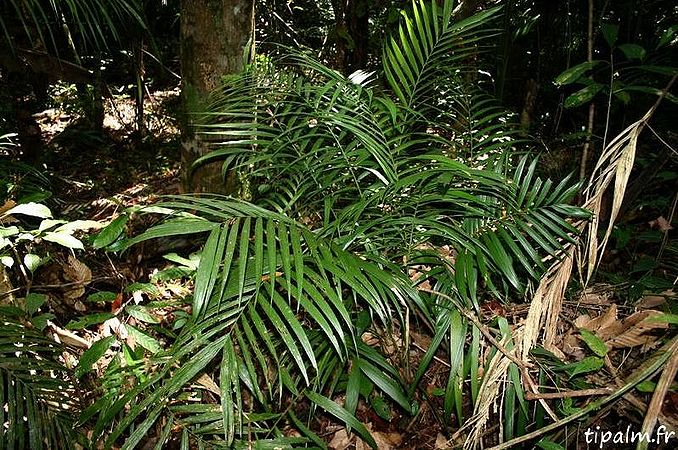
French Guiana. Photo-tipalm.fr

Maripa, French Guiana. Photo-tipalm.fr

Mataroni, French Guiana. Photo-tipalm.fr

Mataroni, French Guiana. Photo-tipalm.fr

Colombia.

Peru.

Peru.

Peru.

Peru.

Machado-Minas Gerais-Brasil. Photo by Mauricio Moreira Caixeta

Machado-Minas Gerais-Brasil. Photo by Mauricio Moreira Caixeta
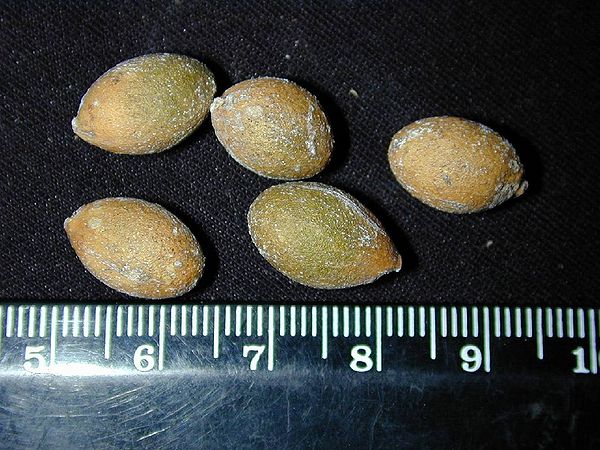
Photo-manuplants.org


External Links
References
Phonetic spelling of Latin names by edric.
Special thanks to Geoff Stein, (Palmbob) for his hundreds of photos.
Special thanks to Palmweb.org, Dr. John Dransfield, Dr. Bill Baker & team, for their volumes of information and photos.
Glossary of Palm Terms; Based on the glossary in Dransfield, J., N.W. Uhl, C.B. Asmussen-Lange, W.J. Baker, M.M. Harley & C.E. Lewis. 2008. Genera Palmarum - Evolution and Classification of the Palms. Royal Botanic Gardens, Kew. All images copyright of the artists and photographers (see images for credits).
Henderson, A.J. 2011. A revision of Geonoma. Magnolia Press.
Many Special Thanks to Ed Vaile for his long hours of tireless editing and numerous contributions.