Difference between revisions of "Butia odorata"
| (7 intermediate revisions by one user not shown) | |||
| Line 20: | Line 20: | ||
}} | }} | ||
==Habitat and distribution== | ==Habitat and distribution== | ||
| − | ''Butia odorata'' is native to the grasslands, and dry woodlands and savannahs of South America. | + | ''Butia odorata'' is native to the grasslands, and dry woodlands and savannahs of South America. [[Image:BoIMG_4167z.jpg|thumb|left|500px|17 years old, edric, Oak Hill FL.]]Populations range across a wide area of northern Argentina, southern Brazil, Paraguay and Uruguay. |
| − | + | ||
| − | [[Image:BoIMG_4167z.jpg|thumb|left| | + | |
==Description== | ==Description== | ||
Long pinnate leaves that arch and recurve towards the ground from atop a thick stout trunk. The trunk can grow to 20 feet, but normally reaches 12-15 ft (3.7-4.6 m) with a diameter of 1-1.5 ft (0.3-0.5 m). Typically, the old leaf stalks persist for years, although specimens with clean trunks are not uncommon. Leaves range from light green to bluish gray, and grow 5 to 10 feet long. The leaf stems range from about 2-4 ft (0.6-1.2 m) in length, and the petiole is armed. The palm produces bright orange fruit (often called pindo dates in the Deep South). These palms vary in form from one individual to the next. Specimens raised in dry and/or infertile soils tend to be smaller in stature with smaller leaves. Light also affects the plant's form while those grown in full sun are more compact. | Long pinnate leaves that arch and recurve towards the ground from atop a thick stout trunk. The trunk can grow to 20 feet, but normally reaches 12-15 ft (3.7-4.6 m) with a diameter of 1-1.5 ft (0.3-0.5 m). Typically, the old leaf stalks persist for years, although specimens with clean trunks are not uncommon. Leaves range from light green to bluish gray, and grow 5 to 10 feet long. The leaf stems range from about 2-4 ft (0.6-1.2 m) in length, and the petiole is armed. The palm produces bright orange fruit (often called pindo dates in the Deep South). These palms vary in form from one individual to the next. Specimens raised in dry and/or infertile soils tend to be smaller in stature with smaller leaves. Light also affects the plant's form while those grown in full sun are more compact. | ||
| − | Trees 3-5 m tall, 40-50 cm in diam.; complete sheathing leaf base not seen, petiole 70-88 cm long; 4-7 cm wide at base, margins mostly armed with fairly short teeth on upper portion, coarsely spiny on lower part and adjacent sheathing base, spines 8-11 cm long; rachis of leaf 150-183 cm long; pinnae 63-80 on each side, regularly arranged, middle ones 60-75 cm long, 1.5-2.5 cm, with oblique, asymmetrical tips; expanded part of spathe 80-100 cm long, 7.0-8.5 cm wide, smooth or striate, more or less glaucous, becoming eglaucous with age; bran~hed part of spadix 85-94 cm long, rachIllae 50-60, 62-69 cm long; pistil. late flowers rounded or ovoid, 4-8 mm long, 4-6 mm in diam.; lower staminate flowers 7-10 mm long, those above 4-7 mm long; mature fruit orange, with soft mesocarp when ripe, ovoid, 1.8-2.6 cm long, 1.5-2.2 cm in diam., with short beak, persistent perianth 0.4-0.6 cm high, locules 1-3, seed ovoid or triangu. lar, 1.8-2.4 cm long, 1.0-1.4, cm in diam. (S.F. Glassman. 1979)/Palmweb. | + | Trees 3-5 m tall, 40-50 cm in diam.; complete sheathing leaf base not seen, petiole 70-88 cm long; 4-7 cm wide at base, margins mostly armed with fairly short teeth on upper portion, coarsely spiny on lower part and adjacent sheathing base, spines 8-11 cm long; rachis of leaf 150-183 cm long; pinnae 63-80 on each side, regularly arranged, middle ones 60-75 cm long, 1.5-2.5 cm, with oblique, asymmetrical tips; expanded part of spathe 80-100 cm long, 7.0-8.5 cm wide, smooth or striate, more or less glaucous, becoming eglaucous with age; bran~hed part of spadix 85-94 cm long, rachIllae 50-60, 62-69 cm long; pistil. late flowers rounded or ovoid, 4-8 mm long, 4-6 mm in diam.; lower staminate flowers 7-10 mm long, those above 4-7 mm long; mature fruit orange, with soft mesocarp when ripe, ovoid, 1.8-2.6 cm long, 1.5-2.2 cm in diam., with short beak, persistent perianth 0.4-0.6 cm high, locules 1-3, seed ovoid or triangu. lar, 1.8-2.4 cm long, 1.0-1.4, cm in diam. (S.F. Glassman. 1979)/Palmweb. Editing by edric. |
This palm was also known incorrectly as Butia capitata for many years. The true Butia capitata was first described and named by Martius as Cocos capitata in 1826. It was discovered in the state of Minas Gerais by Martius near the town of Montes Claros and is a cerrado-loving palm endemic to the central planalto region of Brazil. It is a very different palm from the more robust coastal plane or restinga-loving "Butia capitata" of Uruguay and Rio Grande do Sul, Brazil. Barbosa Rodrigues (1891, 1903) described and named the southern one as Cocos odorata and wrote that it inhabited fields in Rio Grande do Sul and on the Isla de los Padres near the Rio Cebollati (Lagoa Mirim), Uruguay. Beccari (1916) half-heartedly accepted Barbosa Rodrigues' name when he created Butia capitata var. odorata (Barb. Rodr.) Becc. Glassman (1979) synonymized both of these names under Butia capitata expressing a need for further study. Henderson (1999), reiterating my own view, wrote that "They (the southern population) should perhaps be recognized as a separate species, in which case Butia odorata would be the correct name (Larry Noblick, pers. comm.)." Since then, others have supported, but failed to transfer Cocos odorata to Butia odorata. In his PhD thesis, Marcato (2004) created the name Butia odorata (Barb.Rodr.) Noblick ex Marcato, but he never published his thesis nor the name. Lorenzi et al. (2004) published the name Butia odorata (Barb.Rodr.) Noblick & Pirani, but it lacked a proper basionym reference, and the transfer failed. Finally, Lorenzi et al. (2010) published Butia odorata Noblick & Lorenzi, but it had an erroneous basionym reference that rendered the name illegitimate. Therefore, let the above transfer be considered the final, legal and official transfer of Cocos odorata Barb. Rodr. to Butia, with its correct basionym reference. (L. Noblick. 2011) | This palm was also known incorrectly as Butia capitata for many years. The true Butia capitata was first described and named by Martius as Cocos capitata in 1826. It was discovered in the state of Minas Gerais by Martius near the town of Montes Claros and is a cerrado-loving palm endemic to the central planalto region of Brazil. It is a very different palm from the more robust coastal plane or restinga-loving "Butia capitata" of Uruguay and Rio Grande do Sul, Brazil. Barbosa Rodrigues (1891, 1903) described and named the southern one as Cocos odorata and wrote that it inhabited fields in Rio Grande do Sul and on the Isla de los Padres near the Rio Cebollati (Lagoa Mirim), Uruguay. Beccari (1916) half-heartedly accepted Barbosa Rodrigues' name when he created Butia capitata var. odorata (Barb. Rodr.) Becc. Glassman (1979) synonymized both of these names under Butia capitata expressing a need for further study. Henderson (1999), reiterating my own view, wrote that "They (the southern population) should perhaps be recognized as a separate species, in which case Butia odorata would be the correct name (Larry Noblick, pers. comm.)." Since then, others have supported, but failed to transfer Cocos odorata to Butia odorata. In his PhD thesis, Marcato (2004) created the name Butia odorata (Barb.Rodr.) Noblick ex Marcato, but he never published his thesis nor the name. Lorenzi et al. (2004) published the name Butia odorata (Barb.Rodr.) Noblick & Pirani, but it lacked a proper basionym reference, and the transfer failed. Finally, Lorenzi et al. (2010) published Butia odorata Noblick & Lorenzi, but it had an erroneous basionym reference that rendered the name illegitimate. Therefore, let the above transfer be considered the final, legal and official transfer of Cocos odorata Barb. Rodr. to Butia, with its correct basionym reference. (L. Noblick. 2011) | ||
| Line 36: | Line 34: | ||
"After photographing the various Butia odoratas at the Huntington for years, I have discovered that fruit size is extremely variable with some plants producing fruit 3-4x the size of others, yet the plants themselves look identical. I have also discovered that during fruit season (just ending now) one can sample the fruits from literally a dozen different trees there and all taste different. And some fruits start out red like that and some never develop that red color. I will not pretend that these plants all have to be exactly the same species, but all are labeled Butia capitata. Then of course the Huntington has a half dozen Butia paraguayensis and 3-4 Butia yatays, there, too. Not to mention all the Jubaeas and Queens and Parajubaeas that could all be adding their pollen into the smorgashborg. But the fruits of one plant seem pretty consistent over the years (the ones producing reddish fruit do so year after year and the ones making dinky fruits do so year after year)... so this may just be variation in this species." (Geoff Stein). | "After photographing the various Butia odoratas at the Huntington for years, I have discovered that fruit size is extremely variable with some plants producing fruit 3-4x the size of others, yet the plants themselves look identical. I have also discovered that during fruit season (just ending now) one can sample the fruits from literally a dozen different trees there and all taste different. And some fruits start out red like that and some never develop that red color. I will not pretend that these plants all have to be exactly the same species, but all are labeled Butia capitata. Then of course the Huntington has a half dozen Butia paraguayensis and 3-4 Butia yatays, there, too. Not to mention all the Jubaeas and Queens and Parajubaeas that could all be adding their pollen into the smorgashborg. But the fruits of one plant seem pretty consistent over the years (the ones producing reddish fruit do so year after year and the ones making dinky fruits do so year after year)... so this may just be variation in this species." (Geoff Stein). | ||
| − | |||
| − | |||
| − | + | Plant with stems up to 9 feet tall and 32-58 cm in diameter; bract of the inflorescence stalk wider near the middle portion of the expanded portion and gradually tapering towards the apex; fruits often wider than long ............. Butia odorata. (K. Soares & S. Longhi) (From the portuguese) Editing by edric. | |
| − | + | See external links "Palmtalk" for the full story about Butia capitata and odorata. | |
| − | + | ||
| − | + | ||
| − | + | ||
| − | + | ||
| − | + | ||
| − | + | ||
| − | + | ||
| − | + | ||
| − | + | ||
| − | + | ||
| − | + | ||
| − | See external links "Palmtalk" for the full story about Butia capitata and odorata | + | |
<br style="clear:both;"/> | <br style="clear:both;"/> | ||
{{#Widget:AdResban}} | {{#Widget:AdResban}} | ||
<center><gallery caption="IMAGE GALLERY" perrow="" widths="" heights=""> | <center><gallery caption="IMAGE GALLERY" perrow="" widths="" heights=""> | ||
| − | image:-gallery-members-Butia_capitata_craft.jpg|Huntington Botanical Gardens, Los Angeles, California, photo by Paul Craft | + | image:-gallery-members-Butia_capitata_craft.jpg|Huntington Botanical Gardens, Los Angeles, California, photo by Paul Craft. |
Image:Butia capitata flowers Qu.jpg|Flowers. | Image:Butia capitata flowers Qu.jpg|Flowers. | ||
Image:Butia capitata fruiting nicely.jpg|Fruiting. | Image:Butia capitata fruiting nicely.jpg|Fruiting. | ||
| − | image:6638236059_a652df1a9b_b.jpg|Província de Rocha, Uruguay. Photo by Leandro Damschi | + | image:6638236059_a652df1a9b_b.jpg|Província de Rocha, Uruguay. Photo by Leandro Damschi. |
| − | image:4822957194_f31a2db0a8_o.jpg|Panama City, FL. Photo by Susan Knodle | + | image:4822957194_f31a2db0a8_o.jpg|Panama City, FL. Photo by Susan Knodle. |
| − | image:2872642641_3f45941d70.jpg|Brazil. Photo by Dr. Kellen Soares | + | image:2872642641_3f45941d70.jpg|Brazil. Photo by Dr. Kellen Soares. |
| − | image:6710571557_cf760c9a7e_o.jpg|Eastern Uruguay palm savannahs. Photo by Shirley Sekarajasingham | + | image:6710571557_cf760c9a7e_o.jpg|Eastern Uruguay palm savannahs. Photo by Shirley Sekarajasingham. |
| − | image:Capitatauruguay2.JPG|Uraguay. 300 to 400 years old. Photo by Nigel | + | image:Capitatauruguay2.JPG|Uraguay. 300 to 400 years old. Photo by Nigel. |
| − | image:UrButiagrus.jpg|Uraguay. B. odorata and natural Butiagrus. Photo by Nigel | + | image:UrButiagrus.jpg|Uraguay. B. odorata and natural Butiagrus. Photo by Nigel. |
| − | image:Capitata_uruguay09.jpg|Uraguay. B. odorata. Photo by Nigel | + | image:Capitata_uruguay09.jpg|Uraguay. B. odorata. Photo by Nigel. |
| − | image:BoIMG_4764.jpg|At Matty Bradford's place. Spring Valley, CA. Photo by Troy Donovan, | + | image:BoIMG_4764.jpg|At Matty Bradford's place. Spring Valley, CA. Photo by Troy Donovan. |
| − | + | File:bo2008.jpg|Niceville, FL. "These are all of the same palm taken over the years" | |
| − | image:B_capit_fruta.jpg|Photo by | + | File:bo2012 2.JPG|Niceville, FL. "These are all of the same palm taken over the years" |
| − | image:Seed_butias.jpg|The first two seeds labeled capitata, show Butia catarinensis on the left (was considered a var. of the Pindo palm, was capitata, this var. now has it's own classification) and odorata (what was referred to for decades as capitata) on the right, the others are as labeled. photo by | + | File:bo2015.JPG|Niceville, FL. "These are all of the same palm taken over the years" |
| − | image:002_(Large).JPG|Photo by Nigel Kembrey | + | File:Butiafruit-fatmama.jpg|An especially heavy (and weird) fruit cluster on B. capitata. The palm has a massive trunk and always bears huge fruit clusters.Augusta, GA. Photo by Joe Le Vert. |
| + | image:B_capit_fruta.jpg|Photo by Jose A. Grassia. | ||
| + | image:Seed_butias.jpg|The first two seeds labeled capitata, show Butia catarinensis on the left (was considered a var. of the Pindo palm, was capitata, this var. now has it's own classification) and odorata (what was referred to for decades as capitata) on the right, the others are as labeled. photo by Jose A. Grassia. | ||
| + | image:002_(Large).JPG|Photo by Nigel Kembrey. | ||
Image:Butia trunk detail retained leafbases.jpg|Trunk Detail. | Image:Butia trunk detail retained leafbases.jpg|Trunk Detail. | ||
Image:Butia capitata strictor again.jpg|var. Strictor. | Image:Butia capitata strictor again.jpg|var. Strictor. | ||
| Line 110: | Line 97: | ||
*[http://www.ars-grin.gov/cgi-bin/npgs/html/taxon.pl?8181 USDA GRIN site] | *[http://www.ars-grin.gov/cgi-bin/npgs/html/taxon.pl?8181 USDA GRIN site] | ||
*[http://globotv.globo.com/rbs-rs/jornal-do-almoco/v/butiazal-chama-a-atencao-pela-beleza-no-rio-grande-do-sul/2306839/ The largest natural stand (butiazal) of Butia odorata in the state of Rio Grande do Sul, nearly 100 km from the capital Porto Alegre.] | *[http://globotv.globo.com/rbs-rs/jornal-do-almoco/v/butiazal-chama-a-atencao-pela-beleza-no-rio-grande-do-sul/2306839/ The largest natural stand (butiazal) of Butia odorata in the state of Rio Grande do Sul, nearly 100 km from the capital Porto Alegre.] | ||
| − | *[http://www.youtube.com/watch?v=5pE0UsSuoyA&feature=player_embedded At Matty Bradford's place. Spring Valley, CA. video by Troy Donovan | + | *[http://www.youtube.com/watch?v=5pE0UsSuoyA&feature=player_embedded At Matty Bradford's place. Spring Valley, CA. video by Troy Donovan.] |
==References== | ==References== | ||
Phonetic spelling of Latin names by edric. | Phonetic spelling of Latin names by edric. | ||
Latest revision as of 09:50, 15 February 2019
| Butia (boo-TEE-ah) odorata (oh-dohr-AH-tah) | ||||||||
|---|---|---|---|---|---|---|---|---|
 Spathe, about forty minutes after opening, edric, Oak Hill, Florida. | ||||||||
| Scientific Classification | ||||||||
| ||||||||
| Synonyms | ||||||||
|
| ||||||||
| Native Continent | ||||||||
 | ||||||||
| Morphology | ||||||||
| ||||||||
| Culture | ||||||||
| ||||||||
| Survivability index | ||||||||
|
| ||||||||
| Common names | ||||||||
|
| ||||||||
Contents
Habitat and distribution
Butia odorata is native to the grasslands, and dry woodlands and savannahs of South America.
Description
Long pinnate leaves that arch and recurve towards the ground from atop a thick stout trunk. The trunk can grow to 20 feet, but normally reaches 12-15 ft (3.7-4.6 m) with a diameter of 1-1.5 ft (0.3-0.5 m). Typically, the old leaf stalks persist for years, although specimens with clean trunks are not uncommon. Leaves range from light green to bluish gray, and grow 5 to 10 feet long. The leaf stems range from about 2-4 ft (0.6-1.2 m) in length, and the petiole is armed. The palm produces bright orange fruit (often called pindo dates in the Deep South). These palms vary in form from one individual to the next. Specimens raised in dry and/or infertile soils tend to be smaller in stature with smaller leaves. Light also affects the plant's form while those grown in full sun are more compact.
Trees 3-5 m tall, 40-50 cm in diam.; complete sheathing leaf base not seen, petiole 70-88 cm long; 4-7 cm wide at base, margins mostly armed with fairly short teeth on upper portion, coarsely spiny on lower part and adjacent sheathing base, spines 8-11 cm long; rachis of leaf 150-183 cm long; pinnae 63-80 on each side, regularly arranged, middle ones 60-75 cm long, 1.5-2.5 cm, with oblique, asymmetrical tips; expanded part of spathe 80-100 cm long, 7.0-8.5 cm wide, smooth or striate, more or less glaucous, becoming eglaucous with age; bran~hed part of spadix 85-94 cm long, rachIllae 50-60, 62-69 cm long; pistil. late flowers rounded or ovoid, 4-8 mm long, 4-6 mm in diam.; lower staminate flowers 7-10 mm long, those above 4-7 mm long; mature fruit orange, with soft mesocarp when ripe, ovoid, 1.8-2.6 cm long, 1.5-2.2 cm in diam., with short beak, persistent perianth 0.4-0.6 cm high, locules 1-3, seed ovoid or triangu. lar, 1.8-2.4 cm long, 1.0-1.4, cm in diam. (S.F. Glassman. 1979)/Palmweb. Editing by edric.
This palm was also known incorrectly as Butia capitata for many years. The true Butia capitata was first described and named by Martius as Cocos capitata in 1826. It was discovered in the state of Minas Gerais by Martius near the town of Montes Claros and is a cerrado-loving palm endemic to the central planalto region of Brazil. It is a very different palm from the more robust coastal plane or restinga-loving "Butia capitata" of Uruguay and Rio Grande do Sul, Brazil. Barbosa Rodrigues (1891, 1903) described and named the southern one as Cocos odorata and wrote that it inhabited fields in Rio Grande do Sul and on the Isla de los Padres near the Rio Cebollati (Lagoa Mirim), Uruguay. Beccari (1916) half-heartedly accepted Barbosa Rodrigues' name when he created Butia capitata var. odorata (Barb. Rodr.) Becc. Glassman (1979) synonymized both of these names under Butia capitata expressing a need for further study. Henderson (1999), reiterating my own view, wrote that "They (the southern population) should perhaps be recognized as a separate species, in which case Butia odorata would be the correct name (Larry Noblick, pers. comm.)." Since then, others have supported, but failed to transfer Cocos odorata to Butia odorata. In his PhD thesis, Marcato (2004) created the name Butia odorata (Barb.Rodr.) Noblick ex Marcato, but he never published his thesis nor the name. Lorenzi et al. (2004) published the name Butia odorata (Barb.Rodr.) Noblick & Pirani, but it lacked a proper basionym reference, and the transfer failed. Finally, Lorenzi et al. (2010) published Butia odorata Noblick & Lorenzi, but it had an erroneous basionym reference that rendered the name illegitimate. Therefore, let the above transfer be considered the final, legal and official transfer of Cocos odorata Barb. Rodr. to Butia, with its correct basionym reference. (L. Noblick. 2011) L. Noblick, Validation of the name Butia odorata in Palms (1999+) 55 (1). 2011.
Culture
Requirements: Full sun to moderate shade (the fronds grow longer in shady situations, giving the palm a more graceful aspect than those grown in full sun). Prefers sandy, well drained soil but is adaptable and very drought tolerant. Regular watering and feeding will produce a faster growing, more attractive palm.Grown: USDA Zone 8-9. Specimens can be seen in North Carolina and I've had reports of a Butia spotting in Washington D.C. On the west coast the Pindo palm is grown as a novelty in warmer Zone 8 microclimates as far north as British Columbia. This palm is not recommended for subtropical and tropical climates.

Comments and Curiosities
"After photographing the various Butia odoratas at the Huntington for years, I have discovered that fruit size is extremely variable with some plants producing fruit 3-4x the size of others, yet the plants themselves look identical. I have also discovered that during fruit season (just ending now) one can sample the fruits from literally a dozen different trees there and all taste different. And some fruits start out red like that and some never develop that red color. I will not pretend that these plants all have to be exactly the same species, but all are labeled Butia capitata. Then of course the Huntington has a half dozen Butia paraguayensis and 3-4 Butia yatays, there, too. Not to mention all the Jubaeas and Queens and Parajubaeas that could all be adding their pollen into the smorgashborg. But the fruits of one plant seem pretty consistent over the years (the ones producing reddish fruit do so year after year and the ones making dinky fruits do so year after year)... so this may just be variation in this species." (Geoff Stein).
Plant with stems up to 9 feet tall and 32-58 cm in diameter; bract of the inflorescence stalk wider near the middle portion of the expanded portion and gradually tapering towards the apex; fruits often wider than long ............. Butia odorata. (K. Soares & S. Longhi) (From the portuguese) Editing by edric.
See external links "Palmtalk" for the full story about Butia capitata and odorata.
- IMAGE GALLERY
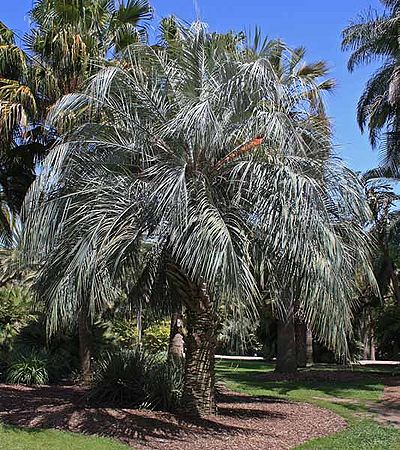
Huntington Botanical Gardens, Los Angeles, California, photo by Paul Craft.

Flowers.

Fruiting.

Província de Rocha, Uruguay. Photo by Leandro Damschi.

Panama City, FL. Photo by Susan Knodle.

Brazil. Photo by Dr. Kellen Soares.

Eastern Uruguay palm savannahs. Photo by Shirley Sekarajasingham.

Uraguay. 300 to 400 years old. Photo by Nigel.

Uraguay. B. odorata and natural Butiagrus. Photo by Nigel.

Uraguay. B. odorata. Photo by Nigel.

At Matty Bradford's place. Spring Valley, CA. Photo by Troy Donovan.

Niceville, FL. "These are all of the same palm taken over the years"
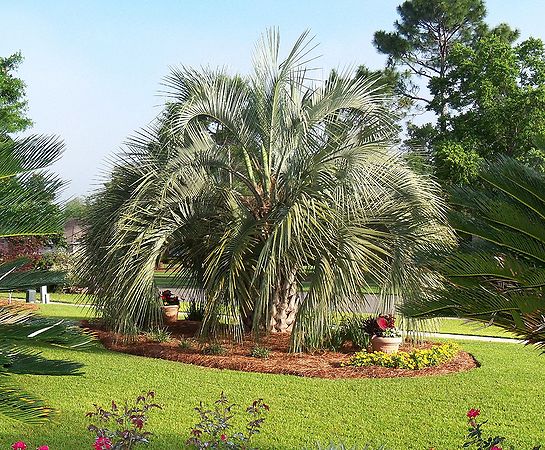
Niceville, FL. "These are all of the same palm taken over the years"

Niceville, FL. "These are all of the same palm taken over the years"

An especially heavy (and weird) fruit cluster on B. capitata. The palm has a massive trunk and always bears huge fruit clusters.Augusta, GA. Photo by Joe Le Vert.

Photo by Jose A. Grassia.
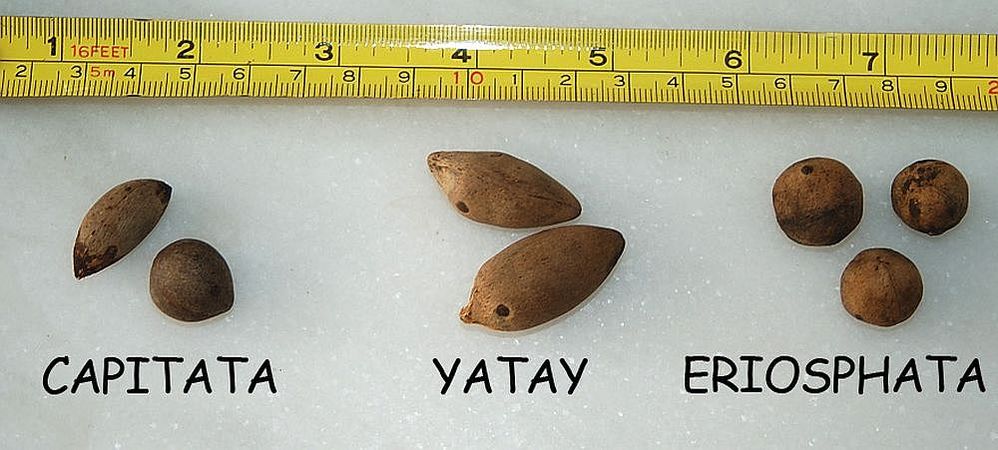
The first two seeds labeled capitata, show Butia catarinensis on the left (was considered a var. of the Pindo palm, was capitata, this var. now has it's own classification) and odorata (what was referred to for decades as capitata) on the right, the others are as labeled. photo by Jose A. Grassia.

Photo by Nigel Kembrey.

Trunk Detail.

var. Strictor.

As Potted Plant.

Argentina. Photo by Ammon.

Fifteen years old from seed, edric, Oak Hill, Florida .

Spathe, the day before it opened, edric, Oak Hill, Florida.

Spathe, about forty minutes after opening, edric, Oak Hill, Florida.

The day after opening, Oak Hill, Florida.

Fruit, just before it ripens, edric, Oak Hill, Florida.

edric, Oak Hill, FL.

edric, Oak Hill, FL.

Oak Hill FL. 20 years old. Photo by edric.

4/6/2009, Island of Venezia, edric, New Smyrna Beach, Florida.

6/28/2014, Island of Venezia, edric, New Smyrna Beach, Florida.

11 months old, edric, Oak Hill FL.

27 months old, in ground 125 days, edric, Oak Hill FL.

30 Months old, in ground 7 months, edric, Oak Hill FL.

17 years old, edric, Oak Hill FL

17 years old, edric, Oak Hill FL

17 years old, edric, Oak Hill FL

Flowers in Feb., edric, Oak Hill FL

Sets seed in March, edric, Oak Hill FL

May 5 2012, edric, Oak Hill FL

May 29 2012, edric, Oak Hill FL


.JPG)


External links
- Glossary of Palm Terms
- MODERN BOTANICAL LATIN
- "Just To Be Clear"
- "Palmtalk"
- "Palmtalk 2"
- http://itp.lucidcentral.org/id/palms/palm-id/Butia_capitata.htm
- Butia capitata on Floridata site
- http://www.palms.org/palmsjournal/2011/v55n1p48-49.pdf
- USDA GRIN site
- The largest natural stand (butiazal) of Butia odorata in the state of Rio Grande do Sul, nearly 100 km from the capital Porto Alegre.
- At Matty Bradford's place. Spring Valley, CA. video by Troy Donovan.
References
Phonetic spelling of Latin names by edric.
Special thanks to Geoff Stein, (Palmbob) for his hundreds of photos.
Special thanks to Palmweb.org, Dr. John Dransfield, Dr. Bill Baker & team, for their volumes of information and photos.
Glossary of Palm Terms; Based on the glossary in Dransfield, J., N.W. Uhl, C.B. Asmussen-Lange, W.J. Baker, M.M. Harley & C.E. Lewis. 2008. Genera Palmarum - Evolution and Classification of the Palms. Royal Botanic Gardens, Kew. All images copyright of the artists and photographers (see images for credits).
Glassman, S.F. 1979. Re-evaluation of the Genus Butia With a Description of a New Species. Principes 23: 65-79.
Many Special Thanks to Ed Vaile for his long hours of tireless editing and numerous contributions.