Difference between revisions of "Dypsis pustulata"
| (13 intermediate revisions by one user not shown) | |||
| Line 1: | Line 1: | ||
__noeditsection__ | __noeditsection__ | ||
{{Palmbox | {{Palmbox | ||
| − | |image= | + | |image=palmsjournal-2012-vol56n4f.jpg |
| − | |image_caption= | + | |image_caption=Madagascar. Photo by Dr. Mijoro Rakotoarinivo/Kew. |
|genus=Dypsis (DIP-sis) | |genus=Dypsis (DIP-sis) | ||
|species=<br>pustulata (poos-too-LAH-tah) | |species=<br>pustulata (poos-too-LAH-tah) | ||
| Line 9: | Line 9: | ||
|synonyms= | |synonyms= | ||
|continent=africa | |continent=africa | ||
| − | |habit=Solitary | + | |habit=Solitary & clustering |
|leaf_type=Pinnate | |leaf_type=Pinnate | ||
|height= | |height= | ||
| Line 19: | Line 19: | ||
}} | }} | ||
==Habitat and Distribution== | ==Habitat and Distribution== | ||
| − | Endemic to Madagascar. Madagascar - Toliara, Taolagnaro, Iabokoho, Tsitongambarika, Ivohibe. | + | Endemic to Madagascar. Madagascar - Toliara, Taolagnaro, Iabokoho, Tsitongambarika, Ivohibe. Location: [[File:dypsis-pustulata998123.jpg|thumb|left|500px|Madagascar. Photo by Dr. Mijoro Rakotoarinivo/Kew.]]Madagascar (-24.532030°N, 47.159843°E) Elevation: 0-499 m. Known only from single locality. |
| − | [[File:dypsis-pustulata998123.jpg|thumb|left|500px|Madagascar. Photo by Dr. | + | |
==Description== | ==Description== | ||
Solitary or clustered palm, to 6 m tall, | Solitary or clustered palm, to 6 m tall, | ||
occasionally with aerial branching. Stem 21–25 | occasionally with aerial branching. Stem 21–25 | ||
| − | mm diam.; internodes 20–30 mm long, dull | + | mm in diam.; internodes 20–30 mm long, dull |
| − | brown; leaf scars | + | brown; leaf scars about 3 mm wide. Leaves about 9 |
in the crown, held ± erect in a rather lax | in the crown, held ± erect in a rather lax | ||
crown; crownshaft well developed, 20–30 cm | crown; crownshaft well developed, 20–30 cm | ||
| − | long, | + | long, about 2.1–3.1 cm in diam., mid green; leaf |
sheath 13–17 cm long, 5.4–6.7 cm wide when | sheath 13–17 cm long, 5.4–6.7 cm wide when | ||
opened out, mid green, covered with scattered | opened out, mid green, covered with scattered | ||
| Line 35: | Line 34: | ||
of the petiole, these green when first emerged, | of the petiole, these green when first emerged, | ||
becoming corky and grey with age, pustules up | becoming corky and grey with age, pustules up | ||
| − | to 1.2 cm wide and standing | + | to 1.2 cm wide and standing about 5 mm proud |
| − | of sheath; leaf to 1.25 m long; petiole | + | of sheath; leaf to 1.25 m long; petiole about 35 |
cm long, 8 × 5 mm wide, tapering to 5 × 3 mm | cm long, 8 × 5 mm wide, tapering to 5 × 3 mm | ||
at the insertion of the basalmost leaflets, | at the insertion of the basalmost leaflets, | ||
| Line 50: | Line 49: | ||
apart from bands of caducous dark brown | apart from bands of caducous dark brown | ||
scales along margins. Inflorescences interfoliar, | scales along margins. Inflorescences interfoliar, | ||
| − | branched to 2 orders; peduncle | + | branched to 2 orders; peduncle about 30–35 cm |
| − | long, flattened at the base, | + | long, flattened at the base, about 9 mm wide, |
| − | distally rounded in cross section, | + | distally rounded in cross section, about 4 mm |
| − | diam., densely covered with dark brown | + | in diam., densely covered with dark brown |
indumentum; prophyll adnate to peduncle in | indumentum; prophyll adnate to peduncle in | ||
basal 6–7 mm, free part 2-keeled, tightly | basal 6–7 mm, free part 2-keeled, tightly | ||
| Line 60: | Line 59: | ||
borne 9 cm above prophyll insertion, similar | borne 9 cm above prophyll insertion, similar | ||
to prophyll but lacking keels; rachis up to 30 | to prophyll but lacking keels; rachis up to 30 | ||
| − | cm long, 4–5 mm diam. at base with dense | + | cm long, 4–5 mm in diam. at base with dense |
dark brown indumentum; first order branches | dark brown indumentum; first order branches | ||
11–13, the basal 5 or 6 branched to 2nd order; | 11–13, the basal 5 or 6 branched to 2nd order; | ||
| − | rachillae | + | rachillae about 20–22, 9–20 cm long, 1.5–2.5 mm |
| − | diam., dull green, covered with dense caducous | + | in diam., dull green, covered with dense caducous |
| − | brown scales; triads | + | brown scales; triads about 4 mm apart. Staminate |
flowers somewhat globular at anthesis, ± | flowers somewhat globular at anthesis, ± | ||
| − | bullet-shaped in bud, | + | bullet-shaped in bud, about 5 mm long, 5 mm |
| − | wide; sepals rounded, | + | wide; sepals rounded, about 1.5 × 1.5 mm, |
irregularly emarginate, strongly keeled, | irregularly emarginate, strongly keeled, | ||
glabrous; petals 4 × 3 mm, broadly triangular, | glabrous; petals 4 × 3 mm, broadly triangular, | ||
rather fleshy, white; stamens 6, 3.1 mm long, | rather fleshy, white; stamens 6, 3.1 mm long, | ||
filaments 1.6 × 1 mm, anthers ± sagittate, 2.1 | filaments 1.6 × 1 mm, anthers ± sagittate, 2.1 | ||
| − | × 1.5 mm; pistillode pyramidal, | + | × 1.5 mm; pistillode pyramidal, about 1 mm high. |
| − | Immature pistillate flower obovoid, | + | Immature pistillate flower obovoid, about 3.5 × |
| − | 2 mm; sepals | + | 2 mm; sepals about 3 × 2 mm; petals ca. 2 × 1.5 |
mm; staminodes 3, irregular, tooth-like, at one | mm; staminodes 3, irregular, tooth-like, at one | ||
side of the gynoecium; gynoecium ovoid to | side of the gynoecium; gynoecium ovoid to | ||
| − | pyramidal, | + | pyramidal, about 1.5 × 1 mm. Fruit unknown. (Dr's. RAKOTOARINIVO, M. AND J. DRANSFIELD. 2012) Editing by edric. |
Dypsis pustulata J. Dransf. & Rakotoarin., sp. | Dypsis pustulata J. Dransf. & Rakotoarin., sp. | ||
| Line 107: | Line 106: | ||
pustules is as yet unknown, but developmental | pustules is as yet unknown, but developmental | ||
material has been collected for further study. (Dr's. RAKOTOARINIVO, M. AND J. DRANSFIELD. 2012) | material has been collected for further study. (Dr's. RAKOTOARINIVO, M. AND J. DRANSFIELD. 2012) | ||
| − | |||
| − | |||
==Culture== | ==Culture== | ||
Cold Hardiness Zone: 10a | Cold Hardiness Zone: 10a | ||
==Comments and Curiosities== | ==Comments and Curiosities== | ||
| + | Etymology: Specific epithet from the Latin for pustules. | ||
Conservation Status: Conservation status CR (Critically Endangered) (B2ab(ii,iii,v);D). | Conservation Status: Conservation status CR (Critically Endangered) (B2ab(ii,iii,v);D). | ||
Known only from the ridge top of Ivohibe | Known only from the ridge top of Ivohibe | ||
| Line 121: | Line 119: | ||
and thus the population size. (Dr's. RAKOTOARINIVO, M. AND J. DRANSFIELD. 2012) | and thus the population size. (Dr's. RAKOTOARINIVO, M. AND J. DRANSFIELD. 2012) | ||
| − | A solitary or clustering palm with stems to 5 m tall, | + | A solitary or clustering palm with stems to 5 m tall, about 3 cm diameter. The leaves are rarely more than 8 in the crown, are strongly arcuate and have few distant, sigmoid, grouped dark green leaflets. The most remarkable feature is the leaf sheath, which is covered, towards the sheath mouth, with irregular warty excrescences, a feature observed on all individuals, and not known on any other palm species. The inflorescences are interfoliar, and have few robust long rachillae. Staminate flowers are globular, creamy yellow, relatively large and have six stamens with more or less sagittate anthers. (Dr's. RAKOTOARINIVO, M. AND J. DRANSFIELD. 2012) |
This and D. lilacina grow together, intermingled in the undergrowth of ridge-top forest together with D. saintelucei and D. culminis. A newly described species from Mt. Ivohibe in south Madagascar. (Dr's. RAKOTOARINIVO, M. AND J. DRANSFIELD. 2012) | This and D. lilacina grow together, intermingled in the undergrowth of ridge-top forest together with D. saintelucei and D. culminis. A newly described species from Mt. Ivohibe in south Madagascar. (Dr's. RAKOTOARINIVO, M. AND J. DRANSFIELD. 2012) | ||
| Line 129: | Line 127: | ||
<center><gallery caption="IMAGE GALLERY" perrow="4" widths="300px" heights="300px" mode="packed"> | <center><gallery caption="IMAGE GALLERY" perrow="4" widths="300px" heights="300px" mode="packed"> | ||
File:dypsis-pustulata998123.jpg|Madagascar. Photo by Dr. Rakotoarinivo Mijoro/Kew. | File:dypsis-pustulata998123.jpg|Madagascar. Photo by Dr. Rakotoarinivo Mijoro/Kew. | ||
| − | File:dp66432200878.JPG|Madagascar. Photo by Dr. Rakotoarinivo Mijoro/Kew. | + | File:dp66432200878.JPG|Madagascar. Photo by Dr. Rakotoarinivo, Mijoro/Kew. |
| − | File:dp78942327886.JPG|Madagascar. Photo by Dr. Rakotoarinivo Mijoro/Kew. | + | File:dp78942327886.JPG|Madagascar. Photo by Dr. Rakotoarinivo, Mijoro/Kew. |
| − | File:dp098063598114.JPG| | + | File:dp098063598114.JPG|Madagascar. Photo by Dr. Rakotoarinivo, Mijoro/Kew. |
| − | File:palmsjournal-2012-vol56n4f.jpg| | + | File:palmsjournal-2012-vol56n4f.jpg|Madagascar. Photo by Dr. Rakotoarinivo, Mijoro/Kew. |
File:dp4409905217654.JPG|All information copyright, Royal Botanic Gardens, Kew. | File:dp4409905217654.JPG|All information copyright, Royal Botanic Gardens, Kew. | ||
File:dp665799120438.JPG|All information copyright, Royal Botanic Gardens, Kew. | File:dp665799120438.JPG|All information copyright, Royal Botanic Gardens, Kew. | ||
| Line 143: | Line 141: | ||
*[http://www.calflora.net/botanicalnames/pronunciation.html MODERN BOTANICAL LATIN] | *[http://www.calflora.net/botanicalnames/pronunciation.html MODERN BOTANICAL LATIN] | ||
*[http://www.jlhudsonseeds.net/Pronunciation.htm "Just To Be Clear"] | *[http://www.jlhudsonseeds.net/Pronunciation.htm "Just To Be Clear"] | ||
| + | *[https://www.palms.org/palmsjournal/2012/vol56n4p161_179.pdf The Palms of Tsitongambarika, Southeast Madagascar] | ||
==References== | ==References== | ||
Phonetic spelling of Latin names by edric. | Phonetic spelling of Latin names by edric. | ||
Latest revision as of 08:04, 20 January 2016
| Dypsis (DIP-sis) pustulata (poos-too-LAH-tah) | |||||||
|---|---|---|---|---|---|---|---|
 Madagascar. Photo by Dr. Mijoro Rakotoarinivo/Kew. | |||||||
| Scientific Classification | |||||||
| |||||||
| Synonyms | |||||||
|
| |||||||
| Native Continent | |||||||
 | |||||||
| Morphology | |||||||
| |||||||
| Culture | |||||||
|
| |||||||
| Survivability index | |||||||
|
| |||||||
| Common names | |||||||
|
| |||||||
Contents
Habitat and Distribution
Endemic to Madagascar. Madagascar - Toliara, Taolagnaro, Iabokoho, Tsitongambarika, Ivohibe. Location:
Description
Solitary or clustered palm, to 6 m tall, occasionally with aerial branching. Stem 21–25 mm in diam.; internodes 20–30 mm long, dull brown; leaf scars about 3 mm wide. Leaves about 9 in the crown, held ± erect in a rather lax crown; crownshaft well developed, 20–30 cm long, about 2.1–3.1 cm in diam., mid green; leaf sheath 13–17 cm long, 5.4–6.7 cm wide when opened out, mid green, covered with scattered caducous dark brown scales and with 6–13 or more irregular rounded pustules near the base of the petiole, these green when first emerged, becoming corky and grey with age, pustules up to 1.2 cm wide and standing about 5 mm proud of sheath; leaf to 1.25 m long; petiole about 35 cm long, 8 × 5 mm wide, tapering to 5 × 3 mm at the insertion of the basalmost leaflets, adaxially flattened, bearing scattered caducous dark brown scales; rachis up to 90 cm long, scaly as the petiole; leaflets ca. 14 on each side of the rachis, arranged singly or in groups of 2 or 3, slightly fanned within the groups, dark green, cucullate; basal leaflets 26–30 × 1.3–1.5 cm; mid leaf leaflets 25–32 × 2.8–3.6 cm; apical leaflets 6–9 × 1.2–1.5 cm; all leaflets ending in drip tips to 4 cm long; leaflet surfaces glabrous apart from bands of caducous dark brown scales along margins. Inflorescences interfoliar, branched to 2 orders; peduncle about 30–35 cm long, flattened at the base, about 9 mm wide, distally rounded in cross section, about 4 mm in diam., densely covered with dark brown indumentum; prophyll adnate to peduncle in basal 6–7 mm, free part 2-keeled, tightly sheathing, 15–20 × 1.2 cm, covered with caducous dark brown scales; peduncular bract borne 9 cm above prophyll insertion, similar to prophyll but lacking keels; rachis up to 30 cm long, 4–5 mm in diam. at base with dense dark brown indumentum; first order branches 11–13, the basal 5 or 6 branched to 2nd order; rachillae about 20–22, 9–20 cm long, 1.5–2.5 mm in diam., dull green, covered with dense caducous brown scales; triads about 4 mm apart. Staminate flowers somewhat globular at anthesis, ± bullet-shaped in bud, about 5 mm long, 5 mm wide; sepals rounded, about 1.5 × 1.5 mm, irregularly emarginate, strongly keeled, glabrous; petals 4 × 3 mm, broadly triangular, rather fleshy, white; stamens 6, 3.1 mm long, filaments 1.6 × 1 mm, anthers ± sagittate, 2.1 × 1.5 mm; pistillode pyramidal, about 1 mm high. Immature pistillate flower obovoid, about 3.5 × 2 mm; sepals about 3 × 2 mm; petals ca. 2 × 1.5 mm; staminodes 3, irregular, tooth-like, at one side of the gynoecium; gynoecium ovoid to pyramidal, about 1.5 × 1 mm. Fruit unknown. (Dr's. RAKOTOARINIVO, M. AND J. DRANSFIELD. 2012) Editing by edric.
Dypsis pustulata J. Dransf. & Rakotoarin., sp. nov. Single-stemmed or clustering palm, distinctive in the presence of irregular pustules on the leaf sheaths, the sigmoid leaflets few in number and grouped, the inflorescence branched to 2 orders with staminate flowers at anthesis globose, with whitish petals and sagittate anthers. Type: MADAGASCAR.
This unusual species forms colonies in lowcrown forest on ridge tops. It occurs together with the previous species, D. lilacina, the two species very similar in form. Dypsis saintelucei and Beccariophoenix madagascariensis are also prominent features of the palm flora of these ridge tops. Dypsis pustulata is unlike any other species in the genus because of the consistent presence of the corky pustules on the leaf sheaths of every single individual observed. Pustules were sectioned in the field to investigate whether they are galls, but there was no sign of any animal within the swellings. Developing sheaths within the crownshaft already show the presence of pustules. The nature and function of these pustules is as yet unknown, but developmental material has been collected for further study. (Dr's. RAKOTOARINIVO, M. AND J. DRANSFIELD. 2012)
Culture
Cold Hardiness Zone: 10a
Comments and Curiosities
Etymology: Specific epithet from the Latin for pustules. Conservation Status: Conservation status CR (Critically Endangered) (B2ab(ii,iii,v);D). Known only from the ridge top of Ivohibe forest where the area of occupancy is less than 1 km square and where fewer than 20 clumps are recorded. The forest is quite well preserved at the moment but any disturbance in the future may affect the quality of the habitat and thus the population size. (Dr's. RAKOTOARINIVO, M. AND J. DRANSFIELD. 2012)
A solitary or clustering palm with stems to 5 m tall, about 3 cm diameter. The leaves are rarely more than 8 in the crown, are strongly arcuate and have few distant, sigmoid, grouped dark green leaflets. The most remarkable feature is the leaf sheath, which is covered, towards the sheath mouth, with irregular warty excrescences, a feature observed on all individuals, and not known on any other palm species. The inflorescences are interfoliar, and have few robust long rachillae. Staminate flowers are globular, creamy yellow, relatively large and have six stamens with more or less sagittate anthers. (Dr's. RAKOTOARINIVO, M. AND J. DRANSFIELD. 2012)
This and D. lilacina grow together, intermingled in the undergrowth of ridge-top forest together with D. saintelucei and D. culminis. A newly described species from Mt. Ivohibe in south Madagascar. (Dr's. RAKOTOARINIVO, M. AND J. DRANSFIELD. 2012)
- IMAGE GALLERY

Madagascar. Photo by Dr. Rakotoarinivo Mijoro/Kew.

Madagascar. Photo by Dr. Rakotoarinivo, Mijoro/Kew.

Madagascar. Photo by Dr. Rakotoarinivo, Mijoro/Kew.

Madagascar. Photo by Dr. Rakotoarinivo, Mijoro/Kew.
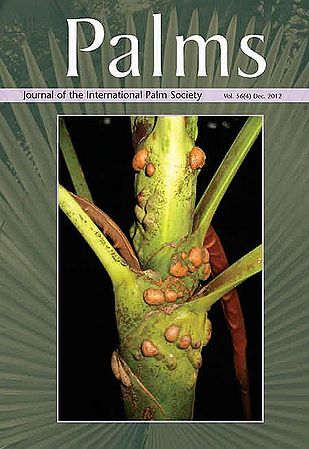
Madagascar. Photo by Dr. Rakotoarinivo, Mijoro/Kew.
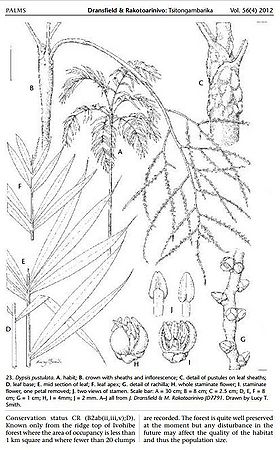
All information copyright, Royal Botanic Gardens, Kew.

All information copyright, Royal Botanic Gardens, Kew.


External Links
- Glossary of Palm Terms
- MODERN BOTANICAL LATIN
- "Just To Be Clear"
- The Palms of Tsitongambarika, Southeast Madagascar
References
Phonetic spelling of Latin names by edric.
Special thanks to Geoff Stein, (Palmbob) for his hundreds of photos.
Special thanks to Palmweb.org, Dr. John Dransfield, Dr. Bill Baker & team, for their volumes of information and photos.
Glossary of Palm Terms; Based on the glossary in Dransfield, J., N.W. Uhl, C.B. Asmussen-Lange, W.J. Baker, M.M. Harley & C.E. Lewis. 2008. Genera Palmarum - Evolution and Classification of the Palms. Royal Botanic Gardens, Kew. All images copyright of the artists and photographers (see images for credits).
Dr's. RAKOTOARINIVO, M. AND J. DRANSFIELD. 2012
Many Special Thanks to Ed Vaile for his long hours of tireless editing and numerous contributions.