Difference between revisions of "Calamus lobbianus"
| (7 intermediate revisions by one user not shown) | |||
| Line 1: | Line 1: | ||
__noeditsection__ | __noeditsection__ | ||
{{Palmbox | {{Palmbox | ||
| − | |image= | + | |image=Calamus-lobbianus09.jpg |
| − | |image_caption= | + | |image_caption=Photo-Malaysian Biological Diversity. |
|genus=Calamus (KAL-ah-muhs) | |genus=Calamus (KAL-ah-muhs) | ||
|species=<br>lobbianus (lohb-bee-AHN-uhs) | |species=<br>lobbianus (lohb-bee-AHN-uhs) | ||
| Line 20: | Line 20: | ||
==Habitat and Distribution== | ==Habitat and Distribution== | ||
Borneo. Rather local in 1st, 2nd and 4th Divisions; also in Peninsular Malaysia. | Borneo. Rather local in 1st, 2nd and 4th Divisions; also in Peninsular Malaysia. | ||
| − | [[]] | + | [[File:cl2787772.jpg|thumb|left|450px|Taman Negara, Pahang, Malaysia. Photo by Dr. John Dransfield, Royal Botanic Gardens, Kew/Palmweb.]] |
==Description== | ==Description== | ||
Solitary stemless or very short-stemmed, moderate rattan. Stem without sheaths c. 20 mm diam., with sheaths to 30 mm diam., internodes to c. 20 mm only. Sheaths dull green, densely armed with slender, long pale green spines varying in length from 5-50 mm, often up ward-pointing, the tips black; knee absent', ocrea absent. Flagellum absent. Petiole to 1m long, armed laterally with pale yellowish-green horizontal spines to 30 mm, rarely more, and much smaller scattered spines; whole leaf ecirrate, to 2 m; leaflets about 20 on each side of the rachis, regularly arranged but rather distant, to 40 x 3 cm, dark green on the upper surface, densely chalky -white beneath, apical leaflets very briefly joined. Inflorescences much shorter than the leaves, rarely more than 40 cm long, zig-zag, with 1-3 partial inflorescences, these appearing to terminate the axis, the true axis appearing as a branch, the tip of the inflorescence enclosed in an empty bract; partial inflorescences composed of very crowded congested branches bearing large flowers (c. 10 mm long). Mature fruit top-shaped or ovoid, conspicuously beaked, c. 3 x 2 cm, covered in 13 - 16 vertical rows of black, highly polished, ungrooved scales; sarcotesta thick, sweet and tasty; endosperm ruminate. Seedling leaf not known. (J. Dransfield, The Rattans of Sarawak. 1992)/Palmweb. Editing by edric. | Solitary stemless or very short-stemmed, moderate rattan. Stem without sheaths c. 20 mm diam., with sheaths to 30 mm diam., internodes to c. 20 mm only. Sheaths dull green, densely armed with slender, long pale green spines varying in length from 5-50 mm, often up ward-pointing, the tips black; knee absent', ocrea absent. Flagellum absent. Petiole to 1m long, armed laterally with pale yellowish-green horizontal spines to 30 mm, rarely more, and much smaller scattered spines; whole leaf ecirrate, to 2 m; leaflets about 20 on each side of the rachis, regularly arranged but rather distant, to 40 x 3 cm, dark green on the upper surface, densely chalky -white beneath, apical leaflets very briefly joined. Inflorescences much shorter than the leaves, rarely more than 40 cm long, zig-zag, with 1-3 partial inflorescences, these appearing to terminate the axis, the true axis appearing as a branch, the tip of the inflorescence enclosed in an empty bract; partial inflorescences composed of very crowded congested branches bearing large flowers (c. 10 mm long). Mature fruit top-shaped or ovoid, conspicuously beaked, c. 3 x 2 cm, covered in 13 - 16 vertical rows of black, highly polished, ungrooved scales; sarcotesta thick, sweet and tasty; endosperm ruminate. Seedling leaf not known. (J. Dransfield, The Rattans of Sarawak. 1992)/Palmweb. Editing by edric. | ||
| Line 28: | Line 28: | ||
==Comments and Curiosities== | ==Comments and Curiosities== | ||
| − | Etymology: | + | Etymology: Specific epithet in honor of Thomas Lobb, 1820 - 1894, plant collector. |
Uses: The cane is too short to be of value for anything other than walking-sticks; the fruits make good eating. | Uses: The cane is too short to be of value for anything other than walking-sticks; the fruits make good eating. | ||
| Line 37: | Line 37: | ||
File:cl2787775.jpg|Genting Highlands, Pahang, Malaysia. Photo by Dr. John Dransfield, Royal Botanic Gardens, Kew/Palmweb. | File:cl2787775.jpg|Genting Highlands, Pahang, Malaysia. Photo by Dr. John Dransfield, Royal Botanic Gardens, Kew/Palmweb. | ||
File:cl2787771.jpg|Gunung Matang, Sarawak, Malaysia. Photo by Dr. John Dransfield, Royal Botanic Gardens, Kew/Palmweb. | File:cl2787771.jpg|Gunung Matang, Sarawak, Malaysia. Photo by Dr. John Dransfield, Royal Botanic Gardens, Kew/Palmweb. | ||
| − | + | File:cl2787773.jpg|Genting Highlands, Pahang, Malaysia. Photo by Dr. John Dransfield, Royal Botanic Gardens, Kew/Palmweb. | |
| − | + | File:cl2787770.jpg|Gunung Matang, Sarawak, Malaysia. Photo by Dr. William J. Baker, Royal Botanic Gardens, Kew/Palmweb. | |
| + | File:cl2787774.jpg|Endau-Rompin, Jahor, Malaysia. Photo by Dr. John Dransfield, Royal Botanic Gardens, Kew/Palmweb. | ||
| + | File:cl2787772.jpg|Taman Negara, Pahang, Malaysia. Photo by Dr. John Dransfield, Royal Botanic Gardens, Kew/Palmweb. | ||
| + | File:Calamus-lobbianus09.jpg|Photo-Malaysian Biological Diversity. | ||
| + | File:Calamus-lobbianus---Infructescene.jpg|Photo-Malaysian Biological Diversity. | ||
| + | File:Calamus-lobbianus---Habit.jpg|Photo-Malaysian Biological Diversity. | ||
</gallery></center> | </gallery></center> | ||
Latest revision as of 23:28, 4 August 2015
| Calamus (KAL-ah-muhs) lobbianus (lohb-bee-AHN-uhs) | |||||||
|---|---|---|---|---|---|---|---|
 Photo-Malaysian Biological Diversity. | |||||||
| Scientific Classification | |||||||
| |||||||
| Synonyms | |||||||
|
| |||||||
| Native Continent | |||||||
 | |||||||
| Morphology | |||||||
| |||||||
| Culture | |||||||
|
| |||||||
| Survivability index | |||||||
|
| |||||||
| Common names | |||||||
|
| |||||||
Contents
Habitat and Distribution
Borneo. Rather local in 1st, 2nd and 4th Divisions; also in Peninsular Malaysia.

Description
Solitary stemless or very short-stemmed, moderate rattan. Stem without sheaths c. 20 mm diam., with sheaths to 30 mm diam., internodes to c. 20 mm only. Sheaths dull green, densely armed with slender, long pale green spines varying in length from 5-50 mm, often up ward-pointing, the tips black; knee absent', ocrea absent. Flagellum absent. Petiole to 1m long, armed laterally with pale yellowish-green horizontal spines to 30 mm, rarely more, and much smaller scattered spines; whole leaf ecirrate, to 2 m; leaflets about 20 on each side of the rachis, regularly arranged but rather distant, to 40 x 3 cm, dark green on the upper surface, densely chalky -white beneath, apical leaflets very briefly joined. Inflorescences much shorter than the leaves, rarely more than 40 cm long, zig-zag, with 1-3 partial inflorescences, these appearing to terminate the axis, the true axis appearing as a branch, the tip of the inflorescence enclosed in an empty bract; partial inflorescences composed of very crowded congested branches bearing large flowers (c. 10 mm long). Mature fruit top-shaped or ovoid, conspicuously beaked, c. 3 x 2 cm, covered in 13 - 16 vertical rows of black, highly polished, ungrooved scales; sarcotesta thick, sweet and tasty; endosperm ruminate. Seedling leaf not known. (J. Dransfield, The Rattans of Sarawak. 1992)/Palmweb. Editing by edric.
C. lobbianus occurs on hill slopes and ridge tops from 100 - 700 m above sea level. The reasons for its patchy distribution are not obvious. This is an easily recognized species with its very short stems, leaflets densely chalky-white on the undersurface and the curious inflorescences. (J. Dransfield, The Rattans of Sarawak. 1992)/Palmweb.
Culture
Comments and Curiosities
Etymology: Specific epithet in honor of Thomas Lobb, 1820 - 1894, plant collector.
Uses: The cane is too short to be of value for anything other than walking-sticks; the fruits make good eating.
- IMAGE GALLERY

Genting Highlands, Pahang, Malaysia. Photo by Dr. John Dransfield, Royal Botanic Gardens, Kew/Palmweb.

Gunung Matang, Sarawak, Malaysia. Photo by Dr. John Dransfield, Royal Botanic Gardens, Kew/Palmweb.

Genting Highlands, Pahang, Malaysia. Photo by Dr. John Dransfield, Royal Botanic Gardens, Kew/Palmweb.
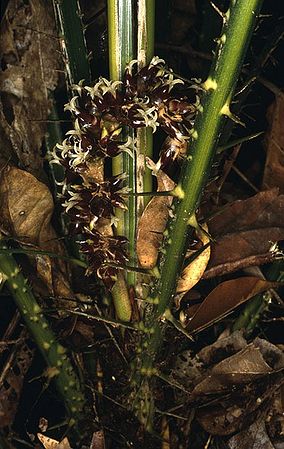
Gunung Matang, Sarawak, Malaysia. Photo by Dr. William J. Baker, Royal Botanic Gardens, Kew/Palmweb.
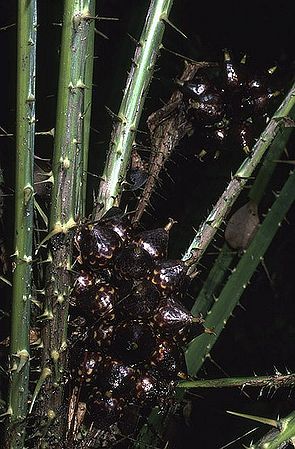
Endau-Rompin, Jahor, Malaysia. Photo by Dr. John Dransfield, Royal Botanic Gardens, Kew/Palmweb.

Taman Negara, Pahang, Malaysia. Photo by Dr. John Dransfield, Royal Botanic Gardens, Kew/Palmweb.
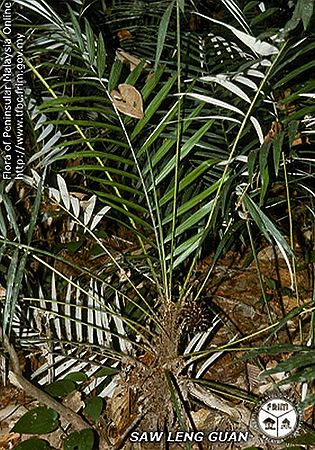
Photo-Malaysian Biological Diversity.

Photo-Malaysian Biological Diversity.

Photo-Malaysian Biological Diversity.


External Links
References
Phonetic spelling of Latin names by edric.
Special thanks to Geoff Stein, (Palmbob) for his hundreds of photos.
Special thanks to Palmweb.org, Dr. John Dransfield, Dr. Bill Baker & team, for their volumes of information and photos.
Glossary of Palm Terms; Based on the glossary in Dransfield, J., N.W. Uhl, C.B. Asmussen-Lange, W.J. Baker, M.M. Harley & C.E. Lewis. 2008. Genera Palmarum - Evolution and Classification of the Palms. Royal Botanic Gardens, Kew. All images copyright of the artists and photographers (see images for credits).
J. Dransfield, The Rattans of Sarawak. 1992
Many Special Thanks to Ed Vaile for his long hours of tireless editing and numerous contributions.