Difference between revisions of "Geonoma longivaginata"
| (7 intermediate revisions by one user not shown) | |||
| Line 1: | Line 1: | ||
__noeditsection__ | __noeditsection__ | ||
{{Palmbox | {{Palmbox | ||
| − | |image= | + | |image=post-1300-0-48243400-1400572786.jpg |
| − | |image_caption= | + | |image_caption=Hawaii. Photo by Timothy Brian. |
|genus=Geonoma (geo-NO-mah) | |genus=Geonoma (geo-NO-mah) | ||
|species=<br>longivaginata <br>(lohn-jih-vah-jih-NAH-tah) | |species=<br>longivaginata <br>(lohn-jih-vah-jih-NAH-tah) | ||
| Line 9: | Line 9: | ||
|synonyms= | |synonyms= | ||
|continent=america | |continent=america | ||
| − | |habit=Solitary & clustering & given to | + | |habit=Solitary & clustering & given to aerial branching. |
|leaf_type=Pinnate | |leaf_type=Pinnate | ||
|height= | |height= | ||
| Line 20: | Line 20: | ||
==Habitat and Distribution== | ==Habitat and Distribution== | ||
Costa Rica, Nicaragua, and Panamá. | Costa Rica, Nicaragua, and Panamá. | ||
| − | [[]] | + | [[File:post-1300-0-50896300-1400572783.jpg|thumb|left|400px|Hawaii. Photo by Timothy Brian.]] |
==Description== | ==Description== | ||
| − | + | Small palm, 3.0 (1.0-8.0) m tall; stems 3.0 (1.0-5.0) m tall, 1.1 (0.6-2.1) cm in diameter, solitary or clustered, canelike; internodes 3.0 (1.2-7.0) cm long, yellowish and smooth. Leaves 9 (6-10) per stem, irregularly pinnate, not plicate, bases of blades running diagonally into the rachis; sheaths 14.9 (6.0-26.0) cm long; petioles 28.4 (5.5-58.0) cm long, drying green or yellowish; rachis 52.5 (16.5-101.0) cm long, 4.1 (1.4-8.0) mm in diameter; veins raised and rectangular in cross-section adaxially or not raised or slightly raised and triangular in crosssection adaxially; pinnae 6 (2-13) per side of rachis; basal pinna 23.8 (8.5-50.0) cm long, 4.1 (0.7-34.5) cm wide, forming an angle of 64 (31-92)° with the rachis; apical pinna 16.6 (6.7-31.5) cm long, 12.7 (5.5-30.0) cm wide, forming an angle of 38 (27-50)° with the rachis. Inflorescences branched 1-2 orders; prophylls and peduncular bracts not ribbed with elongate, unbranched fibers, flattened, deciduous; prophylls 9.0 (3.3-16.0) cm long, short, asymmetrically apiculate, the margins curved around the stem, the surfaces flat with dense, felty, brown tomentum, prophyll equal to and early deciduous with the peduncular bract, the surfaces not ridged, without unequally wide ridges; peduncular bracts 7.5 (4.0-11.6) cm long, well-developed, inserted 0.3 (0.1-0.6) cm above the prophyll; peduncles 8.8 (3.8?16.0) cm long, 4.9 (2.3-9.2) mm in diameter; rachillae 6 (2-18), 23.3 (10.0-42.0) cm long, 3.2 (1.9-5.3) mm in diameter, the surfaces without spiky, fibrous projections or ridges, drying brown, with short, transverse ridges, not filiform and not narrowed between the flower pits; flower pits spirally arranged, glabrous internally; proximal lips without a central notch before anthesis, not recurved after anthesis, not hood-shaped; proximal and distal lips drying the same color as the rachillae, not joined to form a raised cupule, the proximal lip margins overlapping the distal lip margins; distal lips well-developed; staminate and pistillate petals not emergent, not valvate throughout; staminate flowers deciduous after anthesis; stamens 6; thecae diverging at anthesis, inserted onto bifid and well-developed, nonjointed connectives; anthers short and curled over at anthesis; non-fertilized pistillate flowers deciduous after anthesis; staminodial tubes crenulate or shallowly lobed at the apex, those of non-fertilized pistillate flowers not projecting and persistent after anthesis. Fruits 6.5 (5.1-7.9) mm long, 5.3 (4.3-6.3) mm in diameter, the bases without a prominent stipe, the apices not conical, the surfaces not splitting at maturity, without fibers emerging, bumpy from the numerous, subepidermal, tangential, short fibers present, these coming to a point at fruit apices; locular epidermis without operculum, smooth, without pores. (Henderson, A.J. (2011) A revision of Geonoma. Phytotaxa 17: 1-271.)/Palmweb. Editing by edric. | |
| − | + | {{read more top}} | |
Taxonomic notes: - Geonoma longivaginata is a member of a group of three species within the G. stricta clade, the other two being G. divisa and G. ferruginea. It differs from G. divisa in its crenulate or shallowly lobed staminodial tube; and from G. ferruginea in its rachillae with short, transverse ridges. | Taxonomic notes: - Geonoma longivaginata is a member of a group of three species within the G. stricta clade, the other two being G. divisa and G. ferruginea. It differs from G. divisa in its crenulate or shallowly lobed staminodial tube; and from G. ferruginea in its rachillae with short, transverse ridges. | ||
Subspecific variation: - Two traits vary within this species (stem branching, adaxial veins). The species is distributed in Panama and Costa Rica and just reaches Nicaragua. It is divided into several disjunct populations. The state distribution of one trait (adaxial veins) together with geography suggest several subgroups. Specimens with raised adaxial veins occur in Panama (San Blas) and are treated as a separate subgroup. Specimens with non-raised adaxial veins occur in five areas: Atlantic slope in Costa Rica and adjacent Nicaragua and Panama; Pacific slope in Costa Rica; El Copé, Llano Grande, and Cerro Tife in Panama; El Valle in Panama; and the Santa Rita Ridge in Panama. Specimens from the Atlantic and Pacific slopes in Costa Rica do not differ significantly from each other in any quantitative variable, and these are treated as one subgroup. There are thus five potential subgroups, but there are only three specimens of one of these, from the Santa Rita Ridge in Panama, too few to test for differences. Four potential subgroups are tested for differences. ANOVA shows that for pair wise comparison probabilities, all variables except leaf number and fruit length differ significantly (P <0.05) between at least one pair of subgroups, although no variable differs amongst all four subgroups. Based on these results and geography, the four subgroups are recognized as subspecies. Specimens from Santa Rita Ridge in Panama are included with those from the Atlantic and Pacific slopes in Costa Rica (see below) (subspp. copensis, longivaginata, sanblasensis, vallensis). (Henderson, A.J. (2011) A revision of Geonoma. Phytotaxa 17: 1-271.)/Palmweb. | Subspecific variation: - Two traits vary within this species (stem branching, adaxial veins). The species is distributed in Panama and Costa Rica and just reaches Nicaragua. It is divided into several disjunct populations. The state distribution of one trait (adaxial veins) together with geography suggest several subgroups. Specimens with raised adaxial veins occur in Panama (San Blas) and are treated as a separate subgroup. Specimens with non-raised adaxial veins occur in five areas: Atlantic slope in Costa Rica and adjacent Nicaragua and Panama; Pacific slope in Costa Rica; El Copé, Llano Grande, and Cerro Tife in Panama; El Valle in Panama; and the Santa Rita Ridge in Panama. Specimens from the Atlantic and Pacific slopes in Costa Rica do not differ significantly from each other in any quantitative variable, and these are treated as one subgroup. There are thus five potential subgroups, but there are only three specimens of one of these, from the Santa Rita Ridge in Panama, too few to test for differences. Four potential subgroups are tested for differences. ANOVA shows that for pair wise comparison probabilities, all variables except leaf number and fruit length differ significantly (P <0.05) between at least one pair of subgroups, although no variable differs amongst all four subgroups. Based on these results and geography, the four subgroups are recognized as subspecies. Specimens from Santa Rita Ridge in Panama are included with those from the Atlantic and Pacific slopes in Costa Rica (see below) (subspp. copensis, longivaginata, sanblasensis, vallensis). (Henderson, A.J. (2011) A revision of Geonoma. Phytotaxa 17: 1-271.)/Palmweb. | ||
| + | {{read more bottom}} | ||
==Culture== | ==Culture== | ||
Cold Hardiness Zone: 10 b | Cold Hardiness Zone: 10 b | ||
==Comments and Curiosities== | ==Comments and Curiosities== | ||
There are four subspecies: | There are four subspecies: | ||
| − | + | {{read more top}} | |
1.) Geonoma longivaginata subsp. copensis; Panamá. From 8°37-8°47'N and 80°28-80°39'W in central Panama (Cerro Tife, El Copé, Llano Grande) at 721 (200-1200) m elevation in lowland to montane tropical rainforest. Leaves veins not raised or slightly raised and triangular in cross-section adaxially; rachis 23.5(16.5-30.0) cm long. Inflorescences peduncles 5.2(3.8?7.5) cm long; rachillae 3 (2-4), 17.0 (14.0-20.5) cm long. | 1.) Geonoma longivaginata subsp. copensis; Panamá. From 8°37-8°47'N and 80°28-80°39'W in central Panama (Cerro Tife, El Copé, Llano Grande) at 721 (200-1200) m elevation in lowland to montane tropical rainforest. Leaves veins not raised or slightly raised and triangular in cross-section adaxially; rachis 23.5(16.5-30.0) cm long. Inflorescences peduncles 5.2(3.8?7.5) cm long; rachillae 3 (2-4), 17.0 (14.0-20.5) cm long. | ||
| Line 43: | Line 44: | ||
A monoecious species from Mexico to South America, it is fairly difficult and relatively slow growing. It suckers but not profusely so and leaves are very variable from finely pinnate to very broad leaflets to a mixture of both. The oldest plants growing here (Maria's Palmetum, Nth Qld) are about nine years old and have grown to 2 metres in height with trunks of about 3 cm diameter. But, so far, have shown no signs of flowering. New leaves are always very red and may show signs of cold damage in winter. | A monoecious species from Mexico to South America, it is fairly difficult and relatively slow growing. It suckers but not profusely so and leaves are very variable from finely pinnate to very broad leaflets to a mixture of both. The oldest plants growing here (Maria's Palmetum, Nth Qld) are about nine years old and have grown to 2 metres in height with trunks of about 3 cm diameter. But, so far, have shown no signs of flowering. New leaves are always very red and may show signs of cold damage in winter. | ||
| + | This smallish, clustering species has thin, cane-like stems, usually no more than 2 m (7 ft) tall, and dainty leaves with sickle-shaped leaflets. The infructescences are thick and red and particularly eye-catching. It is native to rainforest in Costa Rica and Panama and an easy and rewarding understorey plant for tropical and warm subtropical areas. (RPS.com) | ||
| + | {{read more bottom}} | ||
<br style="clear:both;"/> | <br style="clear:both;"/> | ||
{{#Widget:AdResban}} | {{#Widget:AdResban}} | ||
<center><gallery caption="IMAGE GALLERY" perrow="4" widths="300px" heights="300px" mode="packed"> | <center><gallery caption="IMAGE GALLERY" perrow="4" widths="300px" heights="300px" mode="packed"> | ||
| − | Photo by | + | File:post-1300-0-50896300-1400572783.jpg|Hawaii. Photo by Timothy Brian. |
| + | File:post-1300-0-48243400-1400572786.jpg|Hawaii. Photo by Timothy Brian. | ||
| + | File:Geonoma_longivaginata_specimen.jpg|Flecker Botanical Gardens in Cairns, Australia. Photo by Paul Craft. | ||
| + | File:geonoma-longevaginata.jpg|Photo-Rare Palm Seeds.com | ||
| + | File:geonoma-longevaginata-2.jpg|Photo-Rare Palm Seeds.com | ||
| + | File:HJD-geonoma_sp02_leaf.jpg|Photo-Jungle Music Palms & Cycads. | ||
| + | File:Geonoma_longivaginata99.jpg | ||
</gallery></center> | </gallery></center> | ||
Latest revision as of 23:12, 28 June 2015
| Geonoma (geo-NO-mah) longivaginata (lohn-jih-vah-jih-NAH-tah) | |||||||
|---|---|---|---|---|---|---|---|
 Hawaii. Photo by Timothy Brian. | |||||||
| Scientific Classification | |||||||
| |||||||
| Synonyms | |||||||
|
| |||||||
| Native Continent | |||||||
 | |||||||
| Morphology | |||||||
| |||||||
| Culture | |||||||
|
| |||||||
| Survivability index | |||||||
|
| |||||||
| Common names | |||||||
|
| |||||||
Contents
Habitat and Distribution
Costa Rica, Nicaragua, and Panamá.

Description
Small palm, 3.0 (1.0-8.0) m tall; stems 3.0 (1.0-5.0) m tall, 1.1 (0.6-2.1) cm in diameter, solitary or clustered, canelike; internodes 3.0 (1.2-7.0) cm long, yellowish and smooth. Leaves 9 (6-10) per stem, irregularly pinnate, not plicate, bases of blades running diagonally into the rachis; sheaths 14.9 (6.0-26.0) cm long; petioles 28.4 (5.5-58.0) cm long, drying green or yellowish; rachis 52.5 (16.5-101.0) cm long, 4.1 (1.4-8.0) mm in diameter; veins raised and rectangular in cross-section adaxially or not raised or slightly raised and triangular in crosssection adaxially; pinnae 6 (2-13) per side of rachis; basal pinna 23.8 (8.5-50.0) cm long, 4.1 (0.7-34.5) cm wide, forming an angle of 64 (31-92)° with the rachis; apical pinna 16.6 (6.7-31.5) cm long, 12.7 (5.5-30.0) cm wide, forming an angle of 38 (27-50)° with the rachis. Inflorescences branched 1-2 orders; prophylls and peduncular bracts not ribbed with elongate, unbranched fibers, flattened, deciduous; prophylls 9.0 (3.3-16.0) cm long, short, asymmetrically apiculate, the margins curved around the stem, the surfaces flat with dense, felty, brown tomentum, prophyll equal to and early deciduous with the peduncular bract, the surfaces not ridged, without unequally wide ridges; peduncular bracts 7.5 (4.0-11.6) cm long, well-developed, inserted 0.3 (0.1-0.6) cm above the prophyll; peduncles 8.8 (3.8?16.0) cm long, 4.9 (2.3-9.2) mm in diameter; rachillae 6 (2-18), 23.3 (10.0-42.0) cm long, 3.2 (1.9-5.3) mm in diameter, the surfaces without spiky, fibrous projections or ridges, drying brown, with short, transverse ridges, not filiform and not narrowed between the flower pits; flower pits spirally arranged, glabrous internally; proximal lips without a central notch before anthesis, not recurved after anthesis, not hood-shaped; proximal and distal lips drying the same color as the rachillae, not joined to form a raised cupule, the proximal lip margins overlapping the distal lip margins; distal lips well-developed; staminate and pistillate petals not emergent, not valvate throughout; staminate flowers deciduous after anthesis; stamens 6; thecae diverging at anthesis, inserted onto bifid and well-developed, nonjointed connectives; anthers short and curled over at anthesis; non-fertilized pistillate flowers deciduous after anthesis; staminodial tubes crenulate or shallowly lobed at the apex, those of non-fertilized pistillate flowers not projecting and persistent after anthesis. Fruits 6.5 (5.1-7.9) mm long, 5.3 (4.3-6.3) mm in diameter, the bases without a prominent stipe, the apices not conical, the surfaces not splitting at maturity, without fibers emerging, bumpy from the numerous, subepidermal, tangential, short fibers present, these coming to a point at fruit apices; locular epidermis without operculum, smooth, without pores. (Henderson, A.J. (2011) A revision of Geonoma. Phytotaxa 17: 1-271.)/Palmweb. Editing by edric.
| read more |
|---|
|
Taxonomic notes: - Geonoma longivaginata is a member of a group of three species within the G. stricta clade, the other two being G. divisa and G. ferruginea. It differs from G. divisa in its crenulate or shallowly lobed staminodial tube; and from G. ferruginea in its rachillae with short, transverse ridges. Subspecific variation: - Two traits vary within this species (stem branching, adaxial veins). The species is distributed in Panama and Costa Rica and just reaches Nicaragua. It is divided into several disjunct populations. The state distribution of one trait (adaxial veins) together with geography suggest several subgroups. Specimens with raised adaxial veins occur in Panama (San Blas) and are treated as a separate subgroup. Specimens with non-raised adaxial veins occur in five areas: Atlantic slope in Costa Rica and adjacent Nicaragua and Panama; Pacific slope in Costa Rica; El Copé, Llano Grande, and Cerro Tife in Panama; El Valle in Panama; and the Santa Rita Ridge in Panama. Specimens from the Atlantic and Pacific slopes in Costa Rica do not differ significantly from each other in any quantitative variable, and these are treated as one subgroup. There are thus five potential subgroups, but there are only three specimens of one of these, from the Santa Rita Ridge in Panama, too few to test for differences. Four potential subgroups are tested for differences. ANOVA shows that for pair wise comparison probabilities, all variables except leaf number and fruit length differ significantly (P <0.05) between at least one pair of subgroups, although no variable differs amongst all four subgroups. Based on these results and geography, the four subgroups are recognized as subspecies. Specimens from Santa Rita Ridge in Panama are included with those from the Atlantic and Pacific slopes in Costa Rica (see below) (subspp. copensis, longivaginata, sanblasensis, vallensis). (Henderson, A.J. (2011) A revision of Geonoma. Phytotaxa 17: 1-271.)/Palmweb. |
Culture
Cold Hardiness Zone: 10 b
Comments and Curiosities
There are four subspecies:
| read more |
|---|
|
1.) Geonoma longivaginata subsp. copensis; Panamá. From 8°37-8°47'N and 80°28-80°39'W in central Panama (Cerro Tife, El Copé, Llano Grande) at 721 (200-1200) m elevation in lowland to montane tropical rainforest. Leaves veins not raised or slightly raised and triangular in cross-section adaxially; rachis 23.5(16.5-30.0) cm long. Inflorescences peduncles 5.2(3.8?7.5) cm long; rachillae 3 (2-4), 17.0 (14.0-20.5) cm long. 2.) Geonoma longivaginata subsp. longivaginata; Costa Rica, Nicaragua, and Panamá. From 8°40-11°30'N and 79°40-84°25'W in Nicaragua, Costa Rica (Atlantic and Pacific slopes) and Panama at 185(5-1000) m elevation in lowland tropical rainforest. Leaves veins not raised or slightly raised and triangular in cross-section adaxially; rachis 67.2(42.0-101.0) cm long. Inflorescences peduncles 9.5 (5.0-16.0) cm long; rachillae 7 (4?18), 25.7 (10.0-42.0) cm long. The outlying specimens from the Santa Rita Ridge in Panama (de Nevers 10649, Hammel 14498, Porter 4741) have fewer pinnae, wider basal pinnae, and fewer rachillae than the others, but there are too few specimens to test for differences. Three specimens (Cooper 493, de Nevers 6864, Lewis2162) from western Panama are smaller than others and resemble Geonoma deversa subsp. deversa (although this subspecies does not occur in the area). They may be hybrids and are not included in the above description and analysis. 3.) Geonoma longivaginata subsp. sanblasensis; Panamá. Leaves veins raised and rectangular in cross-section adaxially; rachis 52.8 (42.0-64.0) cm long. Inflorescences peduncles 11.4 (8.0-14.0) cm long; rachillae 6 (4-8), 27.7 (22.3-37.0) cm long. 4.) Geonoma longivaginata subsp. vallensis; Panamá. From 8°37-8°40'N and 80°05-80°12'W in central Panama (El Valle) at 917 (880-950) m elevation in lowland tropical rainforest. Leaves veins not raised or slightly raised and triangular in cross-section adaxially; rachis 28.1(20.5-37.5) cm long. Inflorescences peduncles 9.2 (7.4-12.1) cm long rachillae 4 (3-5), 18.8 (15.4-25.2) cm long. (Henderson, A.J. (2011) A revision of Geonoma. Phytotaxa 17: 1-271.) A monoecious species from Mexico to South America, it is fairly difficult and relatively slow growing. It suckers but not profusely so and leaves are very variable from finely pinnate to very broad leaflets to a mixture of both. The oldest plants growing here (Maria's Palmetum, Nth Qld) are about nine years old and have grown to 2 metres in height with trunks of about 3 cm diameter. But, so far, have shown no signs of flowering. New leaves are always very red and may show signs of cold damage in winter. This smallish, clustering species has thin, cane-like stems, usually no more than 2 m (7 ft) tall, and dainty leaves with sickle-shaped leaflets. The infructescences are thick and red and particularly eye-catching. It is native to rainforest in Costa Rica and Panama and an easy and rewarding understorey plant for tropical and warm subtropical areas. (RPS.com) |
- IMAGE GALLERY

Hawaii. Photo by Timothy Brian.

Hawaii. Photo by Timothy Brian.
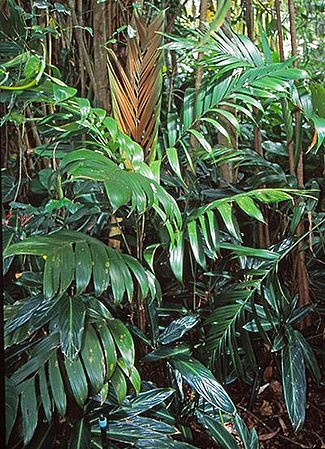
Flecker Botanical Gardens in Cairns, Australia. Photo by Paul Craft.

Photo-Rare Palm Seeds.com

Photo-Rare Palm Seeds.com

Photo-Jungle Music Palms & Cycads.


External Links
References
Phonetic spelling of Latin names by edric.
Special thanks to Geoff Stein, (Palmbob) for his hundreds of photos.
Special thanks to Palmweb.org, Dr. John Dransfield, Dr. Bill Baker & team, for their volumes of information and photos.
Glossary of Palm Terms; Based on the glossary in Dransfield, J., N.W. Uhl, C.B. Asmussen-Lange, W.J. Baker, M.M. Harley & C.E. Lewis. 2008. Genera Palmarum - Evolution and Classification of the Palms. Royal Botanic Gardens, Kew. All images copyright of the artists and photographers (see images for credits).
Many Special Thanks to Ed Vaile for his long hours of tireless editing and numerous contributions.