Difference between revisions of "Colpothrinax wrightii"
| Line 36: | Line 36: | ||
In Cuba, this unique and easily recognized palm is referred to as palma barrigona, which means potbellied palm and aptly describes the grotesque swelling in the trunk of this palm a meter or more above the ground. It is probably the only palm shedding its bark, which is dark brown and rough and often entirely clothed in the fibrous leaf sheaths, but reveals a smooth, gray trunk underneath when it falls off as the palm ages and passes its juvenile stage, after its "belly" is formed. Colpothrinax is related to Pritchardia and indeed, apart from the curious bulge in its trunk, is quite reminiscent of certain Hawaiian Pritchardia. The leaves are dark green above and silvery below, the leaf tips finely drawn out and pendulous. It is still common in western Cuba where it grows in savannas that have now mostly been converted for agriculture, effectively preventing any rejuvenation of the aged populations. The leaves are locally popular as thatch, the trunks as building material the fruits as pig fodder (can you imagine!?!). It adapts well to cultivation in tropical and some warm temperate climates but is still very rarely seen, as seeds are hardly ever available. Growth is slow at first but reasonable once the plant is established, about 25 cm (10 in.) per year. (RPS.com) | In Cuba, this unique and easily recognized palm is referred to as palma barrigona, which means potbellied palm and aptly describes the grotesque swelling in the trunk of this palm a meter or more above the ground. It is probably the only palm shedding its bark, which is dark brown and rough and often entirely clothed in the fibrous leaf sheaths, but reveals a smooth, gray trunk underneath when it falls off as the palm ages and passes its juvenile stage, after its "belly" is formed. Colpothrinax is related to Pritchardia and indeed, apart from the curious bulge in its trunk, is quite reminiscent of certain Hawaiian Pritchardia. The leaves are dark green above and silvery below, the leaf tips finely drawn out and pendulous. It is still common in western Cuba where it grows in savannas that have now mostly been converted for agriculture, effectively preventing any rejuvenation of the aged populations. The leaves are locally popular as thatch, the trunks as building material the fruits as pig fodder (can you imagine!?!). It adapts well to cultivation in tropical and some warm temperate climates but is still very rarely seen, as seeds are hardly ever available. Growth is slow at first but reasonable once the plant is established, about 25 cm (10 in.) per year. (RPS.com) | ||
{{read more bottom}} | {{read more bottom}} | ||
| − | |||
| − | |||
| − | |||
| − | |||
| − | |||
| − | |||
| − | |||
| − | |||
| − | |||
| − | |||
| − | |||
| − | |||
| − | |||
| − | |||
| − | |||
| − | |||
| − | |||
| + | <br style="clear:both;"/> | ||
| + | {{#Widget:AdResban}} | ||
<center><gallery caption="IMAGE GALLERY" perrow="" widths="" heights=""> | <center><gallery caption="IMAGE GALLERY" perrow="" widths="" heights=""> | ||
image:A2d264f2-394c-441c-9827-85920b3c3877z.jpg|Leaf-sheath disintegrating into Fibres, Fairchild Tropical Botanic Garden, Florida. Photo by Dr. John Dransfield, Royal Botanic Gardens, Kew/Palmweb. | image:A2d264f2-394c-441c-9827-85920b3c3877z.jpg|Leaf-sheath disintegrating into Fibres, Fairchild Tropical Botanic Garden, Florida. Photo by Dr. John Dransfield, Royal Botanic Gardens, Kew/Palmweb. | ||
| Line 75: | Line 60: | ||
image:ColWri.jpg|In habitat. Photo-Rare Palm Seeds.com | image:ColWri.jpg|In habitat. Photo-Rare Palm Seeds.com | ||
</gallery></center> | </gallery></center> | ||
| + | ==External Links== | ||
| + | *[http://eunops.org/content/glossary-palm-terms Glossary of Palm Terms] | ||
| + | *[http://www.calflora.net/botanicalnames/pronunciation.html MODERN BOTANICAL LATIN] | ||
| + | *[http://www.jlhudsonseeds.net/Pronunciation.htm "Just To Be Clear"] | ||
| + | *http://southeastgarden.com/cuba.html | ||
| + | *http://www.plantapalm.com/vpe/virtualtours/cuba/vpe_palmsofcuba1.htm | ||
| + | http://perfildaplanta.blogspot.com/2010/07/roystoneas-confusoes-imperiais-parte-ii.html | ||
| + | ==References== | ||
| + | Phonetic spelling of Latin names by edric. | ||
| + | |||
| + | Special thanks to Geoff Stein, (Palmbob) for his hundreds of photos. | ||
| + | |||
| + | Special thanks to [http://palmweb.org/?q=node/2 Palmweb.org], Dr. John Dransfield, Dr. Bill Baker & team, for their volumes of information and photos. | ||
| + | |||
| + | Glossary of Palm Terms; Based on the glossary in Dransfield, J., N.W. Uhl, C.B. Asmussen-Lange, W.J. Baker, M.M. Harley & C.E. Lewis. 2008. Genera Palmarum - Evolution and Classification of the Palms. Royal Botanic Gardens, Kew. All images copyright of the artists and photographers (see images for credits). | ||
| + | |||
| + | Evans, R.J.2001. Monograph of Colpothrinax. Palms 45(4): 177-195. | ||
| + | |||
{{SpeciesListBackLink}} | {{SpeciesListBackLink}} | ||
[[Category:Palms of Cuba]] | [[Category:Palms of Cuba]] | ||
[[Category:COLPOTHRINAX|wrightii]] | [[Category:COLPOTHRINAX|wrightii]] | ||
Revision as of 01:09, 31 October 2014
| Colpothrinax (kol-poh-TRIH-nax) wrightii (RITE-ee) | |||||||
|---|---|---|---|---|---|---|---|
 Fairchild Tropical Botanic Garden, Florida. Photo by Dr. Carl E. Lewis/Palmweb. | |||||||
| Scientific Classification | |||||||
| |||||||
| Synonyms | |||||||
|
| |||||||
| Native Continent | |||||||
 | |||||||
| Morphology | |||||||
| |||||||
| Culture | |||||||
|
| |||||||
| Survivability index | |||||||
|
| |||||||
| Common names | |||||||
|
| |||||||
Contents
Habitat and Distribution
Colpothrinax wrightii is found in southwestern Cuba, and the nearby Isle of Youth (formerly Isle of Pines), alt. O-200 m; semidry savannas and grasslands (formerly pine forests) on white sand. The climate where C. wrightii occurs is classified as dry tropical (Borhidi 1996). The area has a 5-6 month dry season with an annual precipitation of only 750-1,600 mm. However, during the rainy season (approximately April to September) some lands are periodically inundated (Zona et a1. 2000). Colpothrinax wrightii originally occurred on white sand in open pine (Pinus tropicalis Morelet) forests, in association with the understory palm Acoelorraphe wrightii (Griseb. & H. Wend1.) H. Wend1. ex Becc. (Borhidi 1996). These forests have now virtually all been converted to savannas or pastures as a result of logging and subsequent burning and/or grazing. It was usually the pines in the original forest that were targeted by loggers. (R.J. Evans. 2001)/Palmweb.

Description
Trunk 6-12 (-15) m tall, erect, 15-20 cm in diam. breast high, swollen beginning 2-3 m above ground, 30-40 (-50) cm in diam., naked; trunks of juveniles less than about 3-5 m tall usually enclosed in a mat of persistent leaf-sheath fibers, 5-10 cm thick. Leaves usually 10-20 per crown; petiole about 1-1.5 m long, 3.7-4.6 cm wide at attachment to blade; sheath glaucous, disintegrating and fraying into a coarse, fibrous, nonpendulous network, the individual fibers somewhat serpentine and twisted, typically compressed, 0.6-0.8 mm broad; hastula elevated above the blade, 1.7-2.8 x 4.8-5.8 cm, 2.1-2.8 times as wide as long, depressed to very depressedtriangular, obtuse and ± notched apically; costa 19.5-25.0 (-38.5) cm long; blade 142-171 cm long centrally, 39-44 cm long laterally, divided into single-fold segments; central division to within 76-111 cm of (1/3-1/2) base, the lateral-most division extending to within 1.5-2.5 (-3.5) cm of (> 90% to) base; folds per blade half 36-45; widest single-fold segment 3.4-5.0 cm wide. Inflorescences with flowers and fruit about 5, plus about 10 marcescent per individual; primary axis about 1.5 m long; inflorescence bracts lanate, with trichomes 2-3 mm long; peduncle about 0.4 m long; prophyll about 20 x 5 cm; peduncular bracts about 6, 22.0-54.5 cm long; rachis bracts 10.5-65.5 cm long; firstorder branches 6-10; axes creamy yellow initially, becoming orange in fruit, their primary-axes 3.0-73.0 cm long, with unbranched proximal portion 2.0-54.5 cm long, the branched distal portion 1.0-27.0 cm long; prophyll 8.5-44.5 cm long; rachillae typically 20-50 per basal first-order branch, < 10 per apical first-order branch, 3.5-17.5 cm long, tomentose, the trichomes whitish (to ferruginous), 0.4-0.5 mm long; flower-bearing spurs 0.2-0.4 mm long, the subtending bracteole 0.8-1.7 mm long, 0.5-0.9 mm wide basally. Floral receptacle 0.8-1.2 mm long; calyx 2.3-3.3 mm long, free distally from corolla for 1/4-1/2 its length, yellow, with lobes 0.2-0.7 mm long; 1 corolla 5.3-6.2 mm long, yellow, the lobes valvate, with parallel sides and mucronulate apices, fleshy, adaxially furrowed with involute or thickened margins, forming a hood apically, deciduous, with a clear line of abscission; filaments 3.2-4.5 mm long, connate basally for 2.0-2.7 mm (1/2-3/4 their length), stamen-cup much longer than calyx-cup, 1.5-2.7 mm in diam., anthers 2.2-3.9 x 0.8-1.2 mm; pollen 30-40 x 25-35 pm, tectum on nonapertural face foveolate; gynoecium 3.5-4.9 x 1.2-2.0 mm, carpels 1.1-1.6 x 0.7-1.3 mm, styles 2.2-3.4 mm long. Fruit 1.1-1.6 cm in diam. Seed 0.7-0.9 x 0.9-1.1 cm. (R.J. Evans. 2001)/Palmweb. Editing by edric.
| read more |
|---|
|
Colpothrinax wrightii is characterized by its swollen trunk. This feature, in combination with its costapalmate leaves, distinguishes C. wrightii from all other Cuban palms. The only other Cuban "pot-belly" palm, Gastrococos crispa (Kunth) H. E. Moore has pinnate leaves. Within Colpothrinax, the small fruits and seeds of C. wrightii are also diagnostic, as are the clear line of abscission at the base of the deciduous corolla lobes and the relatively long stamen-cup. The deciduous corolla lobes and long stamen-cup of C. wrightii flowers are also characteristics of the flowers in Pritchardia, suggesting these to be the ancestral Colpothrinax states and therefore the persistent corolla lobes and short stamen-cup of C. aphanopetala and C. cookii flowers are derived. Charles Wright collected plants for Asa Gray at Harvard University, throughout the island of Cuba, during the years 1856--1867 (Howard 1988). In September 1865 or 1866, he collected a palm (Wright 3964) known locally as "palma barrigona" in the Vuelta Abajo area of western Cuba. A specimen of this palm was sent to Hermann Wendland, Director of the Royal Gardens in Herrenhausen, Germany for determination. Apparently, Wendland considered this palm to belong to a new species and genus and informally assigned to it the name Colpothrinax wrightii. Wright was given this information, and he, in turn, forwarded it to Francisco Sauvalle, a rich landowner and amateur botanist. Sauvalle included the name (attributing it to Wendland and A. H. R. Grisebach) without description, along with the local Cuban name, in his Flora Cubana (1871) [entry 2382 (2381 in the 1873 edition)]. This list was essentially an update and revision of Grisebach's Catalogus Plantarum Cubensium (1866) that incorporated new taxa collected by Wright during his last two years in Cuba, and not seen by Grisebach. Subsequently, O. C. de Kerchove de Denterghem also used the name Colpothrinax wrightii in his Les Palmiers (1878), but again without description. The genus Colpothrinax was not formally established until the following year (Wendland 1879), and the first valid publication of Colpothrinax wrightii (misspelled as "wightii") did not appear for another 16 years (Siebert and Voss 1895). Although Siebert and Voss ascribed the name to Grisebach and Wendland, they cited no specimens as the basis for their description. Quite possibly they never saw a specimen, their description being based solely on information provided by Wendland and/or Grisebach. The most likely specimen they might have seen was formerly deposited in the Krug and Urban Herbarium in Berlin, where both Siebert and Voss resided at the time of their publication of Colpothrinax wrightii. Although this specimen was destroyed, it was photographed by Beccari (photo at BH, which indicates the negative as being at FI-B). Andreas Voss was formerly University Gardener at G6ttingen (1882-1890), so he potentially could have seen the specimen of Wright 3964 in Wendland's herbarium in nearby Herrenhausen. However, there are no annotations by either Siebert or Voss on any known extant specimens of Wright 3964 (nor on the sheets photographed at B). Therefore, unless new information becomes available that clearly demonstrates Siebert and Voss based their description on Wright 3964 at B, or GOET (where the Wendland Herbarium is now housed), or some other herbarium (it is certain they did not see the sheets of Wright 3964 kept by Gray at Harvard University), lectotypification is not possible. Therefore Glassman's (1972) designation of the GH specimen as type is interpreted as neotypification. (R.J. Evans. 2001)/Palmweb. |
Culture
Sunny, moist, but well drained position. Tropical in its requirements. Quite slow growing.
Comments and Curiosities
Conservation: Despite the elimination of its natural habitat and its exploitation C. wrightii has continued to survive in populations of scattered individuals in the shrub and grasslands and the species was recently given special protection regulating its use (Moya and Leiva 2000). (R.J. Evans. 2001)/Palmweb.
Uses: C. wrightii has also been much exploited locally, the swollen "pot-belly" of the trunk being used for such things as water containers, furniture, and even beehives (Alain 1961; Moya & Leiva 2000). Non-destructive uses include removing leaves for thatching and gathering fruits for feeding pigs (Moya & Leiva 2000; Zona et a1. 2000). (R.J. Evans. 2001)/Palmweb.
| read more |
|---|
|
In Cuba, this unique and easily recognized palm is referred to as palma barrigona, which means potbellied palm and aptly describes the grotesque swelling in the trunk of this palm a meter or more above the ground. It is probably the only palm shedding its bark, which is dark brown and rough and often entirely clothed in the fibrous leaf sheaths, but reveals a smooth, gray trunk underneath when it falls off as the palm ages and passes its juvenile stage, after its "belly" is formed. Colpothrinax is related to Pritchardia and indeed, apart from the curious bulge in its trunk, is quite reminiscent of certain Hawaiian Pritchardia. The leaves are dark green above and silvery below, the leaf tips finely drawn out and pendulous. It is still common in western Cuba where it grows in savannas that have now mostly been converted for agriculture, effectively preventing any rejuvenation of the aged populations. The leaves are locally popular as thatch, the trunks as building material the fruits as pig fodder (can you imagine!?!). It adapts well to cultivation in tropical and some warm temperate climates but is still very rarely seen, as seeds are hardly ever available. Growth is slow at first but reasonable once the plant is established, about 25 cm (10 in.) per year. (RPS.com) |
- IMAGE GALLERY

Leaf-sheath disintegrating into Fibres, Fairchild Tropical Botanic Garden, Florida. Photo by Dr. John Dransfield, Royal Botanic Gardens, Kew/Palmweb.

Fairchild Tropical Botanic Garden, Florida. Photo by Dr. Carl E. Lewis/Palmweb.

|Fairchild Tropical Botanic Garden, Coral Gables, Florida.

Fairchild Tropical Botanic Garden, Coral Gables, Florida. Photo by Kathryn Morgan, edric.


Fairchild Tropical Botanic Garden, Coral Gables, Florida.

Fairchild Tropical Botanic Garden, Coral Gables, Florida.

Used as support posts, Cuba.

Cuba. Photo by Rolf Kyburz, edric.

Cuba. Photo by Rolf Kyburz, edric.

Cuba. Photo by Rolf Kyburz, edric.
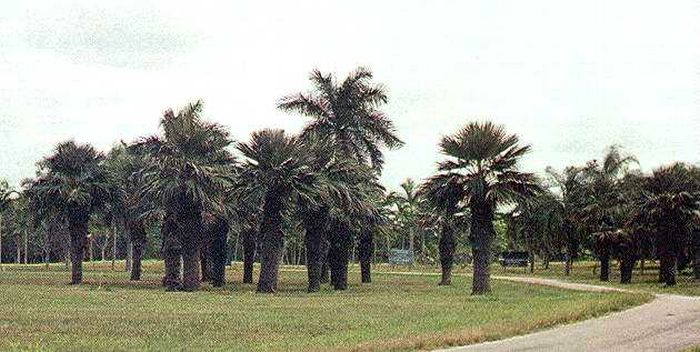
Cuba. Photo-PALMS & CYCADS, edric.

Isle de la Juventud, Cuba, photo by Paul Craft, edric.

Cuba. Photo by Jason Schoneman, edric.

La Habana Botanical Garden, Cuba. Photo by Jason Schoneman, edric.

La Habana Botanical Garden, Cuba. Photo by Jason Schoneman, edric.

La Habana Botanical Garden, Cuba. Photo by Jason Schoneman, edric.

In habitat. Photo-Rare Palm Seeds.com


External Links
- Glossary of Palm Terms
- MODERN BOTANICAL LATIN
- "Just To Be Clear"
- http://southeastgarden.com/cuba.html
- http://www.plantapalm.com/vpe/virtualtours/cuba/vpe_palmsofcuba1.htm
http://perfildaplanta.blogspot.com/2010/07/roystoneas-confusoes-imperiais-parte-ii.html
References
Phonetic spelling of Latin names by edric.
Special thanks to Geoff Stein, (Palmbob) for his hundreds of photos.
Special thanks to Palmweb.org, Dr. John Dransfield, Dr. Bill Baker & team, for their volumes of information and photos.
Glossary of Palm Terms; Based on the glossary in Dransfield, J., N.W. Uhl, C.B. Asmussen-Lange, W.J. Baker, M.M. Harley & C.E. Lewis. 2008. Genera Palmarum - Evolution and Classification of the Palms. Royal Botanic Gardens, Kew. All images copyright of the artists and photographers (see images for credits).
Evans, R.J.2001. Monograph of Colpothrinax. Palms 45(4): 177-195.
Many Special Thanks to Ed Vaile for his long hours of tireless editing and numerous contributions.