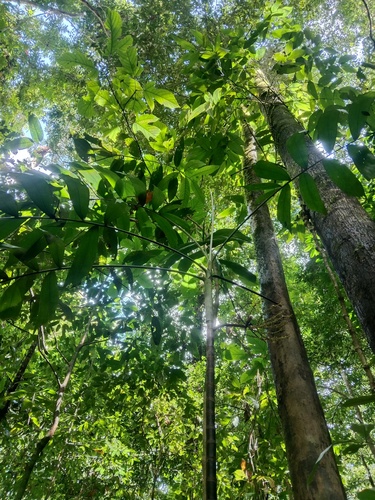
Drymophloeus oliviformis (Giseke) Mart. is a small, very slender feather palm of the rainforest understorey, native to the Maluku Islands of Indonesia and the far north-west of New Guinea. A thin, reed-like stem rising from a cone of stilt roots, a slightly swollen green crownshaft, and few leaves bearing broad, wedge-shaped "fishtail" leaflets with jagged tips mark it out; the two leaflets at the leaf tip are usually fused into a single fan. Its red, olive-shaped fruits, which gave the species its name, are juicy but their flesh is loaded with needle crystals that irritate the skin. It is the type species of the genus Drymophloeus, and its former names include Ptychosperma rumphii, Drymophloeus appendiculatus and Seaforthia oliviformis. In its homeland the tough stems become spears and harpoons; elsewhere it has been grown as a shade palm for the tropics since the 19th century.
Also known aspinang utan (Ambon); songgomi (Wandama, New Guinea); menen; chibraka; biasoi; sebu
Distribution and habitat

Kew records the species as native to Maluku and New Guinea, with no introduced range. In Maluku it is known from Ambon, Buru and Seram, from the Sula Islands and from Halmahera; in New Guinea it is confined to the north-western part of the island (Indonesian West Papua), where it has been photographed and collected on the Wandamen Peninsula, on the Arfak Plains, along the Wosimi River and around Senderawoi. It grows in lowland and hillside rainforest and in alluvial forest, from about 10 to 600 m, frequently on limestone, and also enters low, swampy forest; the Palms of New Guinea account names it among the many palms that stay below the 700 m limit of lowland rainforest. On Ambon it was collected in 1918 at Lateri and Gelala in ravines and forest at 20–200 m. On Halmahera a palm survey of Aketajawe-Lolobata National Park found it, with voucher specimens, in both parts of the park, occurring here and there in primary forest and dense forest on karst below 700 m (Abdo 2017).
Throughout north-western New Guinea it shares its range with its closest relative, Drymophloeus litigiosus. Zona (1999) left open whether the two species met there through secondary contact or diverged in place, and suggested that both sea crossings by birds carrying the red fruits and older geological separation shaped the present pattern.
Description

- Habit and stem: a pleonanthic, monoecious understorey palm, usually solitary, occasionally weakly clustering. The stem is 1–7 m tall and only 2–7 cm thick, with conspicuous leaf scars set well apart; its outer layer is hard and fibrous around a soft, pithy core. Stout brown to grey stilt roots, sometimes branched, form a cone at the base and often carry lines of small corky breathing pores (pneumathodes); plants in cultivation may lack them.
- Leaves: 6 or 7 in the crown, 0.86–2.5 m long, pinnate. The tubular sheaths, 15.5–70 cm long, make a distinct, slightly bulging crownshaft and are covered with silvery branched hairs, with dark scales near the top; petiole 21–61 cm, rachis 60–150 cm. Leaflets in 8–19 pairs, firm and almost rubbery, linear-lanceolate to broadly fan-shaped, mid-leaf leaflets 18–71 cm long and 3–24 cm wide, set 6–15 cm apart, with ragged (erose) tips. The terminal pair is usually united into one broad fan-shaped leaflet, sometimes with a slight notch. Emerging leaves of understorey Drymophloeus can be reddish and mature leaflets may have a metallic sheen. Leaflet shape varies enormously, from narrow and linear to broadly flabellate, which led nineteenth-century botanists to describe several species that are now merged here.
- Inflorescence: below the leaves, one per node, green, 18–30 cm long and sparsely branched (the least branched in the genus with one other species); peduncle 7–26 cm long, much longer than the flowering part. The prophyll (6–20 × 1.3–2.1 cm) and the green peduncular bract (8–28 × 1.5–3.5 cm, splitting along its outer side) both stay on the plant. Rachillae 3–17, 7.5–40.5 cm long and 0.9–4.3 mm thick, with roughly 4–21 female flowers per 5 cm. Flowers are in triads (one female between two males), male only towards the rachilla tips; the females are spirally placed, sometimes in two rows near the tip, and fruits may therefore line up in two ranks.
- Flowers: male flowers bullet-shaped, 5.2–10.2 × 2.3–5.1 mm, greenish brown in bud, with kidney-shaped to semicircular sepals 2–3.5 × 4–4.9 mm, greenish brown petals 5.4–8 × 2.6–4.4 mm, 30–66 stamens 4.2–5.1 mm long (anthers 1.9–3.5 mm) and a pistillode 3.5–6 mm long with a style of 2–2.8 mm, longer than the stamens. Female flowers globose, greenish brown, 3–5.7 × 3–5.6 mm, with sepals and petals each about 3.5 mm long and a conical gynoecium about 4.3 mm long. Pollen has been measured at 31.5–42.8 µm (mean 37.7 µm) by Zona and at 58–60 µm by Thanikaimoni.
- Fruit and seed: fruit ripening from green through yellow to red, fusiform to ovoid or obovoid, fleshy and juicy, 10.6–23.5 × 5.5–11.9 mm, smooth or finely wrinkled when dry, with an apical stigmatic scar. Endocarp spindle-shaped, straw-coloured and finely fibrous outside, caramel-coloured and glassy inside, 8.6–17.9 × 6.7–7.9 mm. Seed globose to ovoid, sometimes flattened at the base, brown, 4.7–11.3 × 4.3–8.3 mm, with homogeneous endosperm and a minute basal embryo.
- Seedling: germination adjacent-ligular; the first leaf (eophyll) is elliptical and undivided with ragged margins, only rarely shallowly notched at the tip.
Similar species
- Drymophloeus litigiosus, its sister species, grows in the same part of New Guinea and also reaches northern Maluku (Morotai, Halmahera, Obi); on Halmahera both species grow in the same primary and karst forests. It is best told apart by its ruminate endosperm (homogeneous in Drymophloeus oliviformis) and by its terminal leaflets, which are broad but separate, giving a bifid leaf tip; its eophyll is broadly notched, it carries 7–9 leaves, its male flowers have only 24–32 stamens, and it climbs higher, to 1200 m. A fused fan-shaped terminal leaflet, when present, identifies Drymophloeus oliviformis even on sterile material.
- Ponapea hentyi (formerly Drymophloeus hentyi) of New Britain is similar in habit but has strongly recurved leaves, lacks stilt roots and has ruminate endosperm with a black, glassy endocarp lining.
- Brassiophoenix has very broad wedge-shaped leaflets and larger orange fruits about 3.5 cm long with ridged endocarps; Dransfieldia has pointed leaflet tips and black fruit; Ptychosperma has grooved or angled endocarps. None of them normally has stilt roots.
Ecology

An understorey palm of shaded forest, it shows the plasticity typical of shade palms, above all in leaflet width. Most plants are single-stemmed, but one population in low, swampy forest in West Papua consisted of weakly clustering individuals; Zona regarded this as a minor, possibly simply inherited variant that does not merit a name.
For the genus, Zona (1999) described strongly protandrous inflorescences: the bracts open two or three months before flowering, and when the male flowers shed pollen the female flowers are still small buds. The pale, unscented, day-flowering male flowers with copious pollen fit a bee-pollination syndrome, and halictid bees were seen visiting a related species then placed in Drymophloeus in cultivation in Florida; no field study of pollination exists for Drymophloeus oliviformis itself. The red, juicy fruits are attractive to birds, which are thought to disperse the seeds, including across water between islands; on Halmahera, fruit pigeons have been watched feeding on the fruits of the sister species Drymophloeus litigiosus (Abdo 2017), although no disperser has yet been recorded for Drymophloeus oliviformis itself. The fruit flesh contains raphides (needle crystals) that commonly cause dermatitis in people, though sensitivity varies between individuals.
Uses
In north-western New Guinea the hard, slender stems are cut for spears and harpoons, and the leaves serve for wrapping sago. Recorded local names include songgomi in the Wandama language of the Wandamen Peninsula and pinang utan ("forest areca") on Ambon; Zona (1999) also lists menen, chibraka, biasoi and sebu. Outside its range it is valued as an ornamental: the species has a long history in cultivation and is illustrated in standard horticultural works on palms.
Cultivation
A palm strictly for the tropics or the warmest subtropics, it wants shade, a free-draining mix and generous, regular watering, conditions that copy its forest-floor habitat. Grown in the open it is planted as an understorey palm beneath taller trees. One grower kept a young plant in bright shade outdoors and moved it to an east-facing window during cold weather, after an unidentified leaf problem had been halted with fungicide. Reliable minimum-temperature figures have not been published.
Propagation is from seed; the seedling first produces an undivided elliptical leaf. Wear gloves when cleaning fruit, since the pulp irritates the skin. Long scarce in collections, it has become more widely available, and plants grow in Thailand (Nong Nooch Tropical Garden, Pattaya), Hawaii, Réunion (Saint-Denis), Costa Rica (Escazú) and southern California.
Conservation
Conservation status: Least Concern.
The palm is widespread across several Maluku islands and north-western New Guinea, including areas of limestone forest, and it occurs within Aketajawe-Lolobata National Park on Halmahera; no specific local threats have been documented.
Name history
The accepted name is cited by Kew from Martius, Historia Naturalis Palmarum 3: 314 (1849). The basionym is Areca oliviformis Giseke (Praelectiones in Ordines Naturales Plantarum, 1792), whose type is the plate of "Saguaster minor" in Rumphius's Herbarium Amboinense (vol. 1: 67, t. 15, published 1741), the first published illustration of any Drymophloeus; Merrill (1917) confirmed that this Ambon palm supplies the oldest valid epithet and designated the plate as lectotype (Interpretation, p. 120), a typification accepted in Turner's (2025) list of names typified by Rumphius's illustrations. Both Martius and Giseke originally spelled the epithet olivaeformis. Martius also published Seaforthia oliviformis, Harina rumphii, Seaforthia jaculatoria and Drymophloeus jaculatorius on the same page; the last two are illegitimate because they cited Giseke's earlier names (Areca vaginata and Areca oliviformis var. gracilis), and the epithet jaculatorius alludes to javelins, recalling the use of the stems.
The genus was proposed by Zippelius in a letter to Blume written near the coast of Timor and dated 9 October 1828, published in 1829. Zippelius likened the new palm to Iriartea, presumably for its broad leaflets and stilt roots, and to Caryota for its bitten-off leaflet tips and stinging fruit pulp, and noted a homogeneous endosperm, which points to this species; his specimen labelled "Iriartea monogyna" and the name Iriartea leprosa are both listed by Kew among the former names. Drymophloeus oliviformis is the lectotype species of the genus (designated by Pichi-Sermolli, 1955) and the type of Saguaster Kuntze.
Several later names rest on variants of the same palm. Blume's Ptychosperma rumphii (1843) and Kunth's Seaforthia blumei were superfluous, since both cited Giseke's name; Blume's Ptychosperma appendiculatum shows this species with a slightly split leaf tip, so Drymophloeus appendiculatus was long misapplied to it. Drymophloeus ceramensis Miq. (1868; type collected on Seram by De Vriese and Teijsmann during their 1859–1860 Moluccan journey), Drymophloeus bifidus Becc. (1877; type Beccari 953, Mount Arfak at Putat, about 300 m, October 1872) and Drymophloeus leprosus Becc. (1885) differ only in leaflet size, which varies continuously. Ptychosperma wartelii Sander and Ptychosperma wartelianum André (1898) were based on a juvenile plant from Seram exhibited by Sander's nursery at St Albans; because it had neither flowers nor fruit, the Palms of New Guinea authors consider its placement uncertain, although Kew treats it as a synonym. Zona (1999) gave the combination Drymophloeus oliviformis to Miquel (1868), whereas Kew credits Martius (1849).
The epithet oliviformis means "olive-shaped", describing the fruit. The meaning of Drymophloeus was never explained by Zippelius: Moore read it as Greek drymos (forest) and phloios (bark), while Zona preferred drymos and phleos (a marsh reed), for the thin, reedy stems of this understorey palm. Pronunciation: dry-moh-FLEH-uhs oh-lee-vih-FOR-mis.
Drymophloeus belongs to subfamily Arecoideae, tribe Areceae, subtribe Ptychospermatinae. Zona (1999) recognised seven species; molecular work (Zona et al. 2011) later moved the Solomon Islands species to Veitchia and Drymophloeus hentyi to Ponapea, leaving Drymophloeus oliviformis and Drymophloeus litigiosus as sister species; Kew also accepts the Samoan Drymophloeus whitmeeanus, known with certainty only from its type and not included in molecular studies.