|
|
| Line 13: |
Line 13: |
| | *'''Habit''': solitary with a crown of 20-30 fan leaves | | *'''Habit''': solitary with a crown of 20-30 fan leaves |
| | *'''Height''': 50' estimate | | *'''Height''': 50' estimate |
| − | *'''Trunk''': 12" at the base; 8" higher up; often covered with retained leaf bases near base; narrowly ringed; brownish red near top and fading near base | + | *'''Trunk''': 12" at the base; 8" higher up; often covered with retained leaf bases near base; narrowly ringed; brownish red near top and fading near base; upper trunk often has retained fibrous material between retained leaf bases |
| | *'''Crownshaft''': none | | *'''Crownshaft''': none |
| | *'''Spread''': 15' | | *'''Spread''': 15' |
Revision as of 10:13, 16 August 2015
Pronunciation: liv-ih-STONE-uh NIH-tih-duh
Common Name: Carnarvon Gorge Palm; Dawson River Fan Palm
Livistona nitida is a fast and reliable grower for California, and a nice cold hardy palm for full sun and arid regions. It does tend to a look a bit like a smaller version of Washingtonia robusta, and that may have something to do with its lack of popularity.
Synonym: Livistona 'Carnarvon Gorge'
|
Appearance and Biology
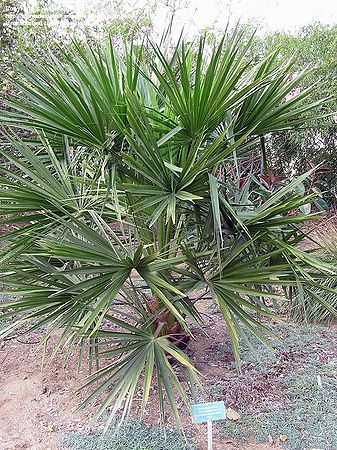
- Habit: solitary with a crown of 20-30 fan leaves
- Height: 50' estimate
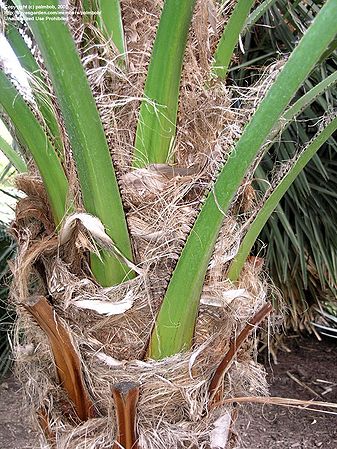
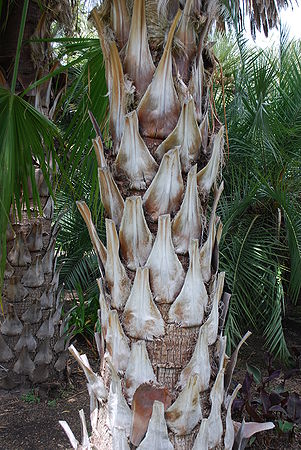
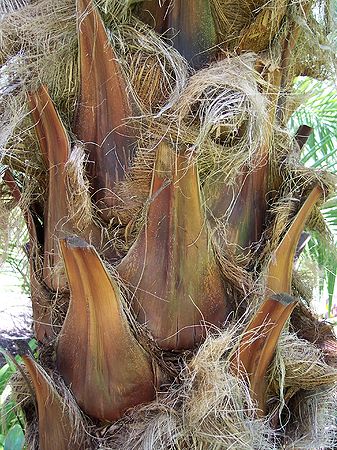
- Trunk: 12" at the base; 8" higher up; often covered with retained leaf bases near base; narrowly ringed; brownish red near top and fading near base; upper trunk often has retained fibrous material between retained leaf bases
- Crownshaft: none
- Spread: 15'
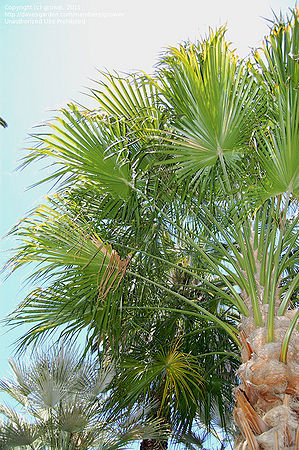
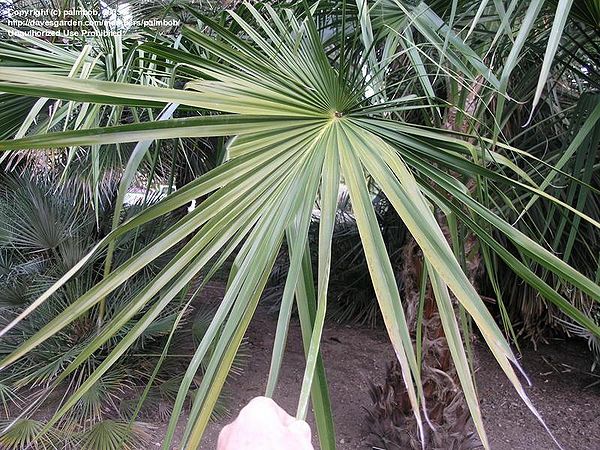
- Leaf Description: costapalmate; deep green to yellowy green near leaflets; 8'-10' long; leaves divided to about 2/3 their length; distal 1/3 leaflets drooping acutely, similar to the other 'ribbon-like' Livistonas; younger palms have stiffer leaflets that do not droop (drooping tends to happen at about same age begins to flower)
- Petiole/Leaf bases: often retained for many years, and indefinitely near trunk base; un-split; armed with small, sharp, red-black teeth proximally, but often smooth distally; 5'-6' long
- Reproduction: monoecious, though 'functionally dioecious (male and female flowers open at different times)
- Inflorescence:
- Fruit: spherical; 1/3" thick; black when ripe
|
Horticultural Characteristics
- Minimum Temp: 24F
- Drought Tolerance: good
- Dry Heat Tolerance: good
- Cool Tolerance: good
- Wind Tolerance: good
- Salt Tolerance: unknown
- Growth Rate: moderate to fast with age
- Soil Preference: very adaptable
- Light Requirement: full sun
- Human Hazards: petiolar teeth very sharp, though small
- Disease or Horticultural Problems: tends to be yellowy unless fertilized well
- Transplants?: unknown
- Indoor?: unknown
- Availability: rare
|
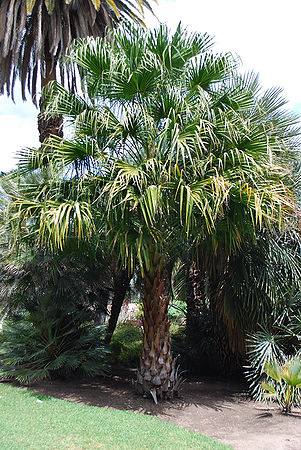
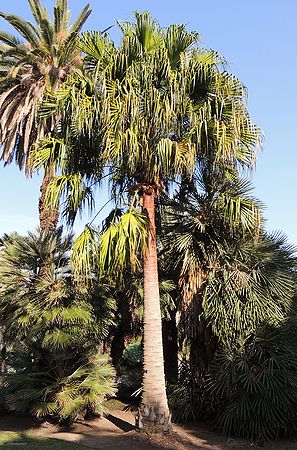
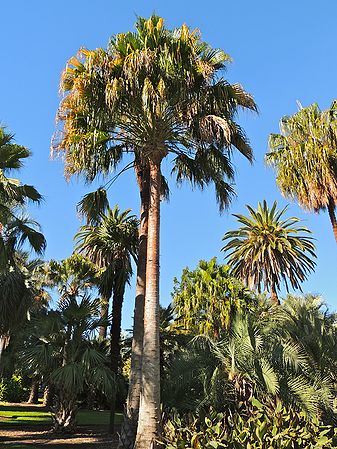
all shots at the Huntington gardens near Pasadena, California, unless otherwise noted
private garden, California
private garden, California







.JPG)


