Difference between revisions of "Parajubaea cocoides"
Geoff Stein - Author & Editor
| Line 4: | Line 4: | ||
</center> | </center> | ||
'''''Parajubaea cocoides'''''is the first Parajubaea to be grown in California and there are numerous mature specimens throughout the state, both in northern and southern California now. However, the other two species have since overrun this one in terms of popularity and are quite a bit more reliable in terms of not having cultivational troubles and rate of growth. However it is still an excellent palm for California. Its origins are unclear as there haven't been any of these found in the wild. | '''''Parajubaea cocoides'''''is the first Parajubaea to be grown in California and there are numerous mature specimens throughout the state, both in northern and southern California now. However, the other two species have since overrun this one in terms of popularity and are quite a bit more reliable in terms of not having cultivational troubles and rate of growth. However it is still an excellent palm for California. Its origins are unclear as there haven't been any of these found in the wild. | ||
| − | + | <center> | |
{| colspan="2" style="background: #FCFCFC; border: 1px solid black; vertical-align: top;" | | {| colspan="2" style="background: #FCFCFC; border: 1px solid black; vertical-align: top;" | | ||
| style="width: 50%; background: #f8e8df; border: 1px solid black; vertical-align: top;" | | | style="width: 50%; background: #f8e8df; border: 1px solid black; vertical-align: top;" | | ||
| Line 36: | Line 36: | ||
*'''Availability''': rare and now even more rare than it was, due to growers preference of other two species | *'''Availability''': rare and now even more rare than it was, due to growers preference of other two species | ||
|} | |} | ||
| + | {{#Widget:AdResBan}} | ||
<gallery> | <gallery> | ||
File:Parajubaea coccoides Osborne2.jpg|Santa Barbara, California | File:Parajubaea coccoides Osborne2.jpg|Santa Barbara, California | ||
Latest revision as of 22:42, 3 August 2015
Common Name: Quito Coconut Palm; Quito Palm
Parajubaea cocoidesis the first Parajubaea to be grown in California and there are numerous mature specimens throughout the state, both in northern and southern California now. However, the other two species have since overrun this one in terms of popularity and are quite a bit more reliable in terms of not having cultivational troubles and rate of growth. However it is still an excellent palm for California. Its origins are unclear as there haven't been any of these found in the wild.
|
Appearance and Biology
|
Horticultural Characteristics
|

Santa Barbara, California

Oakland, California

Santa Barbara, California


Vista, California
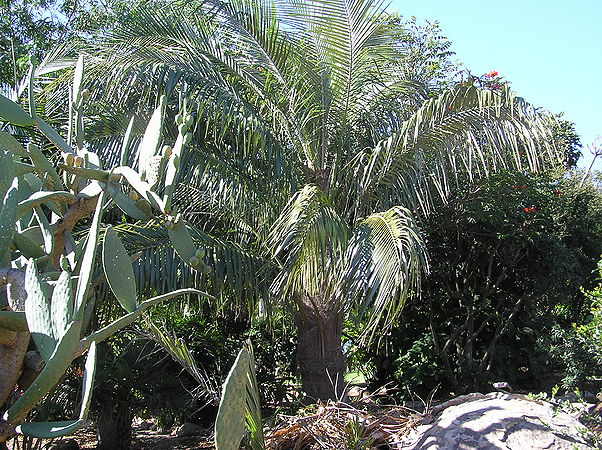
Santa Barbara, California

Huntington Beach, California
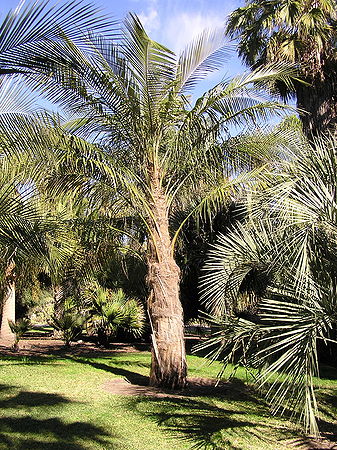
Huntington Gardens near Pasadena, California

Vista, California

Santa Barbara, California

San Fernando valley, California

Orange county, California

Huntington Beach


Ventura, California next to shorter Parajubaea torallyi

successfully grown palm in Hawaii, Floribunda Palms


Santa Barbara

leaflets ventral surface

petioles

leaflets dorsal surface

petioles and trunk
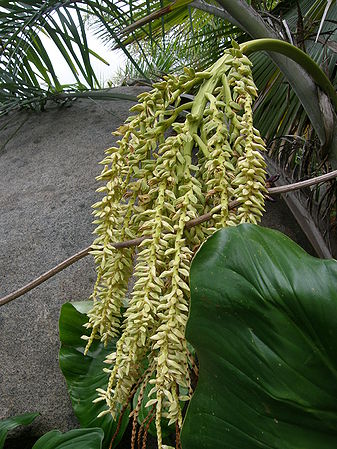
flower, San Diego county

fruits


_and_cocoides_(right)comparison_ventura_c_blowing.jpg)


