Difference between revisions of "Caryota mitis"
Geoff Stein - Author & Editor
| Line 4: | Line 4: | ||
</center> | </center> | ||
'''''Caryota mitis''''' is a fairly commonly available ''Caryota'' in California and is the only suckering species in cultivation in California though suckering Caryotas show up that don't seem to fit this species exactly. Though commonly grown, does not always look good in California (gets an untidy look, particularly after some stems start dying post flowering)- needs humidity, some protection from hot sun, and burns in cold. Stems dies after flowering but plant keeps on living sending up new offsets. Variegated forms not all that uncommon. | '''''Caryota mitis''''' is a fairly commonly available ''Caryota'' in California and is the only suckering species in cultivation in California though suckering Caryotas show up that don't seem to fit this species exactly. Though commonly grown, does not always look good in California (gets an untidy look, particularly after some stems start dying post flowering)- needs humidity, some protection from hot sun, and burns in cold. Stems dies after flowering but plant keeps on living sending up new offsets. Variegated forms not all that uncommon. | ||
| − | + | <center> | |
{| colspan="2" style="background: #FCFCFC; border: 1px solid black; vertical-align: top;" | | {| colspan="2" style="background: #FCFCFC; border: 1px solid black; vertical-align: top;" | | ||
| style="width: 50%; background: #f8e8df; border: 1px solid black; vertical-align: top;" | | | style="width: 50%; background: #f8e8df; border: 1px solid black; vertical-align: top;" | | ||
Revision as of 20:16, 27 July 2015
Common Name: Clustering Fishtail Palm
Caryota mitis is a fairly commonly available Caryota in California and is the only suckering species in cultivation in California though suckering Caryotas show up that don't seem to fit this species exactly. Though commonly grown, does not always look good in California (gets an untidy look, particularly after some stems start dying post flowering)- needs humidity, some protection from hot sun, and burns in cold. Stems dies after flowering but plant keeps on living sending up new offsets. Variegated forms not all that uncommon.
|
Appearance and Biology
|
Horticultural Characteristics
|

Los Angeles, Hooper garden

Los Angeles arboretum near Pasadena, California

Los Angeles arboretum

Los Angeles arboretum

Santa Barbara, California, Schwarz garden

indoor in Orlando, Florida


stems in Los Angeles arboretum


flowering in Los Angeles arboretum
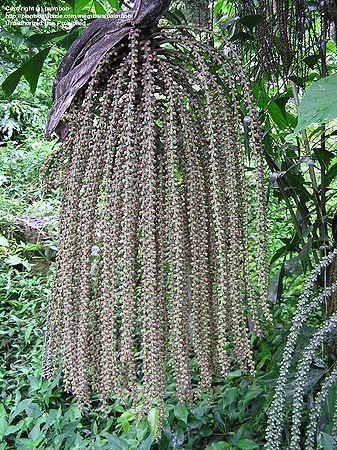
Oahu, Hawaii

Los Angeles arboretum

Hawaii

Hawaii

Hawaii

variegated palm, Nong Nooch Tropical gardens, Thailand

Floribunda Palms, Hawaii


Floribunda Palms

Floribunda Palms

Floribunda Palms

Floribunda Palms

Floribunda Palms

Floribunda Palms

seedling from seed of a variegated palm, Hawaii


