Difference between revisions of "Livistona rigida"
Geoff Stein - Author & Editor
| Line 1: | Line 1: | ||
<center>'''Pronunciation''': lih-vih-STONE-uh RIJ-ih-duh | <center>'''Pronunciation''': lih-vih-STONE-uh RIJ-ih-duh | ||
<br/> | <br/> | ||
| − | '''Common Name''': | + | '''Common Name''': Mataranka Palm |
</center> | </center> | ||
| − | '''''Livistona rigida''''' has been lumped with Livistona mariae until recently 'released' by Dowe to its own species status. However, telling them apart is a real challenge. Like Livistona mariae, younger plants have a nice reddish hue to their foliage and petioles that sadly fades away with maturity. | + | '''''Livistona rigida''''' has been lumped with Livistona mariae until recently 'released' by Dowe to its own species status. However, telling them apart is a real challenge. Like Livistona mariae, younger plants have a nice reddish hue to their foliage and petioles that sadly fades away with maturity. But adult palms have smaller leaves, more deeply costapalmate, leaflets are more rigid (less pendulous near tips) and there are some minor flower differences, too. It would be nice to have two confirmed adult palms of either species growing side by side. |
{| colspan="2" style="background: #FCFCFC; border: 1px solid black; vertical-align: top;" | | {| colspan="2" style="background: #FCFCFC; border: 1px solid black; vertical-align: top;" | | ||
| Line 10: | Line 10: | ||
<div style="padding-left: 1em;"> | <div style="padding-left: 1em;"> | ||
*'''Habit''': solitary with a crown of 20-30 fan leaves | *'''Habit''': solitary with a crown of 20-30 fan leaves | ||
| − | *'''Height''': | + | *'''Height''': 40' estimate |
| − | *'''Trunk''': | + | *'''Trunk''': single; 10" thick; tan; closely ringed; some retained leaf bases near base of palm |
*'''Crownshaft''': none | *'''Crownshaft''': none | ||
| − | *'''Spread''': | + | *'''Spread''': 15'-20' |
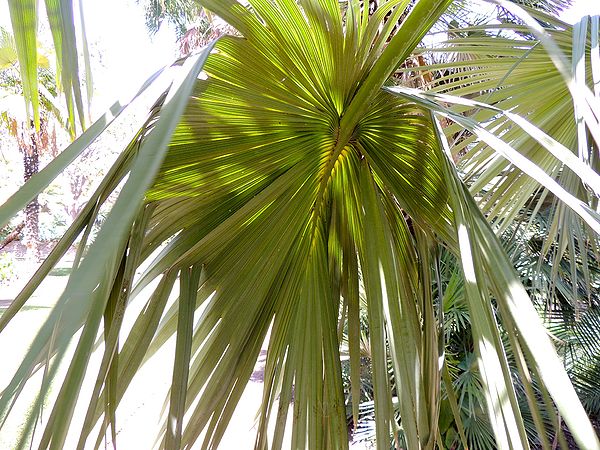
| − | *'''Leaf Description''': | + | *'''Leaf Description''': costapalmate; leaflets fairly stiff with only a bit of leaflet tip droop; young leaves may be red or green; leaves up to 10' long; blades about 3'-4' in diameter; dull to medium green in color |
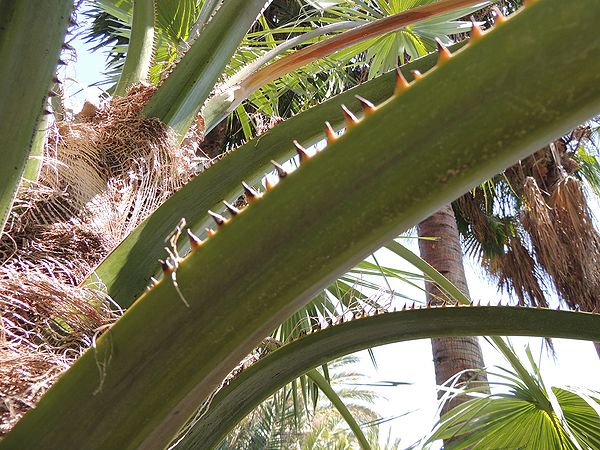
| − | *'''Petiole/Leaf bases''': | + | *'''Petiole/Leaf bases''': armed with prominent, very sharp black teeth; un-split bases, about 7' long |
| − | *'''Reproduction''': | + | *'''Reproduction''': 'functionally dioecious (but not anatomically such, necessarily) |
| − | *'''Inflorescence''': | + | *'''Inflorescence''': 6' long; arching and mostly unbranched; from within leaves |
| − | *'''Fruit''': | + | *'''Fruit''': spherical; 1/2" thick; black when ripe |
| style="width: 50%; background: #f8e8df; border: 1px solid black; vertical-align: top;" | | | style="width: 50%; background: #f8e8df; border: 1px solid black; vertical-align: top;" | | ||
<div style="background: #e5a178; border: 1px solid black; padding: 5px; margin: 3px; font-weight: bold; text-align: center; font-size: 120%;">Horticultural Characteristics</div> | <div style="background: #e5a178; border: 1px solid black; padding: 5px; margin: 3px; font-weight: bold; text-align: center; font-size: 120%;">Horticultural Characteristics</div> | ||
Revision as of 15:44, 16 August 2015
Common Name: Mataranka Palm
Livistona rigida has been lumped with Livistona mariae until recently 'released' by Dowe to its own species status. However, telling them apart is a real challenge. Like Livistona mariae, younger plants have a nice reddish hue to their foliage and petioles that sadly fades away with maturity. But adult palms have smaller leaves, more deeply costapalmate, leaflets are more rigid (less pendulous near tips) and there are some minor flower differences, too. It would be nice to have two confirmed adult palms of either species growing side by side.
|
Appearance and Biology
|
Horticultural Characteristics
|
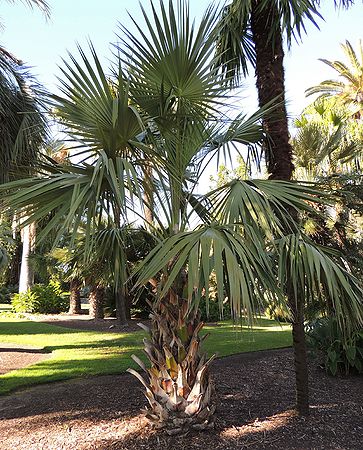
Huntington gardens tree, near Pasadena, California

fast growing tree sold as Livistona rigida, in Simi Valley, California

young plant with nice color in garden of Matt Bradford, San Diego county, California

San Diego county, California
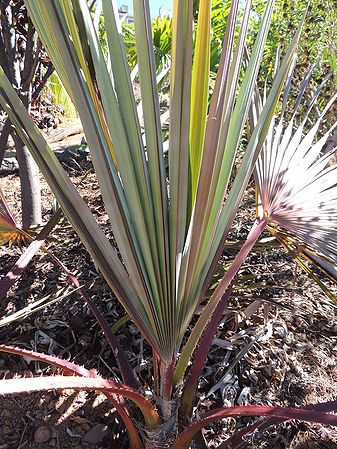
closer shot of Matt's plant in San Diego, California

leaf of palm in Huntington gardens