Difference between revisions of "Licuala ramsayi"
Geoff Stein - Author & Editor
(Created page with "<center>'''Pronunciation''': lih-KWAL-uh RAM-zee-eye <br/> '''Common Name''': Australian Fan Palm; Wedge-leaf Fan Palm </center> '''''Licuala ramsayi''''' is one of the easie...") |
|||
| (6 intermediate revisions by one user not shown) | |||
| Line 3: | Line 3: | ||
'''Common Name''': Australian Fan Palm; Wedge-leaf Fan Palm | '''Common Name''': Australian Fan Palm; Wedge-leaf Fan Palm | ||
</center> | </center> | ||
| − | '''''Licuala ramsayi''''' is one of the easier Licualas to grow in California… but saying that does not make it an easy palm. Most Licualas are impossible to grow here, so this is an exception. But growing this plant well still requires protection from the elements, strict observance of water needs and a good microclimate. In its native Australia, this palm eventually grows into a tall forest of trees which can be walked beneath (unlike most Licualas that stay fairly small and are classified as understory palms). However, in California, no 'trees' exist yet and likely few, if any, will attain enough height to walk below their canopies. | + | '''''Licuala ramsayi''''' is one of the easier Licualas to grow in California… but saying that does not make it an easy palm. Most Licualas are impossible to grow here, so this is an exception. But growing this plant well still requires protection from the elements, strict observance of water needs and a good microclimate. In its native Australia, this palm eventually grows into a tall forest of trees which can be walked beneath (unlike most Licualas that stay fairly small and are classified as understory palms). However, in California, no 'trees' exist yet and likely few, if any, will attain enough height to walk below their canopies. Two varieties are described in the literature, with one being the 'type' and the other var. tuckeri, differentiated by having little to no spines along the petioles (so obviously this might be the more popular variety). Leaves are nearly circular, split randomly and have an ornamental edge as if cut by a pinking shears. It is a highly ornamental species. |
| − | + | <center> | |
{| colspan="2" style="background: #FCFCFC; border: 1px solid black; vertical-align: top;" | | {| colspan="2" style="background: #FCFCFC; border: 1px solid black; vertical-align: top;" | | ||
| style="width: 50%; background: #f8e8df; border: 1px solid black; vertical-align: top;" | | | style="width: 50%; background: #f8e8df; border: 1px solid black; vertical-align: top;" | | ||
<div style="background: #e5a178; border: 1px solid black; padding: 5px; margin: 3px; font-weight: bold; text-align: center; font-size: 120%;">Appearance and Biology</div> | <div style="background: #e5a178; border: 1px solid black; padding: 5px; margin: 3px; font-weight: bold; text-align: center; font-size: 120%;">Appearance and Biology</div> | ||
<div style="padding-left: 1em;"> | <div style="padding-left: 1em;"> | ||
| − | *'''Habit''': | + | *'''Habit''': solitary with a crown of 6-8 fan leaves |
| − | *'''Height''': | + | *'''Height''': 10' estimate |
| − | *'''Trunk''': | + | *'''Trunk''': single; 3"-4" thick; covered with fibrous weave and retained, unsplit leaf bases |
| − | *'''Crownshaft''': | + | *'''Crownshaft''': none |
| − | *'''Spread''': | + | *'''Spread''': 4'-5' |
| − | *'''Leaf Description''': | + | *'''Leaf Description''': palmate; nearly circular; some splits down to petiole; leaf margins 'cut' regularly at each leaflet; pleated pattern of leaflets; 3' long; yellow-green to light green |
| − | *'''Petiole/Leaf bases''': | + | *'''Petiole/Leaf bases''': 1'-2'; bright green; thin and flattish; armed with small teeth, OR unarmed/minimally armed in variety tuckeri; un-split; often retained on trunk for much of height of plant |
| − | *'''Reproduction''': | + | *'''Reproduction''': monoecious |
| − | *'''Inflorescence''': | + | *'''Inflorescence''': 3' long; arching from within leaves mostly horizontal to pendulous; highly branched |
| − | *'''Fruit''': | + | *'''Fruit''': spherical; bright red-orange; 1/3" in diameter |
| style="width: 50%; background: #f8e8df; border: 1px solid black; vertical-align: top;" | | | style="width: 50%; background: #f8e8df; border: 1px solid black; vertical-align: top;" | | ||
<div style="background: #e5a178; border: 1px solid black; padding: 5px; margin: 3px; font-weight: bold; text-align: center; font-size: 120%;">Horticultural Characteristics</div> | <div style="background: #e5a178; border: 1px solid black; padding: 5px; margin: 3px; font-weight: bold; text-align: center; font-size: 120%;">Horticultural Characteristics</div> | ||
<div style="padding-left: 1em;"> | <div style="padding-left: 1em;"> | ||
| − | *'''Minimum Temp''': | + | *'''Minimum Temp''': 27F |
| − | *'''Drought Tolerance''': | + | *'''Drought Tolerance''': low |
| − | *'''Dry Heat Tolerance''': | + | *'''Dry Heat Tolerance''': moderate |
| − | *'''Cool Tolerance''': | + | *'''Cool Tolerance''': low to moderate |
| − | *'''Wind Tolerance''': | + | *'''Wind Tolerance''': low |
| − | *'''Salt Tolerance''': | + | *'''Salt Tolerance''': moderate |
| − | *'''Growth Rate''': | + | *'''Growth Rate''': very slow to slow with age |
| − | *'''Soil Preference''': | + | *'''Soil Preference''': moist and well draining, but adaptable otherwise |
| − | *'''Light Requirement''': | + | *'''Light Requirement''': shade to partial near coast |
| − | *'''Human Hazards''': | + | *'''Human Hazards''': mild petiolar hazard in 'type' variety |
| − | *'''Disease or Horticultural Problems''': | + | *'''Disease or Horticultural Problems''': none |
| − | *'''Transplants?''': | + | *'''Transplants?''': unknown |
| − | *'''Indoor?''': | + | *'''Indoor?''': fair |
| − | *'''Availability''': | + | *'''Availability''': rare |
|} | |} | ||
| + | {{#Widget:AdResBan}} | ||
<gallery> | <gallery> | ||
| − | + | File:Licuala ramsayi Jim 2.jpg|garden of Jim Denz, northern California | |
| + | File:Licuala ramsayi matt.jpg|garden of Matt Bradford, San Diego county, California | ||
| + | File:Licuala ramsayi hartman.jpg|San Diego county showing lack of humidity | ||
| + | File:Licuala ramsayi Sull.JPG|Pauleen Sullivan garden, Ventura, California | ||
| + | File:Licuala ramsayii leaves better.jpg|San Diego county, garden of Matt Bradford | ||
| + | File:Licuala ramsayi Balboa.JPG|Balboa park, San Diego | ||
| + | File:Licuala ramsayi H.JPG| conservatory palm, Huntington Gardens near Pasadena, California | ||
| + | File:Licuala ramsayi 3 Jim.jpg|another palm in Jim Denz's garden, northern California | ||
| + | File:Licuala ramsayi Sullivan.JPG|Sullivan estate in Hawaii | ||
| + | File:Licuala ramsayi again.JPG | ||
| + | File:Licuala ramsayi colony.JPG| | ||
| + | File:Licuala ramsayis Singapore zoo.jpg|Singapore Zoo | ||
| + | File:Licuala ramsayis SBG.jpg|Singapore botanical gardens | ||
| + | File:Licuala ramsayis and people.JPG| | ||
| + | File:Licuala ramsayi tall with person Lyons.JPG|Lyons arboretum, Oahu, Hawaii | ||
| + | File:Licuala ramsayi row.JPG|Lundkvist estate, Hawaii | ||
| + | File:Licuala ramsayi shot again DO.jpg|Hawaii | ||
| + | File:Licuala ramsayi road L.jpg|Lundkvist estate, Hawaii | ||
| + | File:Licuala ramsayi making shade L.jpg|Lundkvist estate | ||
| + | File:Licuala ramsayi Leu.jpg|Leu botanical gardens, Orlando, Florida | ||
| + | File:Licuala ramsayi L.jpg|Lundkvist garden | ||
| + | File:Licuala ramsayi indoor palm GGP.jpg|conservatory palm, Golden Gate Park, San Francisco, California | ||
| + | File:Licuala ramsayi Ho.JPG|Ho'Olamuhia botanical gardens, Oahu, Hawaii | ||
| + | File:Licuala ramsayi from below DO.jpg|Hawaii | ||
| + | File:Licuala ramsayi from above DO.jpg|Hawaii | ||
| + | File:Licuala ramsayi Don.jpg|Hawaii | ||
| + | File:Licuala ramsayi leaf.JPG| | ||
| + | File:Licuala ramsayi leaf end matt.jpg|leaf of palm in San Diego county | ||
| + | File:Licuala ramsayii leaves better.jpg| | ||
| + | File:Licuala ramsay petioles matt.jpg|petiolar teeth of California palm | ||
| + | File:Licuala ramsayi trunk.JPG|Hawaii | ||
| + | File:Licuala ramsayi flower H cons.JPG|flowers on conservatory palm, Huntington gardens | ||
</gallery> | </gallery> | ||
[[Category: Licuala]] | [[Category: Licuala]] | ||
Latest revision as of 12:16, 18 August 2015
Common Name: Australian Fan Palm; Wedge-leaf Fan Palm
Licuala ramsayi is one of the easier Licualas to grow in California… but saying that does not make it an easy palm. Most Licualas are impossible to grow here, so this is an exception. But growing this plant well still requires protection from the elements, strict observance of water needs and a good microclimate. In its native Australia, this palm eventually grows into a tall forest of trees which can be walked beneath (unlike most Licualas that stay fairly small and are classified as understory palms). However, in California, no 'trees' exist yet and likely few, if any, will attain enough height to walk below their canopies. Two varieties are described in the literature, with one being the 'type' and the other var. tuckeri, differentiated by having little to no spines along the petioles (so obviously this might be the more popular variety). Leaves are nearly circular, split randomly and have an ornamental edge as if cut by a pinking shears. It is a highly ornamental species.
|
Appearance and Biology
|
Horticultural Characteristics
|

garden of Jim Denz, northern California

garden of Matt Bradford, San Diego county, California

San Diego county showing lack of humidity

Pauleen Sullivan garden, Ventura, California

San Diego county, garden of Matt Bradford

Balboa park, San Diego

conservatory palm, Huntington Gardens near Pasadena, California

another palm in Jim Denz's garden, northern California

Sullivan estate in Hawaii


Singapore Zoo
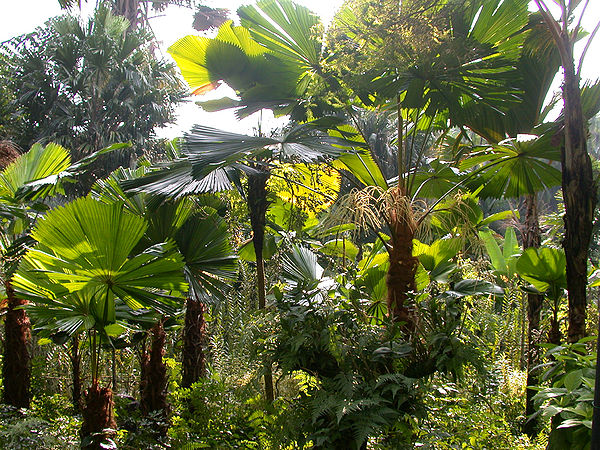
Singapore botanical gardens


Lyons arboretum, Oahu, Hawaii

Lundkvist estate, Hawaii

Hawaii

Lundkvist estate, Hawaii

Lundkvist estate

Leu botanical gardens, Orlando, Florida
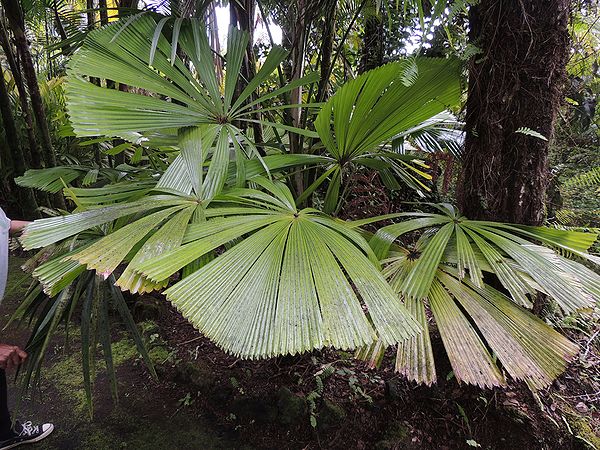
Lundkvist garden

conservatory palm, Golden Gate Park, San Francisco, California

Ho'Olamuhia botanical gardens, Oahu, Hawaii

Hawaii

Hawaii

Hawaii
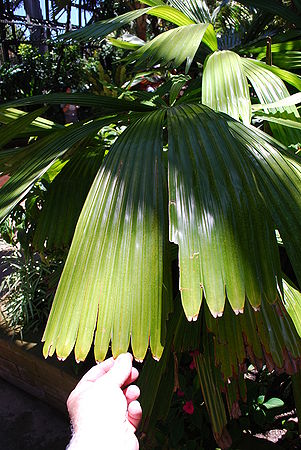

leaf of palm in San Diego county

petiolar teeth of California palm

Hawaii

flowers on conservatory palm, Huntington gardens


