Difference between revisions of "Cocos nucifera"
Geoff Stein - Author & Editor
| (3 intermediate revisions by one user not shown) | |||
| Line 3: | Line 3: | ||
'''Common Name''': Coconut Palm | '''Common Name''': Coconut Palm | ||
</center> | </center> | ||
| − | '''''Cocos nucifera''''' has not been included in publications on palms for California, but since some palms manage to survive BARELY it is being included here. 99% of efforts to grow these outdoors routinely meet with failure, even in the very best climates of California. But every now and then a perfect microclimate is discovered and one manages to grow. The famous coconut of Newport Beach is the prime (and really ONLY good example). But it is most certainly the exception to the rule, having grown several feet of clear trunk. However it seems off and on to skirt disaster and sometimes looks like it will die soon. Some have had success inland near the Salton Sea as well, but that success sadly was fairly short lived (maybe 3-4 years?). These palms will tolerate temperatures down to freezing briefly, but rely on subsequent heat to survive. Periods of chronic cool is what is so lethal to this palm in California. Many have grown coconuts to maturity in Florida where temps have dropped below 32F nearly yearly, but their winters are otherwise far warmer than our miserably cool California winters, which has been the key to their trees' survival. | + | '''''Cocos nucifera''''' has not been included in publications on palms for California, but since some palms manage to survive BARELY it is being included here. 99% of efforts to grow these outdoors routinely meet with failure, even in the very best climates of California. But every now and then a perfect microclimate is discovered and one manages to grow. The famous coconut of Newport Beach is the prime (and really ONLY good example). But it is most certainly the exception to the rule, having grown several feet of clear trunk. However it seems off and on to skirt disaster and sometimes looks like it will die soon. Some have had success inland near the Salton Sea as well, but that success sadly was fairly short lived (maybe 3-4 years?). These palms will tolerate temperatures down to freezing briefly, but rely on subsequent heat to survive. Periods of chronic cool is what is so lethal to this palm in California. Many have grown coconuts to maturity in Florida where temps have dropped below 32F nearly yearly, but their winters are otherwise far warmer than our miserably cool California winters, which has been the key to their trees' survival. Note that one trunking palm that survived many years in Newport Beach died 2015… survived about 20 years. But thankfully a 'replacement' palm was discovered soon after in the California desert with even more trunk and far more healthy looking. |
| − | + | <center> | |
{| colspan="2" style="background: #FCFCFC; border: 1px solid black; vertical-align: top;" | | {| colspan="2" style="background: #FCFCFC; border: 1px solid black; vertical-align: top;" | | ||
| style="width: 50%; background: #f8e8df; border: 1px solid black; vertical-align: top;" | | | style="width: 50%; background: #f8e8df; border: 1px solid black; vertical-align: top;" | | ||
| Line 37: | Line 37: | ||
*'''Availability''': common | *'''Availability''': common | ||
|} | |} | ||
| + | {{#Widget:AdResBan}} | ||
<gallery> | <gallery> | ||
File:Coconut grove.jpg| | File:Coconut grove.jpg| | ||
| Line 46: | Line 47: | ||
File:Cocos nucifera var spicata.JPG| | File:Cocos nucifera var spicata.JPG| | ||
File:Cocos nucifera Samoan.jpg| | File:Cocos nucifera Samoan.jpg| | ||
| − | File:Cocos Samoan Dwarf Coconut.JPG| | + | File:Cocos Samoan Dwarf Coconut.JPG|Lundkvist estate, Hawaii, Somoan Dwarf cultivar |
File:Coconut DT.jpg|Hawaii | File:Coconut DT.jpg|Hawaii | ||
File:Coconut indoor Gaylord.JPG|indoor in large greenhouse hotel, Orlando, Florida | File:Coconut indoor Gaylord.JPG|indoor in large greenhouse hotel, Orlando, Florida | ||
Latest revision as of 20:30, 31 July 2015
Common Name: Coconut Palm
Cocos nucifera has not been included in publications on palms for California, but since some palms manage to survive BARELY it is being included here. 99% of efforts to grow these outdoors routinely meet with failure, even in the very best climates of California. But every now and then a perfect microclimate is discovered and one manages to grow. The famous coconut of Newport Beach is the prime (and really ONLY good example). But it is most certainly the exception to the rule, having grown several feet of clear trunk. However it seems off and on to skirt disaster and sometimes looks like it will die soon. Some have had success inland near the Salton Sea as well, but that success sadly was fairly short lived (maybe 3-4 years?). These palms will tolerate temperatures down to freezing briefly, but rely on subsequent heat to survive. Periods of chronic cool is what is so lethal to this palm in California. Many have grown coconuts to maturity in Florida where temps have dropped below 32F nearly yearly, but their winters are otherwise far warmer than our miserably cool California winters, which has been the key to their trees' survival. Note that one trunking palm that survived many years in Newport Beach died 2015… survived about 20 years. But thankfully a 'replacement' palm was discovered soon after in the California desert with even more trunk and far more healthy looking.
|
Appearance and Biology
|
Horticultural Characteristics
|


Singapore

Hawaii

Hawaii

Hawaii
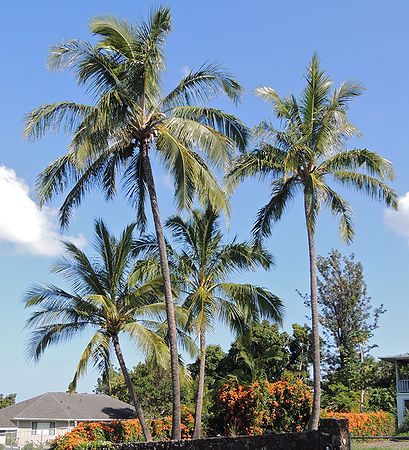
Hawaii


Lundkvist estate, Hawaii, Somoan Dwarf cultivar

Hawaii

indoor in large greenhouse hotel, Orlando, Florida


Singapore

indoor palms in greenhouse hotel, Orlando


matting on younger indoor palm

for sale in California

advertised as indoor foliage plants


