Difference between revisions of "Acanthophoenix crinita"
Geoff Stein - Author & Editor
| (12 intermediate revisions by 2 users not shown) | |||
| Line 1: | Line 1: | ||
| − | + | ||
{| colspan= "1" style="float:right; margin-left: 10px; background-color: #f3f3dd;" | {| colspan= "1" style="float:right; margin-left: 10px; background-color: #f3f3dd;" | ||
| '''Pronunciation:''' uh-can-tuh-FEE-nix kri-NEE-tuh | | '''Pronunciation:''' uh-can-tuh-FEE-nix kri-NEE-tuh | ||
| − | |||
| − | |||
| − | |||
| − | |||
| − | |||
|} | |} | ||
<br style: "clear=all"> | <br style: "clear=all"> | ||
| − | |||
| − | |||
| − | |||
| − | |||
| − | |||
| + | '''''Acanthophoenix crinita''''' is a thin-trunked, pinnate palm from Reunion Island, east of Madagascar. Though from a decidedly tropical climate, this palm has surprising cold tolerance and does surprisingly well in a Mediterranean climate, growing to maturity in several California locations. Though not as colorful as its cousin, Acanthophoenix rubra, it is far hardier and is a fascinating spiny palm for partially sunny areas of the warmer areas of southern California. | ||
<br style: "clear=all"> | <br style: "clear=all"> | ||
{| colspan="2" style="background: #FCFCFC; border: 1px solid black; vertical-align: top;" | | {| colspan="2" style="background: #FCFCFC; border: 1px solid black; vertical-align: top;" | | ||
| Line 23: | Line 14: | ||
<div style="background: #e5a178; border: 1px solid black; padding: 5px; margin: 3px; font-weight: bold; text-align: center; font-size: 120%;">Appearance and Biology</div> | <div style="background: #e5a178; border: 1px solid black; padding: 5px; margin: 3px; font-weight: bold; text-align: center; font-size: 120%;">Appearance and Biology</div> | ||
<div style="padding-left: 1em;"> | <div style="padding-left: 1em;"> | ||
| − | *'''Habit''': solitary | + | *'''Habit''': solitary with a crown of 6-10 feather leaves |
*'''Height''': 15-20 feet | *'''Height''': 15-20 feet | ||
*'''Trunk''': clean; light tan to white, prominently ringed with long black spines when younger, disappearing with age; 'foot' at base; 4"-6" thick | *'''Trunk''': clean; light tan to white, prominently ringed with long black spines when younger, disappearing with age; 'foot' at base; 4"-6" thick | ||
| Line 41: | Line 32: | ||
*'''Drought Tolerance''': poor | *'''Drought Tolerance''': poor | ||
*'''Dry Heat Tolerance''': moderate if protected from sun | *'''Dry Heat Tolerance''': moderate if protected from sun | ||
| + | *'''Cool Tolerance''': moderate | ||
*'''Wind Tolerance''': mod to poor | *'''Wind Tolerance''': mod to poor | ||
*'''Salt Tolerance''': unknown | *'''Salt Tolerance''': unknown | ||
| Line 50: | Line 42: | ||
*'''Indoor?''': very poor choice of indoor palm due to spines | *'''Indoor?''': very poor choice of indoor palm due to spines | ||
|} | |} | ||
| − | + | {{#Widget:AdResBan}} | |
| − | {{#Widget: | + | |
| − | + | ||
<gallery> | <gallery> | ||
File:Acanthophoenix 1 levine.JPG|Vista, California | File:Acanthophoenix 1 levine.JPG|Vista, California | ||
Latest revision as of 13:53, 9 February 2023
| Pronunciation: uh-can-tuh-FEE-nix kri-NEE-tuh |
Acanthophoenix crinita is a thin-trunked, pinnate palm from Reunion Island, east of Madagascar. Though from a decidedly tropical climate, this palm has surprising cold tolerance and does surprisingly well in a Mediterranean climate, growing to maturity in several California locations. Though not as colorful as its cousin, Acanthophoenix rubra, it is far hardier and is a fascinating spiny palm for partially sunny areas of the warmer areas of southern California.
|
Appearance and Biology
|
Horticultural Characteristics
|
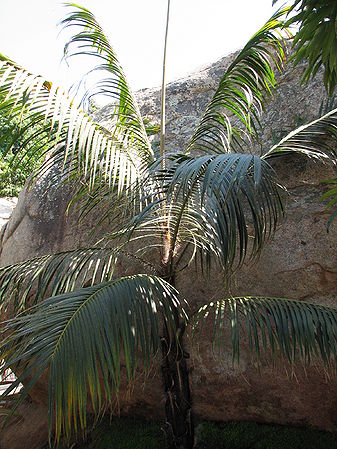
Vista, California

Huntington Beach, California
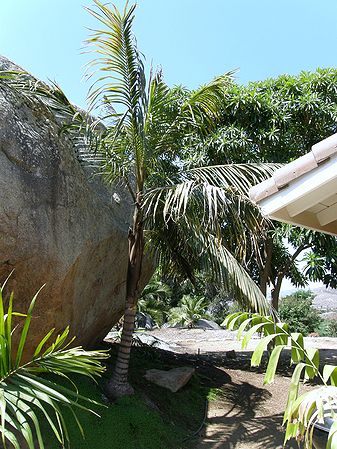
Vista, California
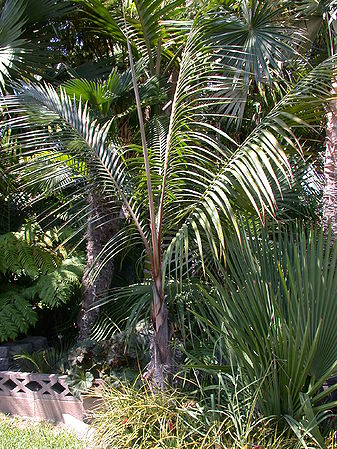
Orange County, California

ringed trunk
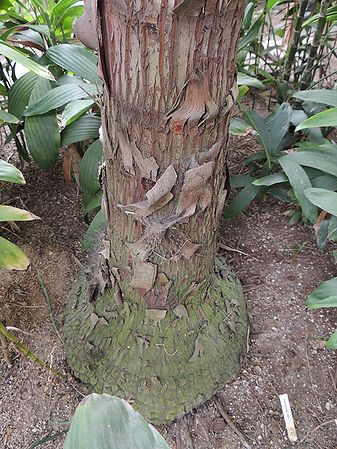
swollen base (foot)

spiny crownshaft

crownshaft shot of mature palm, Orange county, California

flower spathe

flower
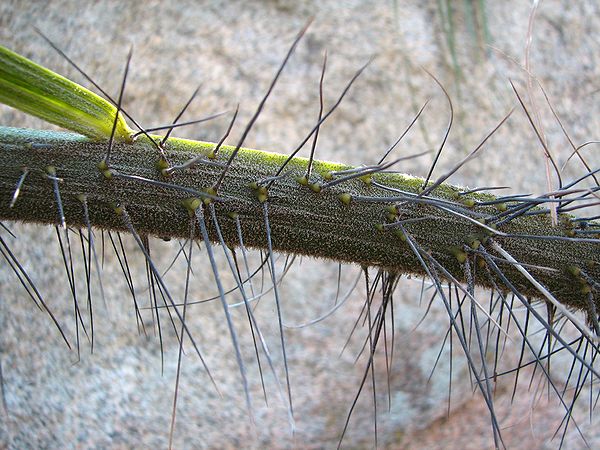
spiny petiole


