Difference between revisions of "Parajubaea torallyi"
Geoff Stein - Author & Editor
| Line 40: | Line 40: | ||
File:Parajubaea torallyii humongous K.jpg|Huntington Beach, California | File:Parajubaea torallyii humongous K.jpg|Huntington Beach, California | ||
File:Parajubaea torralyi microcarpa shot GL 14.jpg|Escondido palm, California, Levine garden, microcarpa form | File:Parajubaea torralyi microcarpa shot GL 14.jpg|Escondido palm, California, Levine garden, microcarpa form | ||
| + | File:Parajubaea microcarpa shot 2 GB.jpg|microcarpa form San Diego County, California | ||
| + | File:Parajubaea microcarpa crown GB.jpg|crown of microcarpa form | ||
File:Parajubaea torralyi wood 1.jpg|Fallbrook, California | File:Parajubaea torralyi wood 1.jpg|Fallbrook, California | ||
File:Parajubaea torralyi Ralph 11.JPG|Orange county, California | File:Parajubaea torralyi Ralph 11.JPG|Orange county, California | ||
Revision as of 16:07, 22 September 2016
Common Name:
Parajubaea torallyi is one of the very best but underused landscape palms for California, both northern and southern. It is an endangered species from Boliva. It was very rare in cultivation until the early 2000s when a lot of seed was shipped in from South America. Germination can be a bit unpredictable, but some have managed to grow them pretty well. Plants can be a bit difficult when young, but then begin to grow faster with age and become much hardier. Trunks tend to widen with age for the first 15 years of growth when finally their maximum diameter is attained. This is an immense palm and has the potential of being one of the most magnificent specimens of all the palms that can grow in California. Still no mature palms with clean trunk by 2014, but soon. There are many palms that are flowering and some even producing fruit already, though. The variety microcarpum has different sized seed, but not consistantly different as a mature palm.
|
Appearance and Biology
|
Horticultural Characteristics
|

Huntington Beach, California

Escondido palm, California, Levine garden, microcarpa form

microcarpa form San Diego County, California

crown of microcarpa form

Fallbrook, California

Orange county, California

Santa Barbara, California
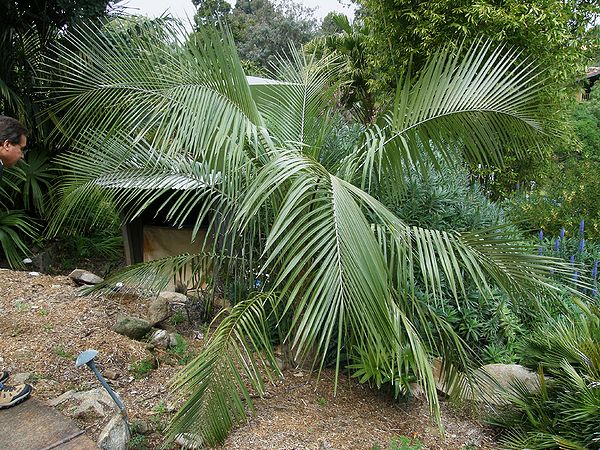
San Diego county, California

Ventura, California


San Fernando valley, California

San Fernando valley, California

Huntington Beach, California, several palms of different ages

San Fernando county, California
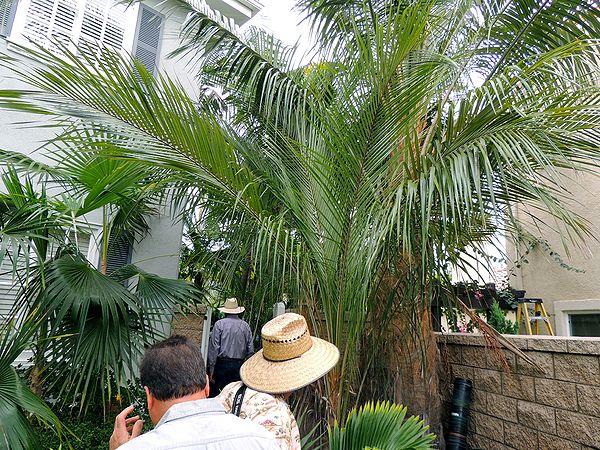
Huntington Beach, California

Ventura next to larger, Parajubaea cocoides (on its right)

petiole shot

leaf color

petioles again

leave bases

petioles

younger palm


trunk of maturing palm, Orange county, California

old flower spathe (a bit stunted)

seedling

young palm in San Fernando valley, California
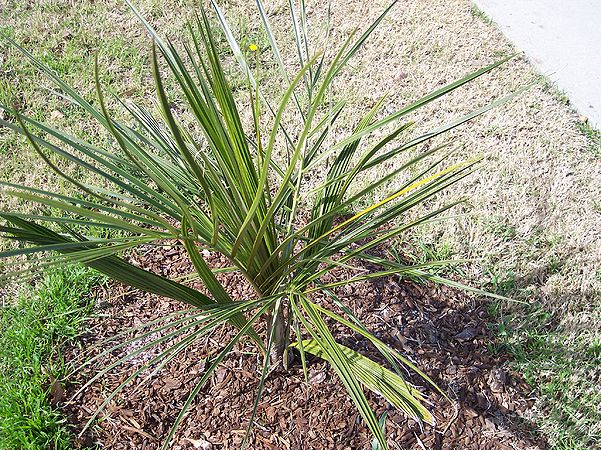
young


_and_cocoides_(right)comparison_ventura_c_blowing.jpg)


