Difference between revisions of "Washingtonia robusta"
Geoff Stein - Author & Editor
| (2 intermediate revisions by one user not shown) | |||
| Line 3: | Line 3: | ||
'''Common Name''': Mexican Fan Palm, Feather Duster Palm | '''Common Name''': Mexican Fan Palm, Feather Duster Palm | ||
</center> | </center> | ||
| − | '''''Washingtonia robusta''''' is probably the most commonly grown palm in the US and one of the most recognizable palms in the world. Many consider these 'trash palms' and they are indeed one of the most serious weeds in many urban and rural areas. However common and easy to grow, these are one of the fastest growing of all palms, and quickly can become majestic landscape specimens. Few palms are more impressive than those over 80 feet tall, planted along avenues evenly spaced and all leaning the same direction (towards the ocean and the afternoon sun). Heads or more compact, greener and trunks thinner than the native California Fan Palm, Washingtonia filifera, which this one is often confused with. Many hybrid palms of the two growing in public landscaping, and referred to as 'filabustas'. | + | '''''Washingtonia robusta''''' is probably the most commonly grown palm in the US and one of the most recognizable palms in the world. Many consider these 'trash palms' and they are indeed one of the most serious weeds in many urban and rural areas. However common and easy to grow, these are one of the fastest growing of all palms, and quickly can become majestic landscape specimens. Few palms are more impressive than those over 80 feet tall, planted along avenues evenly spaced and all leaning the same direction (towards the ocean and the afternoon sun). Heads or more compact, greener and trunks thinner than the native California Fan Palm, ''Washingtonia filifera'', which this one is often confused with. Many hybrid palms of the two growing in public landscaping, and referred to as 'filabustas'. |
| − | + | <center> | |
{| colspan="2" style="background: #FCFCFC; border: 1px solid black; vertical-align: top;" | | {| colspan="2" style="background: #FCFCFC; border: 1px solid black; vertical-align: top;" | | ||
| style="width: 50%; background: #f8e8df; border: 1px solid black; vertical-align: top;" | | | style="width: 50%; background: #f8e8df; border: 1px solid black; vertical-align: top;" | | ||
| Line 32: | Line 32: | ||
*'''Human Hazards''': falling leaves in winds dangerous to both pedestrians and cars; profuse seed production makes sidewalks slippery; petiolar teeth make pruning hazardous; dead petticoats are fire hazard and hiding place for vermin | *'''Human Hazards''': falling leaves in winds dangerous to both pedestrians and cars; profuse seed production makes sidewalks slippery; petiolar teeth make pruning hazardous; dead petticoats are fire hazard and hiding place for vermin | ||
*'''Disease or Horticultural Problems''': few | *'''Disease or Horticultural Problems''': few | ||
| − | *'''Indoor?''': performs moderately well if bright light available, but a dangerous indoor palm | + | *'''Indoor?''': performs moderately well if bright light available, but a dangerous indoor palm; used fairly frequently in large, indoor shopping malls |
|} | |} | ||
| + | {{#Widget:AdResBan}} | ||
<gallery> | <gallery> | ||
File:Washingtonia reflections larb.jpg|Los Angeles arboretum | File:Washingtonia reflections larb.jpg|Los Angeles arboretum | ||
Latest revision as of 22:29, 12 August 2015
Common Name: Mexican Fan Palm, Feather Duster Palm
Washingtonia robusta is probably the most commonly grown palm in the US and one of the most recognizable palms in the world. Many consider these 'trash palms' and they are indeed one of the most serious weeds in many urban and rural areas. However common and easy to grow, these are one of the fastest growing of all palms, and quickly can become majestic landscape specimens. Few palms are more impressive than those over 80 feet tall, planted along avenues evenly spaced and all leaning the same direction (towards the ocean and the afternoon sun). Heads or more compact, greener and trunks thinner than the native California Fan Palm, Washingtonia filifera, which this one is often confused with. Many hybrid palms of the two growing in public landscaping, and referred to as 'filabustas'.
|
Appearance and Biology
|
Horticultural Characteristics
|

Los Angeles arboretum

clean trunk and full petticoat looks

skirts to ground

crown and trunk

Los Angeles arboretum
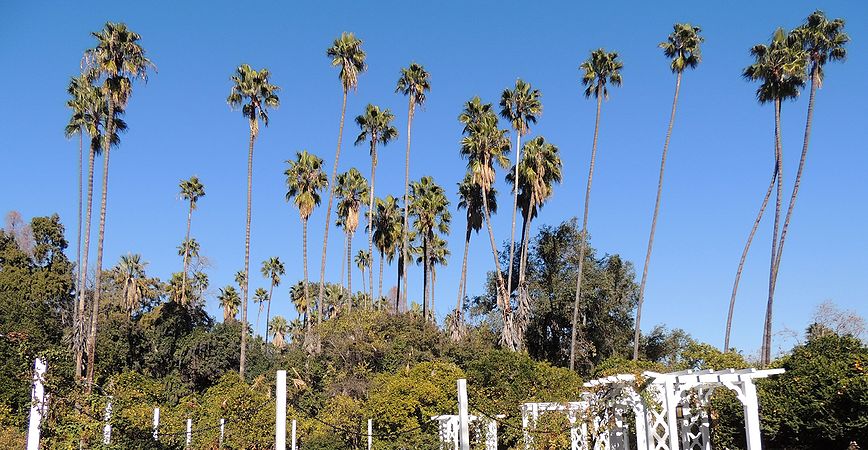
Los Angeles arboretum

street trees

tall trees leaning west

close up of thatched trunk trimming

400px]]

petticoat from below

naturalized in Ventura county

palm with and without a skirt

petticoated palms in Los Angeles arboretum

mature palms

pruned to tight thatch

around the mall
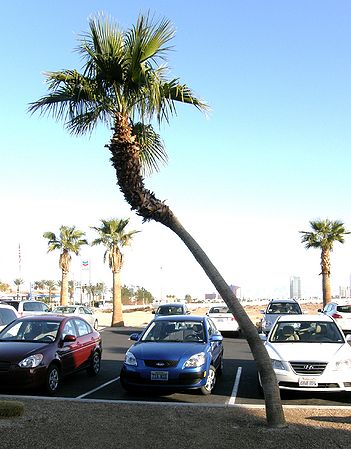
somewhat stunted in Las Vegas

petiolar teeth

leaf bases
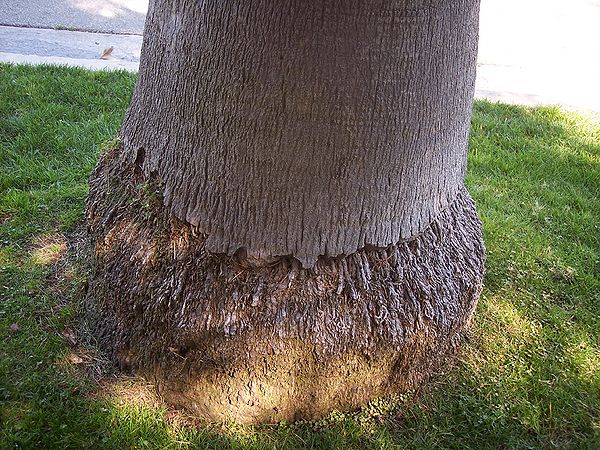
roots
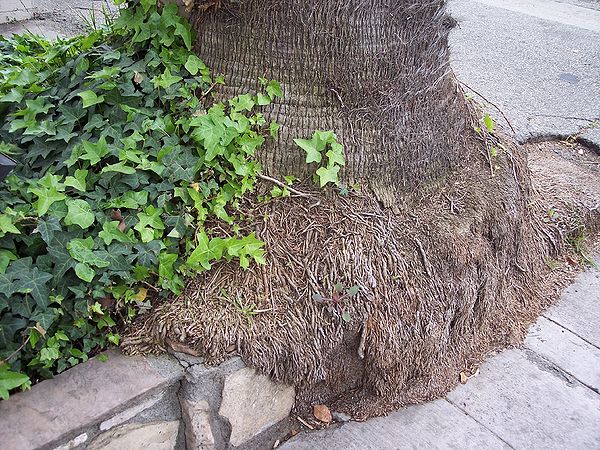
roots covering curb

'hacked'

overpruned

fried from frost in Antelope Valley

after winds, San Fernando Valley, California

typical post trimming trash


