Difference between revisions of "Brahea armata"
Geoff Stein - Author & Editor
| (27 intermediate revisions by 2 users not shown) | |||
| Line 1: | Line 1: | ||
| − | <center>'''Pronunciation''': | + | <center>'''Pronunciation''': bra-HEE-uh ar-MAH-tuh |
<br/> | <br/> | ||
| − | '''Common Name''': | + | '''Common Name''': Mexican Blue Fan Palm |
</center> | </center> | ||
| − | ''''' | + | '''''Brahea armata''''' is a relatively common Mexican native frequently grown in Southern California by both landscapers and private growers alike. This is one of the most drought tolerant, cold tolerant and wind tolerant species that can be grown in southern California, and it is easy to grow, as well as highly ornamental, which is why it so commonly used in both public and private landscaping. It is ideal for the deserts of California and does fairly well along the coast (salty winds have some negative effect upon its appearance). Growing this palm among greener palms and vegetation make it stand out even more. It is a variable plant with some forms being nearly green while the most sought after forms have almost white leaves. Also has very showy flowers that arch outward from middle of crown many feet sometimes down to the ground. Brahea clara, listed separately here, is thought by many scientists as being a different form of the same species. |
| − | + | <center> | |
{| colspan="2" style="background: #FCFCFC; border: 1px solid black; vertical-align: top;" | | {| colspan="2" style="background: #FCFCFC; border: 1px solid black; vertical-align: top;" | | ||
| style="width: 50%; background: #f8e8df; border: 1px solid black; vertical-align: top;" | | | style="width: 50%; background: #f8e8df; border: 1px solid black; vertical-align: top;" | | ||
| − | <div style="background: #e5a178; border: 1px solid black; padding: 5px; margin: 3px; font-weight: bold; text-align: center; font-size: 120%;"> | + | <div style="background: #e5a178; border: 1px solid black; padding: 5px; margin: 3px; font-weight: bold; text-align: center; font-size: 120%;">Morphology (Identification)</div> |
<div style="padding-left: 1em;"> | <div style="padding-left: 1em;"> | ||
| − | *''' | + | *'''Habit''': solitary with a crown of about 40 leaves |
| − | *''' | + | *'''Height''': 50 feet |
| − | *''' | + | *'''Trunk''': up to 3' in diameter, mostly clean but dead leaves are retained in younger palms, or near the top of the trunk of older ones. |
| − | *''' | + | *'''Leaf description''': palmate to mildly costapalmate; 6'-8' long; pale blue-green to sea green or sometimes whitish; stiff and waxy coated (leaflets rarely droop, or not much); leaves divided about 1/3 leaf length |
| − | *''' | + | *'''Spread''': 6'-10' |
| − | *''' | + | *'''Petiole''': armed with hooked, sharp yellowish teeth; dense layer of scurf; unsplit leaf base on trunk |
| − | *''' | + | *'''Reproduction''': monoecious |
| − | *''' | + | *'''Inflorescence''': extremely long and droopy, sometimes arching to the ground; yellow and highly branched |
| + | *'''Fruit''': 2cm; green initially, turning yellow and eventually maturing to black | ||
| + | *'''Seed''': 1-1.2cm and spherical | ||
| style="width: 50%; background: #f8e8df; border: 1px solid black; vertical-align: top;" | | | style="width: 50%; background: #f8e8df; border: 1px solid black; vertical-align: top;" | | ||
| − | <div style="background: #e5a178; border: 1px solid black; padding: 5px; margin: 3px; font-weight: bold; text-align: center; font-size: 120%;"> | + | <div style="background: #e5a178; border: 1px solid black; padding: 5px; margin: 3px; font-weight: bold; text-align: center; font-size: 120%;">Horticultural Characteristics</div> |
<div style="padding-left: 1em;"> | <div style="padding-left: 1em;"> | ||
| − | *''' | + | *'''Minimum Temperature''': 15F |
| − | *''' | + | *'''Speed of Growth''': very slow at first, but moderate once a trunk has formed |
| − | *''' | + | *'''Drought Tolerance''': very drought tolerant |
| − | *''' | + | *'''Wind Tolerance''': high |
| − | *''' | + | *'''Heat Tolerance''': high |
| − | *''' | + | *'''Salt Tolerance''': low |
| − | *''' | + | *'''Soil Preference''': very tolerant of a wide variety of soils, including heavy clay |
| + | *'''Light Requirement''': full sun | ||
| + | *'''Human Hazards''': sharp, hooked teeth on petioles | ||
| + | *'''Disease Problems''': few in California though prone to bud rot if it is exposed to tap water in cold weather | ||
| + | *'''Transplant?''': once trunk forms very touchy when transplanted and difficult (as are most Braheas) | ||
| + | *'''Availability''': fairly commonly available, even at larger outlet nurseries | ||
|} | |} | ||
| + | {{#Widget:AdResBan}} | ||
<gallery> | <gallery> | ||
| − | + | File:Brahea armatas (2).JPG|Mature palms in Los Angeles | |
| − | + | File:Brahea armatas at Topanga.jpg|Maturing palms in inland Los Angeles | |
| + | File:Brahea armata flowering Tarzana.jpg|flowering palms inland Los Angeles | ||
| + | File:Brahea armata flower skirt.JPG|old flower skirt | ||
| + | File:Brahea armata blooming Santa Monica.jpg|flowering palms along coastal California | ||
| + | File:Brahea armata blue against green LA arb.jpg|palm in Los Angeles Arboretum | ||
| + | File:Brahea armatas.JPG|immature palms | ||
| + | File:Brahea armata Topanga.JPG|San Fernando vallley, California | ||
| + | File:Brahea armata restaurant Simi 2.JPG|Ventura county, California | ||
| + | File:Brahea armata not pruned.JPG|unpruned palm | ||
| + | File:Brahea armata grey Balboa Park.JPG|Balboa Park, San Diego | ||
| + | File:Brahea armata color phases Topanga.JPG|two diff colored palms | ||
| + | File:Brahea armata Encino.jpg|San Fernando valley, California | ||
| + | File:Brahea armata beefy Ha.JPG|San Diego county | ||
| + | File:Brahea armata pale blue Ha.JPG|San Diego county | ||
| + | File:Brahea armata 2 LD.jpg|Palm Desert, California | ||
| + | File:Brahea armata and Washingtonia.JPG|Brahea armata and Washingtonia (in foreground) | ||
| + | File:Brahea armata AV front of yard.jpg|Palm Desert, California | ||
| + | File:Brahea armata from below.JPG|view from below | ||
| + | File:Brahea armata Osborne.jpg|young palms | ||
| + | File:Brahea armata in flower H.JPG|400px]] | ||
| + | File:Brahea armata silver flowering Tarzana.jpg|flowering palm in San Fernando Valley | ||
| + | File:Brahea armata short flowers H.jpg|short flowers | ||
| + | File:Brahea armata in flower H.JPG|palm in flower | ||
| + | File:Brahea armata early flowers.jpg|early flowers | ||
| + | File:Brahea armata blue flowering Tarzana.jpg|bluer palm in San Fernando valley flowering | ||
| + | File:Brahea armata 2 flwer and seed Topanga.jpg|palms in flower and seed | ||
| + | File:Brahea armata flower skirt.JPG|flower skirt | ||
| + | File:Brahea armata flowers close SD.jpg|inflorescence | ||
| + | File:Brahea armata fruits.JPG|unripe fruits | ||
| + | File:Brahea armata fruit up close.jpg|ripening fruits | ||
| + | File:Brahea armata trunk.JPG|trimmed trunk with retained leaf bases | ||
| + | File:Brahea armata trunk in shade.JPG|trunk with old retained leaf bases | ||
| + | File:Brahea armata trunk (2).JPG|naturally clean trunk | ||
| + | File:Brahea armata clean trunk Simi.JPG|recently cleaned trunk | ||
| + | File:Brahea armata petiole top.JPG|petiole | ||
| + | File:Brahea armata petiolar teeth.JPG|teeth | ||
| + | File:Brahea armata leaf M.JPG|leaf shot | ||
| + | File:Brahea armata costapalmate leaf.jpg|showing some costapalmate morphology | ||
| + | File:Brahea armata leaf bases mank.jpg|petioles | ||
</gallery> | </gallery> | ||
| + | [[Category: Brahea]] | ||
Latest revision as of 00:34, 31 July 2015
Common Name: Mexican Blue Fan Palm
Brahea armata is a relatively common Mexican native frequently grown in Southern California by both landscapers and private growers alike. This is one of the most drought tolerant, cold tolerant and wind tolerant species that can be grown in southern California, and it is easy to grow, as well as highly ornamental, which is why it so commonly used in both public and private landscaping. It is ideal for the deserts of California and does fairly well along the coast (salty winds have some negative effect upon its appearance). Growing this palm among greener palms and vegetation make it stand out even more. It is a variable plant with some forms being nearly green while the most sought after forms have almost white leaves. Also has very showy flowers that arch outward from middle of crown many feet sometimes down to the ground. Brahea clara, listed separately here, is thought by many scientists as being a different form of the same species.
|
Morphology (Identification)
|
Horticultural Characteristics
|

Mature palms in Los Angeles
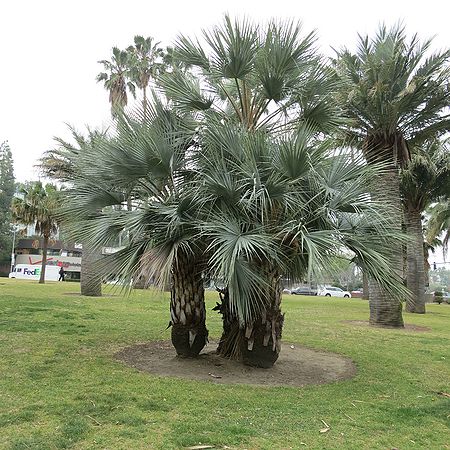
Maturing palms in inland Los Angeles

flowering palms inland Los Angeles

old flower skirt

flowering palms along coastal California

palm in Los Angeles Arboretum

immature palms

San Fernando vallley, California

Ventura county, California

unpruned palm

Balboa Park, San Diego

two diff colored palms

San Fernando valley, California

San Diego county

San Diego county
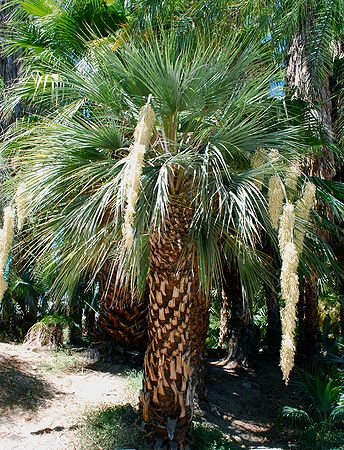
Palm Desert, California

Brahea armata and Washingtonia (in foreground)

Palm Desert, California

view from below
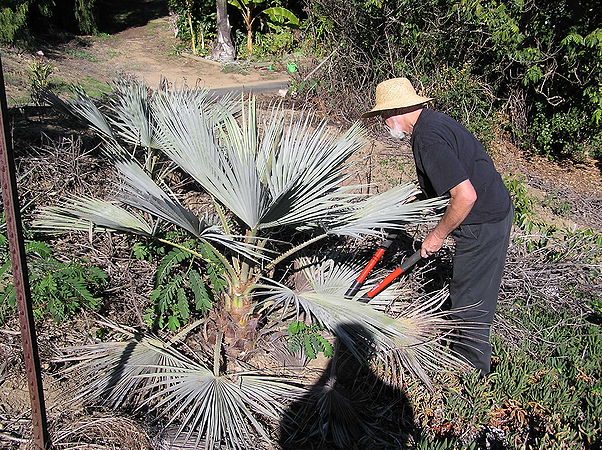
young palms

400px]]

flowering palm in San Fernando Valley

short flowers
palm in flower

early flowers

bluer palm in San Fernando valley flowering

palms in flower and seed
flower skirt

inflorescence

unripe fruits

ripening fruits

trimmed trunk with retained leaf bases

trunk with old retained leaf bases

naturally clean trunk

recently cleaned trunk

petiole

teeth

leaf shot
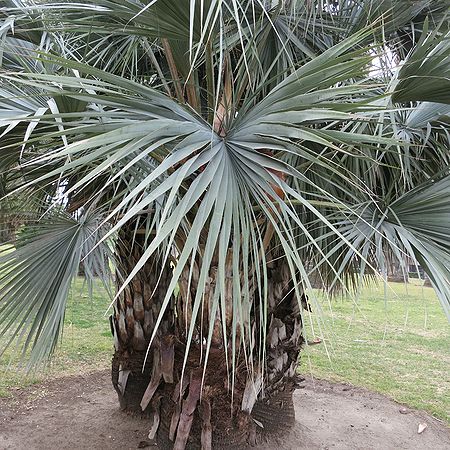
showing some costapalmate morphology
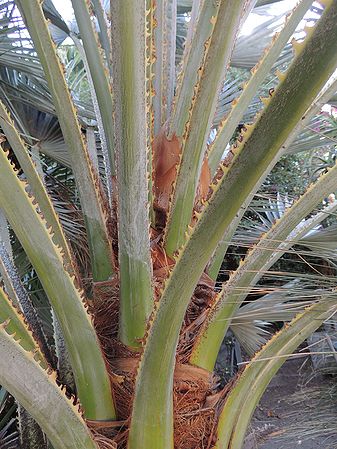
petioles
.JPG)


.JPG)


