Difference between revisions of "Washingtonia robusta"
Geoff Stein - Author & Editor
| Line 11: | Line 11: | ||
*'''Habit''': solitary | *'''Habit''': solitary | ||
*'''Height''': 100 feet | *'''Height''': 100 feet | ||
| − | *'''Trunk''': partial or complete retained dead leaf petticoat | + | *'''Trunk''': partial or complete retained dead leaf petticoat except in very old palms usually clean (in cultivation usually pruned clean or closely thatched); 16"-24" thick, grey (reddish when recently pruned); often leaning toward the west when very tall |
*'''Spread''': 6'-8' | *'''Spread''': 6'-8' | ||
*'''Leaf Shape''': palmate | *'''Leaf Shape''': palmate | ||
| Line 31: | Line 31: | ||
*'''Soil Preference''': extremely tolerant of a wide range of soil types | *'''Soil Preference''': extremely tolerant of a wide range of soil types | ||
*'''Light Requirement''': full sun, though can grow well in deep shade for years | *'''Light Requirement''': full sun, though can grow well in deep shade for years | ||
| − | *'''Human Hazards''': falling leaves in winds dangerous to both pedestrians and cars; profuse seed production makes sidewalks slippery; petiolar teeth make pruning hazardous | + | *'''Human Hazards''': falling leaves in winds dangerous to both pedestrians and cars; profuse seed production makes sidewalks slippery; petiolar teeth make pruning hazardous; dead petticoats are fire hazard and hiding place for vermin |
*'''Disease or Horticultural Problems''': few | *'''Disease or Horticultural Problems''': few | ||
*'''Indoor?''': performs moderately well if bright light available, but a dangerous indoor palm | *'''Indoor?''': performs moderately well if bright light available, but a dangerous indoor palm | ||
Revision as of 09:11, 22 July 2014
Common Name: Mexican Fan Palm, Feather Duster Palm
Washingtonia robusta is probably the most commonly grown palm in the US and one of the most recognizable palms in the world.
|
Appearance and Biology
|
Horticultural Characteristics
|

Los Angeles arboretum

clear and trimmed to thatch looks

skirts to ground

crown and trunk

Los Angeles arboretum
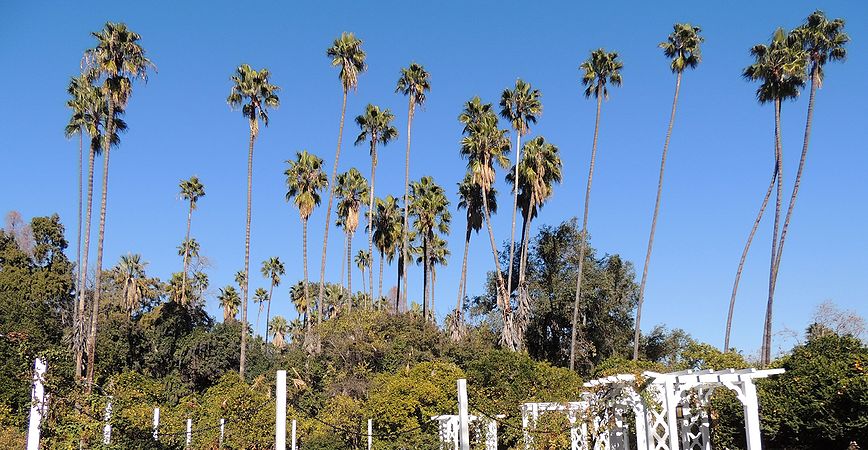
Los Angeles arboretum

street trees

tall trees leaning west

close up of thatched trunk trimming


