Dypsis madagascariensis
Geoff Stein - Author & Editor
Common Name: Malagasy Palm
Dypsis madagascariensis is one of the first Madagascan palms to be grown in California and there are some fairly mature palms in same areas of the state. However, it is a somewhat marginal palm and really struggles inland. This is a suckering or, more commonly, solitary palm with plumose leaves in a triangular array (like Dypsis decaryi), a strikingly ringed trunk and a nearly white crownshaft. But if not grown well, the leaves tend to look anemic and the whole look can be somewhat disappointing. Well grown palms are wonderful specimens, though.
Synonym: Dypsis lucubensis (single stem form); Chrysalidocarpus madagascariensis; Dypsis mahajanga
|
Appearance and Biology
|
Horticultural Characteristics
|
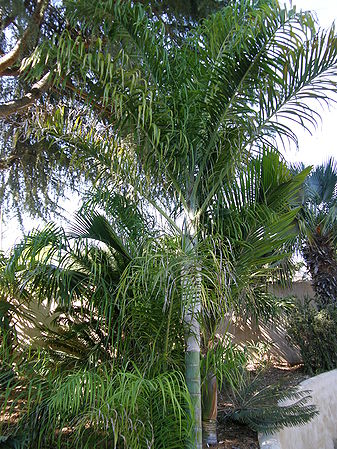
San Gabriel mountains, California

Orange county, California, nearly 30' tall

3 mature palms in San Diego county, under name Dypsis mahajanga

Huntington gardens, California near Pasadena, under name Dypsis mahajanga

younger palm, Vista, California

Hawaii

Hawaii


Hawaii about 40'

Nong Nooch Tropical gardens, Thailand

Thailand

Hawaii

Hawaii

Leu gardens, Orlando, Florida

Ho'omaluhia gardens, Oahu, Hawaii

Hawaii


