Arenga wightii
| Arenga (ah-REN-gah) wightii (white'-ee) | |||||||
|---|---|---|---|---|---|---|---|
 | |||||||
| Scientific Classification | |||||||
| |||||||
| Synonyms | |||||||
|
| |||||||
| Native Continent | |||||||
 | |||||||
| Morphology | |||||||
| |||||||
| Culture | |||||||
|
| |||||||
| Survivability index | |||||||
|
| |||||||
| Common names | |||||||
|
| |||||||
Contents
Habitat and distribution
Arenga wightiiis endemic to India.
Description
This is a monoecious palm. Trunk & Bark: Trunk clustering, color grey, densely clothed with the black fibrous remains of the newly opened frond. Leaves: Leaves compound, pinnate, 3.5-8 m long; leaflets to 30-100 cm x 2-2.5 cm, linear ensiform, apical one often confluent and obconic, apex narrowed, sometimes shortly, unequally 2-lobed, base asymmetricaly auricled, dark green above, glaucous beneath, margin entire or toothed in the upper half. Inflorescence / Flower: Male and female spadices separated, 1 m long. Fruit and Seed : Berry, hard, globose; 2-3 seeded.
Culture
Comments and Curiosities
Wight's Sago Palm is a threatened Indian palm species. Trunk is up to 6 m tall, grey, densely clothed with the black fibrous remains of the leaf sheaths. Leaves are compound, pinnate, 3.5-8 m long. Leaflets are up to 30-100 cm x 2-2.5 cm, linear ensiform, apical one often confluent and obconic, apex narrowed, sometimes shortly, unequally 2-lobed, base asymmetricaly auricled, dark green above, glaucous beneath, margin entire or toothed in the upper half. Male and female spadices separated, 1 m long. Berry is hard, spherical, 2-3 seeded. This palm is exploited for making brooms, palm wine and even a unique source of starch. Wight's Sago Palm is endemic to the Western Ghats - South and Central Sahyadris. (www.flowersofindia.net)
The IUCN Red List of Threatened Species 1998 - Vulnerable.
- IMAGE GALLERY

Royal Botanic Gardens, Kew, Surrey, UK. Photo by Dr. William J. Baker, Royal Botanic Gardens, Kew/Palmweb.

Nong Nooch Tropical Gardens, Thailand.

Nong Nooch Tropical Gardens, Thailand.


India. Photo by Clayton York, Utopia Palms & Cycads

Kannur, India.

India.

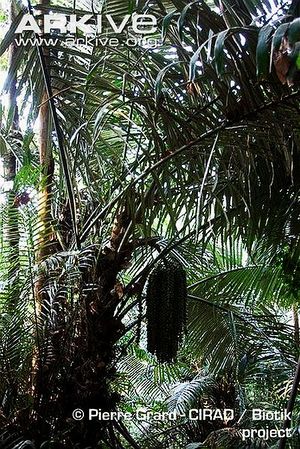


South Goa, India.

South Goa, India.

South Goa, India.

Kerala, India.


Muir of Ord, Highland, UK.

Muir of Ord, Highland, UK.


Sri Lanka. Photo by Ahamed.


External Links
- Glossary of Palm Terms
- MODERN BOTANICAL LATIN
- "Just To Be Clear"
- http://nopr.niscair.res.in/bitstream/123456789/906/1/IJTK%206(1)%20(2007)%20195-198.pdf
References
Phonetic spelling of Latin names by edric.
Special thanks to Geoff Stein, (Palmbob) for his hundreds of photos.
Special thanks to Palmweb.org, Dr. John Dransfield, Dr. Bill Baker & team, for their volumes of information and photos.
Glossary of Palm Terms; Based on the glossary in Dransfield, J., N.W. Uhl, C.B. Asmussen-Lange, W.J. Baker, M.M. Harley & C.E. Lewis. 2008. Genera Palmarum - Evolution and Classification of the Palms. Royal Botanic Gardens, Kew. All images copyright of the artists and photographers (see images for credits).
Many Special Thanks to Ed Vaile for his long hours of tireless editing and numerous contributions.